
Ask the internet what a homestay earns and you will meet two very different numbers. The first lives in the “start a homestay” articles: lakhs a month, passive income, your hills cottage paying for itself while you sleep. The second lives in the tracked data: on one short-term rental analytics platform, the average listing in Manali earned about 2,700 US dollars in the last year, roughly Rs 2.3 lakh, at 23% occupancy. That is around Rs 19,000 a month, before a single cost is paid.
Both numbers are real. The gap between them is this post. Because the honest answer to “what does a homestay earn?” is not a figure, it is a spread: the same three rooms in the same town can produce pocket money for one owner and a solid living for another. What separates them is almost never location or luck. It is a handful of decisions this series has been mapping for months, which is why this post reads like the arithmetic the whole series was building toward.
What this post covers
Homestay income: the short answer
The short version. A passive homestay, listed once and left to the apps, typically earns Rs 2 to 4 lakh a year in gross room revenue in a decent leisure destination, which is what the tracked averages show. A well-run three to four room homestay in the same destination, with a present host, home food, rate discipline and a growing base of direct and repeat guests, commonly grosses Rs 10 to 20 lakh a year. After real running costs, that is roughly Rs 5 to 12 lakh of owner income, plus the rent-free use of their own house.
One boundary before going further: the six-plus room property with the owner living elsewhere and a manager at the desk is not a homestay at all, whatever its listing says. A homestay is defined by the host family living there, at the same table, under the same roof. Once the owner moves out, the property becomes a guesthouse or a small hotel and it earns as one. Most state homestay schemes draw the same line in rules: registration is typically capped at around six rooms, so the bigger property is outside the category formally, not just in spirit.
Two honest tiers, one town, one word. The rest of this post is the arithmetic behind each tier and, more usefully, what moves a property from one tier to the next.
The arithmetic that decides everything
Homestay income has only three levers and every earnings claim you will ever read is some arrangement of them: rooms, rate and nights sold.
Run the honest central case. A three-room homestay in a leisure destination, Rs 3,000 average nightly rate across the year’s mix of weekend, festive and off-season pricing. Three rooms give 1,095 available room-nights a year. Sell 40% of them, which the occupancy post showed is a genuinely good year for a weekend-driven property at full rate. That leaves 438 room-nights sold and roughly Rs 13 lakh of gross room revenue.
Now flex the levers one at a time. Drop the rate to Rs 2,000 because the property never invested in what justifies more: gross falls to Rs 8.8 lakh. Let occupancy slide to the tracked average of 23% because the listing runs passive: Rs 7.5 lakh at the full rate, Rs 5 lakh at the discounted one. Add a fourth room: every number above grows by a third. None of this is mysterious. But notice which lever moved the number most brutally: the combination of a weak rate and a passive listing cuts the same house’s income by more than half. Owners spend years wishing for a better location when the arithmetic says the location was never the problem.
What the tracked averages actually say
The dreamy articles quote no source, so quote a real one. AirROI, a platform that tracks short-term rental listings on the global home-sharing sites, publishes market data for Indian destinations and its recent figures are the most honest public window into homestay income available. They deserve a slow read.
In Manali, the average listing earned about 2,743 dollars in the year, roughly Rs 2.3 lakh, at 22.9% occupancy and an average nightly rate near Rs 5,500. In Munnar, about 3,581 dollars, roughly Rs 3 lakh, at 22.8% occupancy, with the average listing taking just eleven bookings in the whole year at an average stay of under three nights. Even in Delhi, with year-round city demand, the average listing cleared only about 2,244 dollars at 26% occupancy.
Read those numbers again: the average listed property in two of India’s most famous leisure destinations sells fewer than one night in four and earns under Rs 25,000 a month gross. Meanwhile Manali’s listing count more than doubled in a single year. More properties are joining the apps each season while the average listing sits three-quarters empty. That is the real market the “passive income” articles are selling you into.
Why the average is so low
The tracked average is not a verdict on homestays. It is a verdict on passivity and it has three honest causes.
First, the average includes the abandoned. Every half-hearted listing, the flat listed in a burst of enthusiasm and never photographed properly, the cottage whose owner replies to enquiries two days late, sits in the same average as the thriving property. Listing sites make starting so easy that the average is dragged down by properties that were never really run at all.
Second, the calendar concentrates. The occupancy post showed why a leisure property’s year lives in roughly 130 to 150 high-intent nights: weekends, long weekends and the festive windows. A passive listing captures only the overflow of those peaks, when everything else is full. It has no regulars committing early, no direct channel, no reason to be chosen first. Peak overflow plus empty weekdays is exactly how you arrive at 23%.
One data honesty note before the third cause: those averages mix everything, single spare rooms beside whole four-bedroom villas, which is partly why the rate looks high while the revenue looks low. The average is not describing any one property; it is describing what happens when a market fills with listings nobody actively runs. Treat it as a floor to climb from, not a forecast.
Third, the platform’s spotlight is rented, not owned. The OTA economics post covered this in full: visibility on the apps follows commission, ranking games and discounts. A small homestay that competes only there is competing on the one field where it is weakest, against inventory that doubled last year. The properties that beat the average are the ones with demand the apps cannot see, which the WhatsApp post showed is where small-property India actually books.
What it costs to run
Gross is the number articles quote because it is the flattering one. Owners live on net, so walk the costs for the honest central case, the three-room property grossing around Rs 13 lakh.
Help is the largest line. A cook-housekeeper, or a local couple sharing caretaking, cleaning and kitchen work, runs Rs 15,000 to 25,000 a month in most leisure destinations, more where labour is scarce. Call it Rs 2.5 lakh a year. The staffing post made the case that this person is not a cost to minimise but the product itself; here, just count them honestly.
Food comes next for a homestay serving meals, which most should, because food is half the reason guests choose a homestay over a hotel, as the homestay vs hotel post argued. Groceries and gas for breakfasts and dinners across 438 sold room-nights land somewhere near Rs 1.5 to 2 lakh, partly recovered if meals are charged separately. Charged properly, at Rs 250 to 400 a plate for dinner, the kitchen usually returns a modest profit on top of its real job, which is earning the review and the return visit.
Then the steady drip: electricity and heating (hill winters are expensive), water, laundry, linen replacement, repainting after every monsoon, the plumber, the leaking geyser, wifi, insurance. Budget Rs 1.5 to 2 lakh a year and be pleasantly surprised. Commission on whatever share of bookings still comes through the apps takes its usual fifth of that share. State registration fees and local taxes vary widely; they are real but rarely the number that decides anything.
Total it: roughly Rs 5.5 to 7 lakh of running costs against Rs 13 lakh of gross. The well-run three-room homestay nets its owner Rs 6 to 7.5 lakh a year. A good living in most of homestay India, a poor one in a metro, a catastrophe if a bank loan was taken on the strength of the magazine numbers.
The two shapes of homestay income
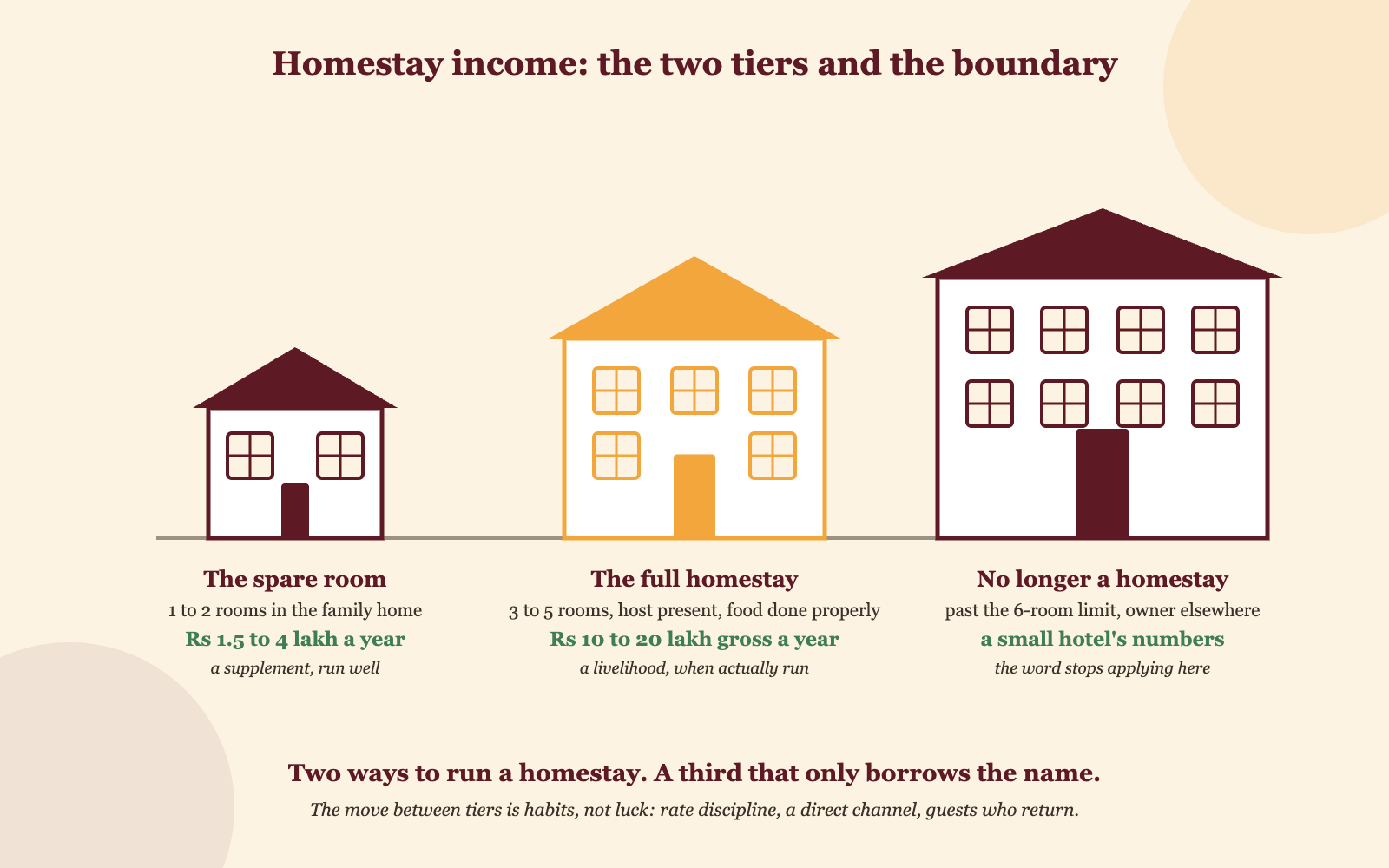
Averages hide the fact that “homestay” covers two different businesses, plus one property that only borrows the name.
The spare-room homestay, one or two rooms in the family’s own house, is a supplement, not a livelihood. Run well it adds Rs 1.5 to 4 lakh a year with almost no extra fixed cost, because the house, the kitchen and the family’s own dinner were happening anyway. Its economics are the best in the trade per rupee invested. Its ceiling is simply the room count. For a retired couple, a farming family or anyone whose house sits somewhere worth visiting, this is the version the government schemes were designed for and the version least likely to disappoint.
The purpose-built three to five room homestay is the full business this post’s central case describes, Rs 10 to 20 lakh gross in a good destination when actually run. It demands what a business demands: someone present every day, food done properly, a guest list kept, rates defended. It returns what a business returns.
The manager-run property, six rooms and up with the owner elsewhere, is the borrower of the name: not a homestay at all, because the one thing the guest is actually buying, the family at the table, is missing. Most states agree in writing, since homestay registration schemes typically cap a property at around six rooms. It runs a guesthouse’s reality, a manager’s salary, higher staffing, professionalised everything, so it needs the occupancy and staffing arithmetic of a small hotel and it competes as one. Plenty succeed. But nobody should price one using homestay articles, including this one.
The loan trap
One reader deserves a section of their own: the family about to borrow money to build.
The construction articles make the same promise as the income articles and the two promises multiply. Building three or four guest rooms properly, with the bathrooms, furnishing and finishing that justify a defensible rate, commonly runs Rs 8 to 12 lakh a room by the time the last snag is fixed. Call it Rs 35 to 45 lakh for a four-room wing. Service that from the honest central case, a net of Rs 6 to 9 lakh a year on four rooms. The arithmetic works: the wing pays for itself in five to seven patient years while the family lives in an asset that is appreciating anyway.
Now service the same loan from the passive tier, Rs 2 to 3 lakh gross before costs. The arithmetic does not work at all. The EMI arrives monthly; the income arrives in festive bursts; the gap arrives on the owner’s credit card. Most homestay distress stories in the trade follow exactly this shape, borrowed money sized to the magazine numbers, earning at the tracked average.
The honest rule: borrow against the tier you have proven you can run, not the tier the article promised. Better still, start with the rooms the house already has, learn the trade for two seasons and let the first wing be paid for partly by the guests who already came.
The festive concentration
Whichever shape you run, the income does not arrive evenly and budgeting as if it does is how owners get into trouble.
The festive pricing post mapped the calendar in detail: for a leisure homestay, something like half the year’s revenue commonly arrives in the hundred-odd nights around the festive stretches, the year-end window and the long weekends. The monsoon months can earn close to nothing. The tracked data agrees, showing peak-month revenue at two to three times the low months in the hill markets.
The practical discipline is a two-account mind, even if the bank account is one. The festive earnings are the year’s salary; the off-season trickle is the bonus. Owners who park the season’s surplus against the monsoon’s fixed costs, the salaries and the EMIs that arrive whether guests do or not, get through February without panic. Panic in February becomes discounting in March, which becomes a cheaper property by next season, the exact spiral the festive pricing post warned against.
This concentration is why the levers from earlier in this post compound so hard. Getting the festive fortnights right at the right rate, as that post argued, is not a seasonal nicety; it is the year’s income showing up on time. Missing them, or selling them early and cheap to the apps, cannot be fixed in February. The owners who treat those hundred nights as the actual business, with the other two hundred as bonus, budget calmly. The ones who divide last year’s income by twelve and spend accordingly meet their bank manager in August.
What moves the number
Everything above describes the machine. Here is what actually moves it, in the order of leverage this series keeps finding.
Rate discipline beats occupancy chasing. The strongest earning lever is refusing to buy occupancy with discounts. The arithmetic section showed why: the weak-rate passive property earns less than half the disciplined one. Hold the published rate, let the calendar do the discounting through honest off-season tiers and sell the peaks at what they are worth.
The direct share decides the margin. Every booking moved from the apps to WhatsApp or the property’s own website keeps the commission fifth at home. A property doing Rs 13 lakh gross with a 70% direct share simply banks more than its identical neighbour at 30% direct, year after year, from the same rooms.
Repeat guests are the compounding engine. The repeat guest post made the full case: returning families book the hardest dates early, at full rate, commission-free. Every year’s festive season converts a few first-timers into next year’s pre-sold nights. Five years of that habit is the difference between the tiers in this post.
Food earns twice. Meals add revenue directly, Rs 250 to 400 a plate across every guest-night. They also justify the rate, drive the reviews and create the memory that brings the family back. The kitchen is the highest-return investment most homestays can make.
Reviews and recognition fill the top of the funnel. The Google reviews post and the AI recommendations post covered how strangers now find and trust a small property. That machinery runs on the same fuel: stays worth writing about, captured while the warmth is fresh.
The parts nobody prices
An honest earnings post has to name the costs that never appear in any spreadsheet.
The owner’s own labour is the biggest. The central case above nets Rs 6 to 7.5 lakh only because the owner, or the owner’s family, is doing work a hotel would salary: front desk, guest relations, procurement, marketing, crisis plumbing at 11 pm. Price that labour at what it would cost to hire and the “profit” shrinks by several lakh. Most owners happily accept this trade because the alternative was not a salary elsewhere; it was the house earning nothing. But anyone comparing homestay income to a job should compare it to a job honestly.
Privacy is the second. A homestay sells the family’s own home and table. Some families flourish on it; the hosting is the point, the guests become the social life. Others discover by February that they have sold something they wanted back. This cost is real, unbudgetable and the most common reason good homestays quietly close.
The third is the season’s grip on family life. The property earns hardest exactly when the family might want its own Diwali, its own Christmas, its own long weekends. The trade’s oldest joke is that hosts holiday in the monsoon. It is not entirely a joke.
The honest limits
A few boundaries, so this post does not become the dreamy article it set out to correct.
Location sets the ceiling, even if it rarely explains the floor. A well-run homestay beats a passive one anywhere, but a well-run homestay two hours beyond the last attraction still fights gravity. The realistic bands in this post assume a destination people already visit, within the weekend radius of some city, as the Instagram post mapped. Remote beauty with no demand is a different, harder business.
Supply is rising fast. Manali’s listings doubling in a year is not unique; every attractive district is adding rooms. The average will likely fall further. That strengthens rather than weakens this post’s argument, because averages falling is what happens when passive supply floods in, but it does mean the passive tier will earn even less tomorrow than it does today.
Regulation is real but manageable. Most states now run homestay registration schemes with modest fees and the framework is broadly supportive; NITI Aayog’s recent report on homestays, Rethinking Homestays, pushes for even simpler, single-window registration. Rules differ by state and change often, so check your own state’s current scheme before building anything.
And no single year proves much. A wedding in the family, a landslide season, a viral review: individual years swing hard in a business this small. The tiers in this post are steady-state numbers, what a property converges to over three or four honest years.
Count your own number
A post full of other people’s figures should end with a way to find yours, because the only homestay income that matters is your own property’s, tracked honestly.
Three numbers, once a year, after the festive season closes. Gross per room: the year’s total room revenue divided by rooms, which lets a two-room and a five-room property compare themselves fairly against the bands in this post. Direct share: what fraction of bookings arrived without commission, the margin lever. Return share: what fraction of guests had stayed before, the repeat guest post’s compounding lever and the best predictor of next year.
An hour with the bookings diary produces all three. Watch them across seasons and the property’s true tier stops being a matter of opinion: gross per room rising with a growing direct share means the climb is working, while a flat gross with a falling return share is next year’s warning arriving early, whatever this year’s occupancy looked like. Owners who know these three numbers argue with nobody’s averages, including this post’s.
Where software fits honestly
The earning levers above are decisions and habits, not features. Where booking software genuinely helps a homestay’s income, ours included, is in stopping the leaks that habit alone cannot: one calendar so the direct channel and the apps never double-book, published rates and festive tiers applied automatically instead of renegotiated in every chat, the advance-to-confirm discipline from the advance payment post enforced without awkwardness, the guest list and stay history kept without effort, the post-checkout thank-you and review request going out on time while the warmth is fresh.
None of that creates demand by itself. It converts the demand a well-run homestay already earns into money that actually arrives, at rates that actually hold. The warmth, the food and the remembering stay yours.
The one-line summary
If this post must fit in one line: homestay income in India runs from roughly Rs 2 lakh a year for a passive listing to Rs 10 to 20 lakh gross for a well-run three to four room property in a real destination. The difference is not location but the handful of habits this series keeps returning to, rate discipline, a direct channel, home food and guests who come back.
The house is already standing. The season is already coming. The only question the arithmetic leaves open is which tier you choose to run in.
Straight questions, straight answers
How much can you earn from a homestay in India?
Honestly: from pocket money to a solid living. Tracked data across Indian leisure destinations shows the average listed property earning only Rs 2 to 3 lakh a year gross at around 23% occupancy. A well-run three to four room homestay in a genuine destination commonly grosses Rs 10 to 20 lakh a year, netting roughly Rs 5 to 12 lakh after real running costs. The spread comes from rate discipline, direct bookings, food and repeat guests far more than from location.
Is a homestay business profitable in India?
It can be, with the right expectations. A spare-room homestay in the family’s own house is almost always profitable because the fixed costs already existed; it just will not replace a salary. A purpose-built homestay run as a real business, with a present host and a defended rate card, typically nets its owner several lakh a year plus rent-free living. A passive listing left to the apps is usually not meaningfully profitable, especially as listing supply in popular destinations is growing every year.
How much should a homestay charge per night in India?
Most Indian homestays price between Rs 1,500 and Rs 6,000 a night depending on destination, room quality and food. The honest method is not copying neighbours but pricing the full experience: a room with home-cooked meals, a host and character justifies more than a bare room. Set a published rate you can defend year-round, add festive tiers for peak windows and resist discounting to buy occupancy, because a low rate with high occupancy usually earns less than a fair rate with moderate occupancy.
How many rooms does a homestay need to earn well?
One or two rooms make a supplement, roughly Rs 1.5 to 4 lakh a year run well. Three to five rooms make a livelihood, commonly Rs 10 to 20 lakh gross in a good destination, because the same host, kitchen and effort spread across more saleable nights. Beyond six rooms, once the owner no longer lives on the property and a manager runs the desk, it is no longer a homestay at all; it is a small hotel using the word and in most states it falls outside homestay registration anyway, since the schemes typically cap a homestay at around six rooms. The best count is the largest number the family can host personally, since the personal hosting is what the guest is paying extra for.
What are the running costs of a homestay?
For a three to four room homestay the big lines are help (a cook-housekeeper or caretaker couple, Rs 15,000 to 25,000 a month), food for guest meals, utilities including hill-winter heating, laundry and linen, monsoon maintenance and repainting, plus commission on whatever share of bookings comes through booking platforms. Together these commonly consume 40 to 50% of gross revenue. The largest unbilled cost is the owner’s own labour, which honest owners at least acknowledge even if they never invoice it.
Do homestays earn more from direct bookings?
Meaningfully more, on identical occupancy. A booking through the big platforms surrenders roughly a fifth of the tariff in commission; the same stay booked on WhatsApp or the property’s own website keeps the full rate. Since a homestay’s best guests, returning families and referred friends, naturally book direct, income grows twice over as the direct share rises: the commission stays home and the guests who book that way accept published rates without negotiation.
Image credits: The mountain house photo is by Saksham Kanwar on Unsplash and the thali photo is by Zoshua Colah on Unsplash, both free to use under the Unsplash License. The three-tiers illustration is original OpenStays artwork.
OpenStays provides booking software for homestays, hotels and resorts, but this blog is not about software. It is about running a property well, written for owners, with owners.
What did your homestay actually earn last year and what would you tell someone about to start one? Tell us in the comments below. The best stories will find their way into future posts, with your permission and full credit.



Leave a Reply