

It is 9:43 on a Tuesday night. Somewhere a phone lights up: “Hi, room available this weekend? 2 adults 1 kid.” Within the hour there will be photos sent, a rate quoted, a small negotiation, a UPI advance received with a thumbs-up emoji and a booking made that no dashboard anywhere will ever count. Multiply that chat by every homestay, guesthouse and small hotel in the country and you are looking at what may be India’s largest direct booking channel, running entirely inside a messaging app.
This post takes that channel seriously, because almost nobody does. Owners treat WhatsApp bookings as an informal habit rather than a channel with economics of its own. The trade press treats them as a footnote to the booking apps. Yet ask any small property where its direct bookings actually close and the answer is the same green icon. Something this large deserves what every other channel gets: an honest look at why it wins, what its informality quietly costs and what running it well actually looks like.
What this post covers
WhatsApp bookings: the channel nobody counts
The short version: for most small Indian properties, WhatsApp bookings are the biggest direct channel there is, bigger than the website form, bigger than walk-ins, often rivalling the booking apps themselves. The channel is invisible for a simple reason: it produces no reports. The apps send monthly statements; the website has analytics; WhatsApp has scroll. So the channel that fills the calendar gets the least deliberate attention of any, which is exactly backwards.
The undercounting has soft reasons too. App bookings arrive with statements and dashboards that feel like business; chat bookings feel like favours to friends, however many lakhs they quietly total. Owners proudly quote their app ranking at association meetings; nobody quotes their WhatsApp conversion rate, though it is usually higher. The channel suffers, in short, from looking too much like ordinary life.
Being uncounted also means being undervalued. An owner who knows the apps brought forty bookings last quarter rarely knows WhatsApp brought sixty, because nobody added them up. The first useful act with this channel costs one evening with a notebook: count last month’s confirmed bookings by where they actually closed. Most owners who do this discover their “informal” channel is their main one. Everything else in this post follows from taking that discovery seriously.
Why India books stays on WhatsApp
The channel did not win by accident. It won because it fits how India already transacts.
Start with scale: India is WhatsApp’s largest market on earth, the one country where the app is effectively the phone’s second dial tone. A channel every guest already lives inside starts with an advantage no app install can match.
Trust comes first. A traveller wary of an unknown property does not want a form; she wants a human who answers. A reply in ten minutes, a voice note from the owner, current photos of the room taken on request: each message is evidence that somebody real stands behind the listing. The conversation IS the trust-building, the same work a review page does, performed live.
Language comes second. The guest writes in whatever mix of English, Hindi or her own language she thinks in. The owner replies in kind. No interface, no dropdowns, no translation of oneself into form fields. For two people doing a deal, chat is the most natural software ever shipped.
Negotiation comes third, honestly. Indians negotiate stays, especially longer ones, especially families. A booking platform cannot haggle; a chat can. We argued in the festive pricing post that the rate itself should not bend, but the conversation around it, an early check-in, a cot for the child, dinner included for the group, is exactly where a warm yes wins a booking that a rigid interface loses.
And money already lives on the same phone. The UPI transfer that confirms the booking happens in the same two minutes as the decision, no gateway, no card details, no drop-off. Discovery may begin on Google, Instagram or, increasingly, an AI recommendation; in small-property India the deal itself closes in the chat.
What a WhatsApp booking actually is
Watch the anatomy of one booking and the channel’s whole character becomes visible.
The guest found the property somewhere else, the map listing, a reel, a friend, a mention. The first message is short and arrives at an inconvenient hour. The owner replies with availability, two photos and a rate. There is a question about food, a request for a slightly better price, perhaps a call. Then the decisive moment: the owner asks for an advance to confirm, sends a UPI ID, the payment arrives and a final message seals it: “Confirmed. 22 to 24 Nov, 2 rooms, breakfast included. See you!”
Notice what just happened. The chat performed discovery follow-up, sales, negotiation, payment collection and contract, five departments of a hotel, inside one thread. Notice also what did NOT happen: nothing was written anywhere else. The calendar, the rate discipline, the terms of cancellation, the record itself, all of it now lives in one scrollable conversation on one person’s phone. That is the channel’s power and its fragility in a single frame.
Voice notes, photos and the grammar of chat selling
Because the channel is a conversation, it has persuasion rules of its own, different from a listing’s.
Fresh photos beat perfect photos. The listing photo, polished and three years old, is advertising; the photo taken on request this morning, the room as it is, the view with today’s clouds, is evidence. Guests know the difference instinctively, which is why “can you send current photos?” is the most common question in the channel. A property that answers it happily wins trust that no gallery can buy.
The voice note is the channel’s secret weapon, especially for hosts more fluent in warmth than in typing. Thirty seconds of the owner’s actual voice describing the road, the weather, what is cooking for dinner, does what paragraphs cannot: it proves a person. Many of the best-loved homestays in this country have been half-sold by voice note for years without anyone calling it marketing.
And speed is part of the message. In chat, response time reads as care: the enquiry answered in ten minutes usually wins over the better property that replied at noon the next day, because the guest has already moved on. This is not an argument for answering at 2 am; it is an argument for the night-shift arrangement we come to below, so that the channel’s speed does not have to be bought with the owner’s sleep.
The strengths the apps cannot copy
Give the channel its due first, because its advantages are structural, not accidental.
Every rupee stays home. A WhatsApp booking pays no commission, which on festive rates is the difference we mapped in the OTA economics post: the premium belongs to the property, not the platform.
The relationship belongs to you. The platform guest is the platform’s customer; the chat guest is YOURS, name, number, dates, preferences, all of it. This is the raw material of the regulars-first September offer, the repeat booking that arrives without being advertised for, the list that fills festive weekends before the market hears about them. No exported CSV from any platform matches a chat history with a family that has come three years running.
The channel flexes like a human. Late arrival, an extra mattress, dinner kept aside, the jeep arranged for the morning: the accommodations that fill review pages with warmth all happen in chat, because chat is where a person can simply say yes.
And it compounds. The same thread that booked the stay carries the post-checkout thank-you, the review request, the photos the guest shares back, next year’s Diwali offer. One relationship, one thread, running for years. The apps reset to zero with every booking; WhatsApp remembers.
The family forward: how chat bookings multiply
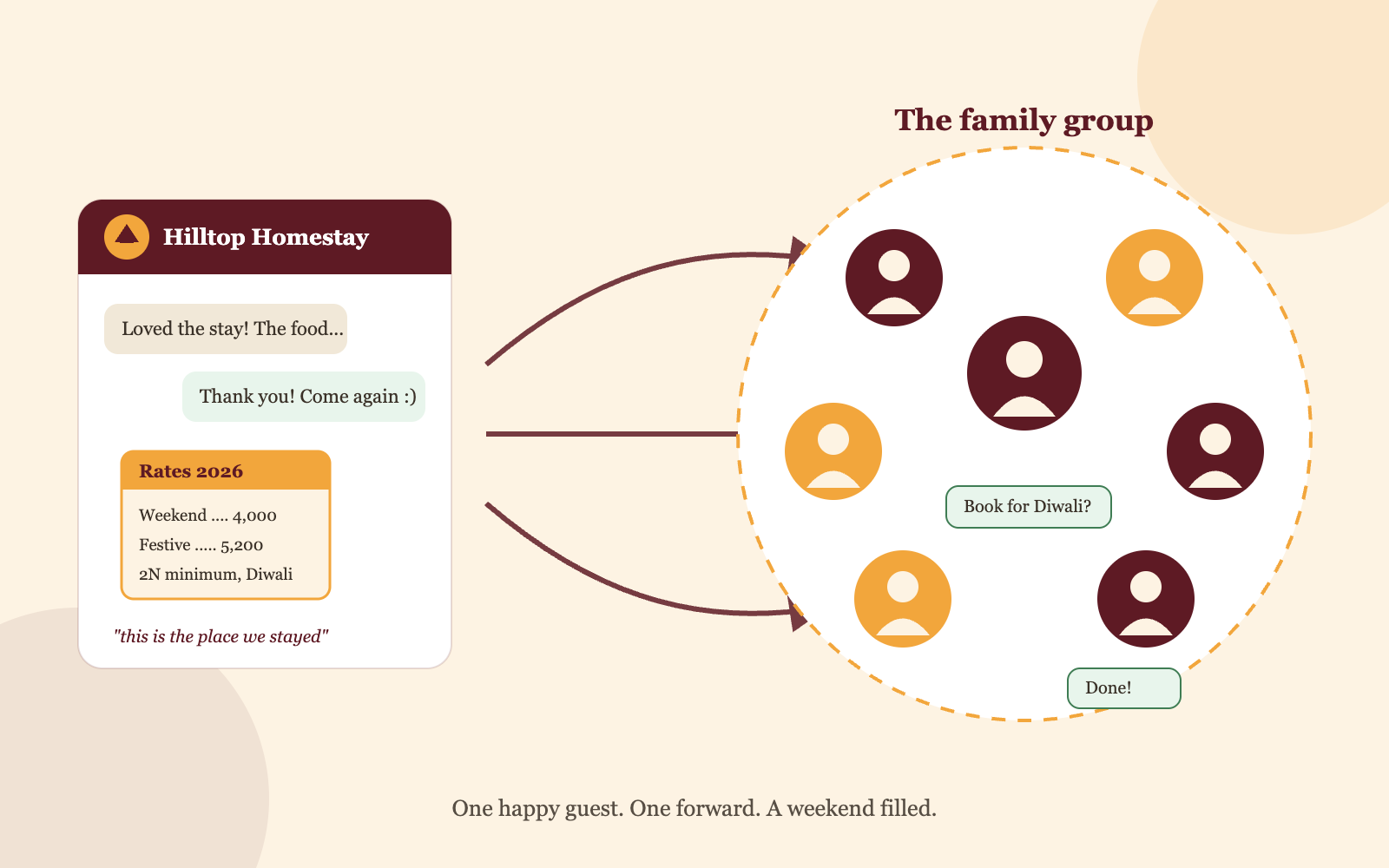
One more strength deserves its own section because it is the channel’s growth engine. WhatsApp bookings travel by forward.
The family that enjoyed its Dasara stay does not write you a newsletter; it forwards your number into the family group with one line, “this is the place we stayed, talk to the owner directly”. That forward arrives pre-trusted in a way no advertisement ever is, vouched for by a cousin rather than an algorithm. Group trips assemble the same way: one member chats, screenshots the rates into the group, collects a consensus and returns with a six-room booking no platform ever saw.
This is why the shareable artefacts matter more than owners realise. A clean rate-card image, the festive planner, a one-page PDF with photos and rates: these are built to be forwarded, your property’s advertisement travelling through networks you cannot see, carried by people whose word carries. The property whose rates exist only as improvised chat replies has nothing for its happiest guests to forward.
Diwali is the forward’s festival. Family groups light up for two weeks with plans. A single “where did you stay last year?” in a forty-member group can fill a weekend. The owners who notice this send their happiest guests something worth forwarding at exactly this time of year, the new season’s rate card, a photo of the property lit for the festival, then let the network do what networks do.
The multiplication also compounds across years. Every festive season adds a ring of families who hold your number. The regulars-first offer each September then reactivates the whole network at once. The apps rent you strangers; the forwards build you a following.
What the informality quietly costs
Now the other column, because every one of these costs is real and most owners have paid several.
Availability has no single truth. When the calendar lives in one person’s memory plus a scrolling chat, two guests can be promised the same festive Saturday, the exact double-booking disaster that peak season cannot absorb. The apps, whatever their commission, never sell one room twice.
Advance discipline slips. In a form, payment is a gate; in a chat, it is a request that can be deferred. “Will transfer tonight, boss” is the most expensive sentence in the channel: unconfirmed holds pile up exactly on the dates where every room matters, the phantom bookings our advance payment post was written to prevent.
A close cousin: the screenshot is not the money. Every festive season, properties hold rooms against a payment screenshot that never lands in the account, sometimes carelessness, sometimes fraud, always discovered too late. The rule that protects everyone is mechanical: a booking is confirmed when the amount appears in YOUR bank or UPI app, verified by you, not when a green tick appears in the chat.
The record vanishes into scroll. What rate was agreed? Was breakfast included? Which room was promised? The answers exist, somewhere above four hundred newer messages. When a dispute arrives, the printed policy that settles it calmly, the discipline of the cancellation ladder, was never stated in the thread at all.
Rates drift call by call. The same weekend gets quoted three prices in three chats, mood pricing reborn in text form, with the added risk that guests screenshot. The festive post’s argument holds doubly here: printed tiers exist precisely so that the chat can quote them without inventing.
And the owner pays in hours. The channel that never closes is answered by a person who must. We counted this honestly in the staffing post: the 9 pm rate query was a staffing requirement before it was a message. WhatsApp did not create the burden, but it concentrated all of it into one pocket, the owner’s.
The guest list you are accidentally building
There is an asset growing inside the channel that deserves to be named, because most owners own it without knowing.
Every chat adds a guest to a list no platform will ever hand you: name, number, dates stayed, rooms taken, the child’s name, the food preferences, the anniversary that brought them. Marketers pay heavily for a fraction of this. A small property accumulates it free, simply by doing business in conversation. The occupancy post’s quietest alarm, vanishing regulars, is answered here: the list is how regulars are kept visible and reachable.
But an asset this valuable deserves adult custody. It lives, typically, on one phone, unbacked-up, one theft or one broken screen away from erasing years of relationships. Owners who take the channel seriously keep the essentials, names, numbers, stay dates, somewhere that survives the phone: the same notebook or booking system that holds the calendar. The chats are the relationship; the list is the business. Keep the second where the first cannot delete it.
Custody also means restraint. The list is valuable precisely because these people trust you with their number, so the fastest way to destroy it is to treat it as a broadcast audience. The property that messages its past guests weekly becomes noise and gets blocked; the one that writes twice a year, the September festive offer and perhaps a quiet summer note, stays welcome for a decade. In this channel, silence most of the year IS the marketing; it is what makes the one message that does arrive feel personal rather than promotional.
A tale of two chats
The difference between amateur and professional WhatsApp booking fits in two short conversations.
The first chat: “Room available?” “Yes sir.” “Rate?” “How many people?” “2” “3500” “Too much, 2500 final” “Ok 3000 last” “Ok will confirm tomorrow” and then silence, a hold with no advance, a rate invented under pressure, no dates written, nothing to point to when the guest returns claiming 2500 was agreed.
The second chat: the same enquiry, answered with the season’s printed rate and two current photos; a warm no to the discount with a genuine yes attached, early check-in if the room is free; the advance requested plainly with a UPI ID and a line stating the cancellation terms; and on payment, one message that reads like a receipt: dates, rooms, rate, what is included, arrival directions. Same warmth, same speed, same human channel. But the second property has printed tiers behind its quotes, one calendar as the single truth and a thread any court, or any forgetful guest, could read back.
The difference costs nothing. It is not software, not staff, not English. It is the same September decision the whole series keeps making: decide once, write it down, then let every chat quote the decision instead of reopening it.
The discipline that keeps the warmth
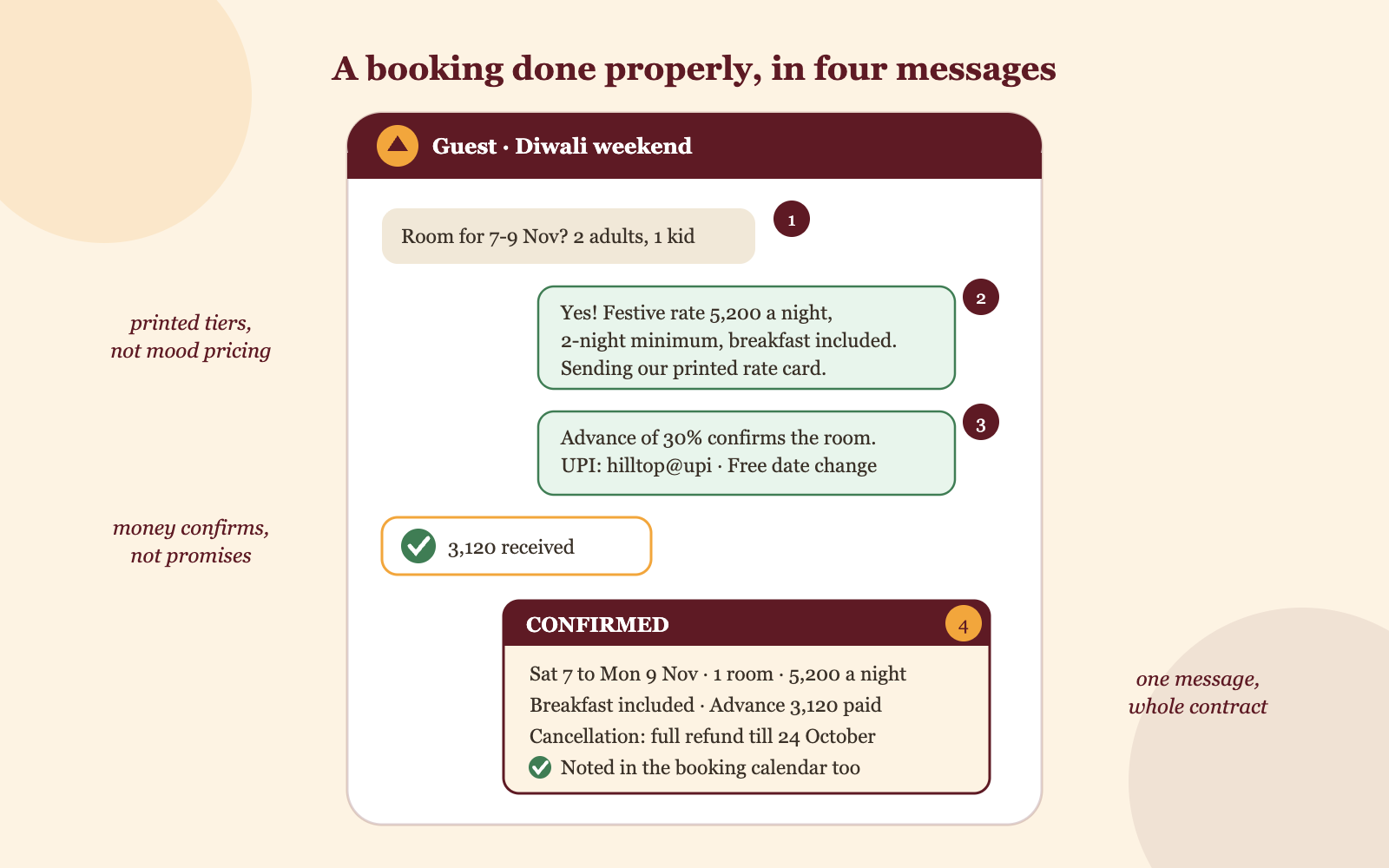
Run the channel like a channel and the fixes are few and boring, which is the best news in this post.
One calendar, one truth. Whether it is a wall calendar, a notebook or booking software, every confirmed booking lands in ONE place the moment the advance arrives, before the thumbs-up is sent. The chat is where deals happen; it must never be where availability is remembered.
The advance confirms, nothing else does. A date is held when money arrives, a rule stated kindly and applied to everyone, exactly as the advance post argued. Until then it is an enquiry, however enthusiastic.
Quotes come from the printed tiers. The festive planner sitting beside the phone exists for this: the season’s rates decided in September, read out in October, identical in every chat. A rate card image sent into the thread does quiet extra work: it shows the price is public, not invented for this caller.
Terms live in the confirmation. The one message after payment carries the whole contract: dates, rooms, rate, inclusions, the cancellation line. Thirty seconds of typing that settles every future dispute before it exists.
The dying enquiry deserves a named place in the discipline too. Every unanswered chat is a lead expiring in real time; most guests enquire at two or three properties and book whichever answers. A short sweep of the inbox at fixed times, morning, afternoon, evening, beats heroic instant replies at random hours, keeps the owner sane and loses fewer bookings than the always-on approach that burns out by December. WhatsApp Business labels make the sweep visible: what is an enquiry, what is holding for advance, what is confirmed.
And the thread finishes the loop. After checkout, the same conversation carries the thank-you and the request for a review and photos, the habit that builds tomorrow’s review base and, as the AI post showed, writes the property’s file for the recommendation engines now reading it.
The festive fortnight: when the channel earns its keep
Publish this in the first week of November and every reader’s phone is already proving the point. Diwali week is when WhatsApp bookings surge from steady to torrential: regulars confirming their standing dates, new families forwarded by relatives, the last-minute Thursday flood for the weekend.
The channel’s festive strengths are the season’s strengths. The September offer to regulars went out on WhatsApp before any rate went public, the quiet loyalty move the festive post recommended. The peak-date rooms held back from the apps sell here at full published rate, commission-free, to guests who arrive pre-trusted. The date-change conversations that replace refunds happen humanely in chat.
The Thursday flood deserves its own plan. Festive weekends compress the channel’s whole week into two evenings: regulars confirming, groups negotiating, strangers asking for the already-sold Saturday. The properties that cope triage rather than drown, confirmed guests get logistics, paying holds get the UPI reminder, new enquiries for full dates get a warm no with the next open weekend offered. A refusal handled gracefully in chat converts surprisingly often into a booking for the quieter date, which no sold-out sign on an app has ever done.
But the season also stresses every weak joint at once. The double-booking risk peaks exactly when rooms are scarcest. The “will transfer tonight” holds multiply exactly when phantom bookings hurt most. The owner’s hours drown exactly when the property needs its host present, the staffing post’s warning in its acutest form. The properties that sail through Diwali on WhatsApp are the ones that fixed the discipline in September. The ones that improvise are one scroll away from promising the same room twice on the year’s most valuable night.
Where software fits honestly
The honest division of labour, consistent with everything this blog has argued: automate the clerical, keep the personal.
A booking page on your own website is not a rival to WhatsApp; it is the night shift. It answers the midnight enquiry with the right rate, takes the advance and blocks the calendar while the owner sleeps, then hands the human conversation back in the morning. The two channels work best pointed at each other: the website’s confirmation arrives on WhatsApp; the chat’s overflow points guests to the booking page.
The clerical halves of the chat itself can also run unattended: the confirmation message after payment, the reminder before arrival, the post-checkout review request. Booking software does this, ours included, but the argument stands regardless of whose: every automated confirmation is a record that cannot vanish into scroll and a message the owner did not type at 11 pm.
What must never be automated is the part guests actually book: the voice note about the weather, the honest answer about the road, the warmth. WhatsApp Business, the free app, adds useful basics on its own, quick replies for the questions every guest asks, labels to separate enquiries from confirmed bookings, a catalogue for rooms. None of it changes the channel’s nature. All of it reduces the scroll.
One caution completes the honesty: the channel belongs to someone else. WhatsApp’s rules, features and business pricing change on Meta’s schedule, not yours, which is one more reason the guest list, the calendar and the records should live outside the app that hosts the conversation. Rent the channel happily. Own the relationship, the data and the discipline yourself.
The one-line summary
If this post must fit in one line: WhatsApp bookings are the largest uncounted channel in small-property India, they win on trust, language and zero commission. They repay one evening of discipline, one calendar, advance-to-confirm, printed tiers, a proper confirmation message, with the strongest bookings a property can get.
The chats will keep arriving tonight, festive-season thick. The only question is whether they land in a channel run with the same seriousness as any other, or in a scroll that will eventually promise one room to two families. Count the channel, discipline the channel and it will quietly out-earn every commission you have ever paid.
Straight questions, straight answers
Can hotels and homestays take bookings on WhatsApp?
They can and across small-property India they already do, at a scale most owners have never added up. WhatsApp bookings typically begin with an enquiry from a guest who found the property elsewhere, close with a UPI advance and a confirmation message in the same thread. The channel is legitimate and commission-free; what it lacks is built-in discipline, which the property must supply itself through one calendar, advance-to-confirm and clearly stated terms.
Are WhatsApp bookings safe for guests and owners?
Reasonably, when both sides keep the record straight. For guests, the safeguards are paying a modest advance rather than the full amount, receiving a written confirmation with dates, rate and cancellation terms and checking the property’s reviews on other sites. For owners, safety means confirming only against received payment, stating terms in the thread and keeping every booking in one calendar. Most WhatsApp booking disputes trace to something nobody wrote down.
How does a WhatsApp booking get confirmed?
By money, not by messages. The working rule across the trade: an enquiry becomes a booking when the advance arrives, usually by UPI. The property then replies with one message carrying the full details, dates, rooms, rate, inclusions and the cancellation line. That single message is the contract both sides can scroll back to. Holds without advances are the channel’s most common failure, multiplying exactly on high-demand dates.
Should a property use WhatsApp Business instead of normal WhatsApp?
Generally yes, since it is free and built for exactly this. WhatsApp Business adds a profile with the property’s name, location and timings, quick replies for repeated questions, labels that separate enquiries from confirmed stays and a catalogue for room types. None of it changes how guests chat. It simply reduces typing and scroll, the two taxes the channel levies on every owner.
What are the risks of running bookings on WhatsApp?
The channel’s informality is the risk. Double bookings when no single calendar holds the truth, unconfirmed holds that block valuable dates, rates that drift between chats, agreements buried under newer messages and the owner’s own hours consumed by a channel that never closes. Every one is fixable by discipline rather than technology, though booking software removes several automatically.
Does WhatsApp replace a booking engine or website?
No, they do different shifts. WhatsApp is unmatched for conversation, trust and flexibility while a booking page on the property’s own website answers instantly at midnight, shows published rates, collects the advance and blocks the calendar without anyone awake. Properties run best with both pointed at each other: the website for the guest who wants to book now, the chat for the guest who wants to talk first.
Image credits: Shopfront photo by Ravi Sharma on Unsplash, under the free Unsplash License. The chat and family-forward illustrations are original OpenStays artwork.
OpenStays provides booking software for homestays, hotels and resorts, but this blog is not about software. It is about running a property well, written for owners, with owners.
How many of last month’s bookings closed on WhatsApp at your property, have you ever counted? Tell us in the comments below. The best stories will find their way into future posts, with your permission and full credit.



Leave a Reply