
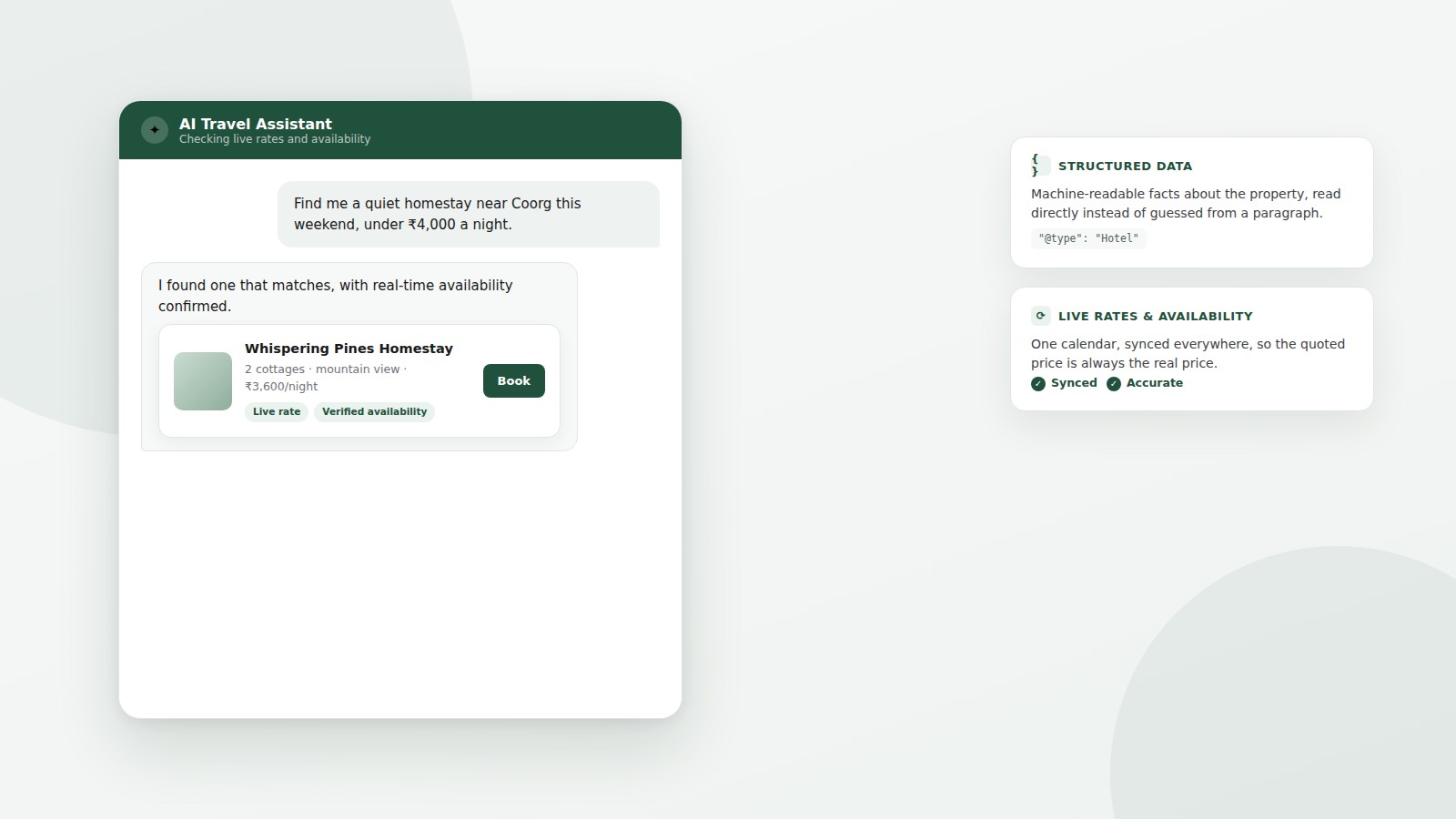
AI-bookable hotels became a live reality on 27 August 2026, when Google began rolling out hotel booking directly inside AI Mode in Search. A traveller can now research, compare and book a room without ever clicking through to a hotel website or an OTA listing, the whole transaction happens inside the chat, backed by Google Pay. Ten major chains and online travel platforms were the first to be connected. It is currently limited to the United States, and it is currently limited to large chains and the biggest global booking platforms, but the direction is unmistakable. ChatGPT, Claude and Gemini can already research and, in a growing number of cases, complete a hotel booking on a traveller’s behalf. Independent hotels, homestays and resorts in India are not part of this first wave, and that is exactly why this is the right moment to prepare rather than the moment to worry.
This guide explains what “AI-bookable” actually means in plain, non-technical language, why it is happening now, and what an independent property in India can realistically do about it today, this month, and over the next year. None of this requires you to rip out your existing website or booking engine. Most of it is about making the data you already have accurate, consistent and easy for a machine to read, the same discipline that has always mattered for search engines and OTAs, just with a new and faster class of reader.
Open your own website, your Google Business Profile and your two busiest OTA listings in three browser tabs side by side. Check whether your room count, amenity list and photos genuinely match across all three.
Ask your booking engine or channel manager provider one direct question: is my calendar a single source of truth that updates everywhere automatically, or does someone still manually block dates on one platform at a time?
Open ChatGPT or Gemini and ask it to find a property like yours in your area under your typical rate. See whether you appear, and whether what it says about you is actually true.
What “AI-Bookable” Actually Means
A property becomes AI-bookable when an AI agent, whether that is Google’s AI Mode, ChatGPT, Claude, Gemini or Perplexity, can do two things without human help: find your property and describe it accurately, and check your actual rates and availability and either complete a booking or hand the traveller off to book with one click. Those are two separate capabilities, and most properties are currently missing pieces of both.
The first capability, being findable and accurately described, depends on what the industry calls structured data. Instead of a human reading your homepage and figuring out that you have twelve rooms, free breakfast and a 11 AM checkout, that information is marked up in a machine-readable format (a technical standard called schema markup, using vocabulary types like Hotel, LodgingBusiness and Offer) so a program can extract it directly and reliably, without guessing or misreading a paragraph of marketing copy.
The second capability, being transactable, depends on your rates and availability being exposed live, through an application programming interface (API) rather than sitting only inside a calendar a staff member updates by hand. A small but growing number of technical protocols now let AI systems read this live data and, in some cases, execute a booking against it. Model Context Protocol (MCP) is the connective layer several hotel technology vendors are using to let AI assistants read live rates and inventory. Google’s Universal Commerce Protocol (UCP), built with Shopify, is the newer piece that lets an AI agent actually complete a purchase inside its own interface rather than sending the traveller elsewhere to check out. You do not need to understand the engineering behind either of these to prepare for them, you need to understand what they require of your data, and that is the focus of this guide.
Put simply: AI-bookable means a machine can discover you, trust what it reads about you, and finish the transaction, or hand off to finishing it, without a human bridging the gaps by phone or WhatsApp. Most independent properties today are AI-discoverable at best, a chatbot can mention their name and rough location, but not AI-bookable, the chatbot cannot confirm a real room is actually available tonight at a specific price.
Why This Is Happening Now
Three things converged in 2026 to make this a live topic instead of a theoretical one. First, general-purpose AI assistants became genuinely good at multi-step tasks, comparing options, checking constraints, and following through on a booking rather than just answering a question. Second, the large travel platforms and search engines started building the plumbing, structured commerce protocols, payment handoffs, partner integrations, to let those assistants actually transact instead of only describing. Third, and this is the part that affects an independent property directly, the volume is starting to show up in the numbers. An industry analysis of over 1.5 million real hotel bookings across more than 90 online travel agencies projected that AI agents could account for 5 to 8 percent of OTA bookings by the end of 2027. That is not a majority of bookings, and it will not be evenly spread, but it is a meaningful and fast-growing slice, and the properties that show up cleanly in that channel now will have an advantage that compounds as the channel grows.
The framing from one industry report captures the practical shift well: an AI agent does not scroll through pretty pictures the way a human traveller does. It checks prices and availability in milliseconds and tends to book from whoever answers fastest with the cleanest, most consistent data. That is a different competition than the one independent properties have been fighting on OTA listing pages for the last decade, it rewards accuracy and machine-readability over glossy photography and persuasive copywriting, which is arguably a fairer fight for a well-run small property than the OTA visibility game has ever been.
Google’s own rollout is the clearest signal so far, because it commits real infrastructure to the idea rather than just describing it. As of the current rollout, Google’s AI Mode lets a traveller track flight prices, view loyalty point redemption values, and complete a hotel reservation with “Continue on Google” and Google Pay, all without leaving the chat. It is US-only today, and the launch partners are limited to a handful of the largest global hotel chains and booking platforms, not independent properties directly. For an independent Indian hotel, the realistic path in over the next year or two runs through the same channel managers and booking-engine vendors that already keep your rates synced across OTAs, since those are the businesses building the technical connections to these emerging protocols on behalf of properties too small to build direct integrations themselves. What you can and should do right now is make sure the underlying data those vendors will eventually expose to AI agents, your property details, your live rates, your policies, is actually accurate and complete. Good data is never wasted effort, it helps you today on Google Business Profile, on your OTA listings and on your own website, and it is the exact prerequisite for AI-bookability whenever it reaches your market and your platforms.
This is already happening in smaller, more accessible ways than Google’s headline-grabbing launch. Several hotel technology vendors now offer AI-visibility features bundled into their existing channel management plans, connecting a property’s already-synced rates to ChatGPT’s booking surface with no separate technical setup on the hotel’s side, similar to how a channel manager already connects one calendar to a dozen OTA extranets today. This is worth knowing because it means the realistic first step for most independent Indian properties will likely arrive as an added capability inside a tool they already use, rather than as a brand-new system to adopt from scratch.
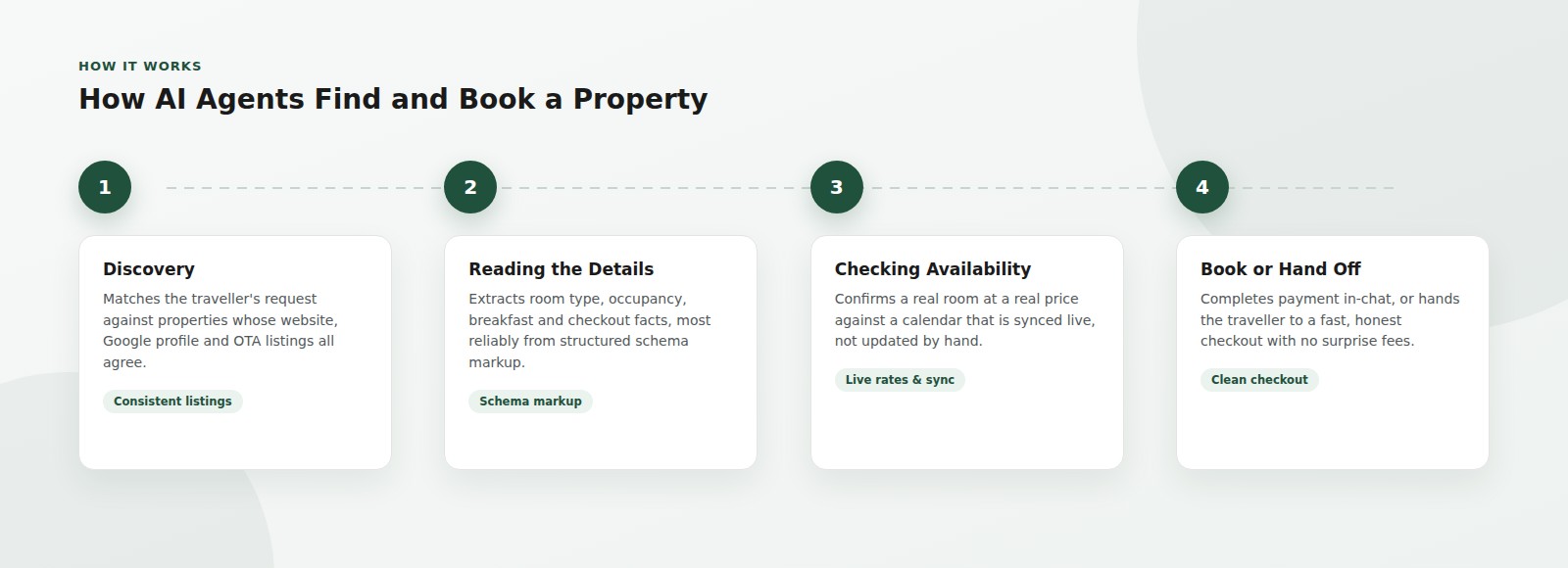
How AI Agents Actually Find and Book a Property
It helps to walk through the mechanics once, in plain language, so the readiness checklist that follows makes sense rather than reading like an arbitrary list of chores.
Step one: discovery
A traveller asks an AI assistant something like “find me a quiet homestay near Coorg for next weekend under four thousand rupees a night.” The assistant needs to match that request against real properties. If your website, your Google Business Profile and your OTA listings all describe your property with the same room types, the same amenity list and the same location details, an AI system can match you confidently. If they disagree, one page says four rooms, another says six, one calls a room type “Deluxe” and another calls the same room “Premium”, the AI system either drops you from consideration entirely or, worse, describes you inaccurately to the traveller, which damages trust before a booking even happens.
Step two: reading the details
Once a property is a candidate, the assistant needs specifics: does it sleep four, is breakfast included, what time is checkout, is there parking. Traditionally this information lives in prose on a website, written for a human to skim. An AI system can often extract facts from plain prose reasonably well today, but it does this far more reliably, and without hallucinating a detail that is not actually true, when the same facts are also marked up as structured data. This is the schema markup mentioned earlier, a layer of code invisible to a human visitor that states, in a standard machine-readable format, exactly what a Hotel, a HotelRoom and an Offer actually include. Adding this markup is a one-time technical task, usually handled by whoever manages your website, and it does not change how your site looks to a human visitor at all.
Step three: checking if it is actually available
This is where most independent properties currently fall short, not because of anything they are doing wrong, but because the infrastructure to expose live availability to an AI agent is still new and mostly channels through existing distribution partners rather than through a hotel’s own website directly. If your booking engine or channel manager already keeps your rates and calendar synced automatically across your OTA listings and your website, and does not rely on someone logging in each morning to manually mark rooms as sold out, you already have the raw ingredient this step needs. The remaining piece, connecting that live data to an AI-readable protocol, is largely the responsibility of the software vendor, not something you build yourself, similar to how you never personally built the connection between your booking engine and each OTAs extranet.
Step four: completing, or handing off, the booking
In the most advanced version of this, like Google’s new AI Mode flow, the traveller finishes payment inside the chat and never sees your website at all. In the far more common version today, the AI assistant surfaces your property with an accurate summary and a direct link, and the traveller clicks through to complete the booking on your own site or through a channel it trusts. Both outcomes depend on the same foundation: a fast, simple, honest checkout experience once the traveller does land on your booking page, since an AI agent that sends a traveller to a confusing five-step form with a surprise fee on the last screen will not recommend that property a second time.
The AI-Bookable Readiness Checklist
None of the seven items below require an engineering team. Several are things you can genuinely finish this week. Work through them roughly in order, since the first three set up everything after them.
1. Structured data on your own website
If you have a website, whoever built or maintains it should be able to add Hotel, HotelRoom, Offer and FAQPage schema markup using the JSON-LD format, which is the standard Google and most AI systems expect. This is invisible to a visitor and does not change your site’s design. If you use a website builder or a hotel-specific website provider, ask them directly whether structured data is already included, many modern platforms add basic Hotel schema automatically, and if not, ask what it would take to add it. You can check whether a page currently has this markup using Google’s free Rich Results Test tool, which will tell you plainly whether valid Hotel or LodgingBusiness schema is present.
2. Real-time rates and availability, not a calendar someone updates by hand
If a staff member manually closes out dates on a spreadsheet or a paper register while your website and OTA listings run on separate, unsynced calendars, this is the single highest-leverage fix on this list, and it is worth fixing for your everyday operations even before AI-bookability enters the picture. A channel manager or booking engine that keeps one calendar as the single source of truth, synced automatically everywhere else, removes stale-data risk entirely and is the exact foundation any future AI-agent connection would need.
3. The same property information everywhere, always
Pull up your website, your Google Business Profile and your top two or three OTA listings side by side right now. Check that your property name, address, phone number, room type names, amenity list and photos genuinely match across all of them. AI systems that pull from multiple sources treat disagreement between sources as a strong negative signal, worse in practice than simply having less detail in one place. A short monthly habit of checking this consistency is more valuable than a one-time perfect setup that quietly drifts out of sync over the following year.
4. Machine-readable policies, with every fee named and priced
Create, or clean up, a single dedicated policies page covering cancellation terms, deposit requirements, pet policy, smoking policy, minimum check-in age and parking, and make sure every mandatory fee, a facility fee, a caretaker fee, an extra-guest charge, is named and priced explicitly rather than folded into vague language like “additional charges may apply.” An AI agent evaluating your property against a traveller’s budget needs a real number, and a policy that only reveals its true cost on the final screen of a human checkout flow will simply be read as incomplete or untrustworthy by a system trying to compare you fairly against alternatives.
5. A booking path that finishes in a handful of steps
Whether a human or an AI agent hands a traveller off to your booking page, the same principle applies: fewer steps convert better. Aim for a checkout that does not force account creation, does not ask a guest to re-enter information they already provided earlier in the conversation, and confirms the booking clearly. If your current booking engine takes more than about four steps from room selection to confirmation, ask your provider whether a simplified guest-checkout flow is available.
6. Reviews that are recent, honest, and answered
AI systems evaluating a property weigh review sentiment and review-response behaviour, not just the star rating. A steady stream of recent reviews, and thoughtful responses to both good and difficult ones, signals an actively managed property rather than an abandoned listing. This is also simply good practice independent of AI: a calm, specific response to a critical review often reassures a future guest more than another five-star review would.
7. A monthly check-in: ask the AI assistants about your own property
Once a month, open ChatGPT, Claude, Gemini or Perplexity and ask a question a real traveller might ask, such as “find me a homestay in [your area] with parking under [your typical rate].” See whether your property appears, whether the details quoted are accurate, and whether the rate matches what you actually charge. This costs nothing, takes a few minutes, and is the single best early-warning system for catching a data mismatch before it costs you a booking. Keep a simple running note of what you find each month, since patterns across a few months matter more than any single check.
A Realistic Example
A homestay owner near Munnar asked an AI assistant to describe her own property, out of curiosity, after reading about this shift. The assistant found her, named her correctly, and described her as having a mountain view and home-cooked meals. It also confidently stated a room rate that was nearly a year out of date, from before her last price revision, and claimed she offered airport pickup, a service she had actually discontinued eighteen months earlier. Nothing about this was malicious or even surprising, the assistant was working from whatever it could find, and an old blog post mentioning the airport pickup was still indexed online even though her own current listings no longer mentioned it. She fixed it in an afternoon: she updated the one blog post still carrying the old claim, added the current rate to her Google Business Profile and her website in matching language, and asked the same question again a week later. The rate was correct, the discontinued pickup was gone, and the mountain view and home-cooked meals, the details that were actually still true, remained. The fix cost nothing but attention, and it is the same fix available to any property reading this today.
How to Tell Whether This Is Actually Working
Treat this the same way you would treat any new distribution channel: measure it, do not just set it up once and hope. Two simple habits cover most of what matters.
First, if your website analytics allow it, look for traffic arriving from AI referral sources, ChatGPT, Perplexity, Google’s AI Mode and similar tools increasingly show up as identifiable referrers in standard analytics tools, the same way a referral from a search engine or an OTA does today. A rising trend here, even from a small base, tells you the channel is starting to send you real visitors, not just theoretical exposure.
Second, run the monthly self-check described in the readiness checklist above as an actual habit, not a one-time test, and keep a short running note of what you find each time, whether you appeared, whether the rate quoted was accurate, and whether any detail was wrong. Three or four months of these notes will tell you far more about your real progress than any single check, since it shows you whether the fixes you made are holding up as your listings and your rates continue to change over time.
If you use a tracked rate code or a distinct landing page for any AI-referred bookings you can identify, even a simple one, you will eventually be able to see actual bookings attributable to this channel rather than only visibility. This is not essential in the early stages, but it is worth setting up once you start seeing meaningful referral traffic, so you can make the case to yourself, or to a business partner, for how much further attention this channel deserves.
Common Mistakes That Keep a Property Invisible to AI
A stale Google Business Profile is the most common one, an address that changed, a phone number for a landline nobody answers anymore, or photos from a renovation that finished two years ago. Since Google Business Profile is one of the sources AI systems cross-reference most heavily, letting it drift out of date quietly undermines every other effort on this list.
Conflicting amenity lists across channels are close behind, one listing mentions a swimming pool that was actually removed, another still lists an in-house restaurant that closed, or room counts differ between your website and your OTA listings because one was updated after an expansion and the other was not. Each individual mismatch seems minor, but AI systems treat a pattern of small inconsistencies as a much stronger negative signal than a single obviously outdated page, since it suggests nobody is actively maintaining the data at all.
Static, manually updated rates are a third recurring problem, a rate card that was accurate in January and never touched again, while your actual pricing has moved with the season. An AI agent checking live pricing against a stale published rate will either flag the mismatch or simply stop recommending you once it happens more than once.
Hidden fees revealed only at the final step of checkout are the fourth, and arguably most damaging, since they erode exactly the trust an AI system is trying to establish on the traveller’s behalf before it recommends anyone. Name every fee, upfront, everywhere.
Finally, having no structured data at all is common simply because most independent properties have never heard of it until a moment like this one. It is the easiest item on this entire list to fix once someone points it out, which is precisely why it is worth checking today rather than assuming your website already handles it.
What This Looks Like by Property Type
A budget or mid-market hotel with a straightforward room-type structure has the simplest path here, the main work is usually just making sure the channel manager already in place is genuinely the single source of truth for availability, and that basic schema markup gets added to the website. There is rarely anything unusual to describe.
A homestay or small guesthouse often has the opposite challenge, a genuinely distinctive property with character that is hard to reduce to a rigid room-type table, but that same uniqueness is exactly what an AI agent needs described in specific, concrete terms rather than atmospheric marketing language. “Cosy and charming” tells an AI system nothing useful, “a converted 1930s planter’s bungalow with two independent cottages, each sleeping four, with a shared kitchen and mountain-facing verandah” gives it everything it needs to match you against a specific traveller request.
A boutique property competing on design and experience should resist the temptation to lean entirely on evocative brand language in its structured data and machine-facing descriptions, save that tone for the parts of your website written for a human. The schema markup and FAQ content should still state plain facts, room counts, exact amenities, real pricing, since that is the layer an AI agent actually reads, however beautifully written the human-facing prose is elsewhere on the page.
A business hotel near a transit hub or commercial district should pay particular attention to fast, accurate response-and-answer content around practical traveller questions, distance to the airport or station, whether there is a work desk and reliable Wi-Fi, and late checkout availability, since these are exactly the specific, factual queries an AI agent is best at matching against structured answers rather than general marketing copy.
How OpenStays Fits In
OpenStays was built as an AI-first infrastructure layer for independent Indian properties, so several pieces of this checklist overlap directly with what the platform already does, and it is worth being specific and honest about which parts that covers and which parts remain your own work or a separate vendor’s job.
The calendar and rate management feature keeps one live calendar as the single source of truth across your direct booking page and connected channels, which is exactly the real-time availability foundation item 2 on the checklist above describes. The 0 percent commission direct booking engine gives guests a fast, simple checkout path without the multi-step friction item 5 warns against, and because it is your own booking flow rather than a third-party listing page, you control exactly how clearly fees and policies are presented, which supports item 4. The WhatsApp conversational AI feature already answers guest questions about your property in a structured, consistent way, quoting rates, checking availability and confirming details, which is a close cousin of what an external AI agent needs to do, just currently reaching guests through WhatsApp rather than through ChatGPT or Google’s AI Mode.
What OpenStays does not currently do, to be direct about it, is generate or manage Hotel and Offer schema markup on your own website, or expose your live rates through the specific emerging protocols like MCP or UCP that external AI agents use. Structured data is typically a website-level task handled by whoever builds or maintains your site, and direct AI-agent protocol integration is still forming across the industry broadly, most channel managers and booking-engine vendors, OpenStays included, are watching this space closely rather than claiming a finished integration that does not exist yet anywhere at meaningful scale for independent properties. The honest, useful thing to do today is exactly what this guide recommends: get your live-rate infrastructure, your consistent property information and your clear policies genuinely solid now, so that whichever vendor builds the AI-agent connection first, your underlying data is already ready for it.
Frequently Asked Questions
What does “AI-bookable” actually mean in one sentence?
It means an AI assistant like ChatGPT, Claude, Gemini or Google’s AI Mode can find your property, describe it accurately, check your real rates and availability, and either complete a booking or hand a traveller off to book in one click, without a human bridging any of those gaps.
Do I need to hire a developer to become AI-bookable?
For the highest-leverage items, keeping one accurate calendar, matching your details across every channel, and naming every fee clearly, no, these are operational fixes anyone on your team can do. Adding formal schema markup to your website is a small technical task, usually a short job for whoever already maintains your site, not a major development project.
Will OTAs stop mattering because of AI agents?
Not in the foreseeable future. AI-agent bookings are projected to reach a meaningful single-digit percentage of OTA-style bookings by the end of 2027, a genuinely important and fast-growing channel, but nowhere close to replacing existing distribution. Treat AI-bookability as an additional channel to prepare for, not a replacement strategy.
What is schema markup, in plain terms?
It is a standard, invisible layer of code added to a webpage that states facts about your property, room types and pricing in a format a machine can read directly and reliably, instead of a machine having to guess those facts from a paragraph of marketing text written for a human.
What is MCP, in plain terms?
Model Context Protocol is a technical standard that lets an AI assistant read live, real-time information, like your actual rates and availability, directly from a connected system, rather than relying on outdated or scraped data.
What is UCP, in plain terms?
Universal Commerce Protocol is a newer standard, introduced by Google with Shopify, that lets an AI agent go a step further than just reading information, letting it actually complete a purchase or booking inside its own interface on a traveller’s behalf.
Is this relevant to my property in India right now, given Google’s rollout is US-only?
Yes, for two reasons. First, ChatGPT, Claude, Gemini and Perplexity are already used by Indian travellers researching and in some cases booking trips today, well before Google’s specific AI Mode feature expands geographically. Second, the underlying work, accurate structured data, live availability, consistent information, and clear policies, is valuable on its own regardless of which specific AI feature reaches India first, and it is far easier to build this discipline now than to retrofit it later under pressure.
Can WhatsApp bookings and AI-agent bookings coexist?
Yes, they solve different parts of the same problem. WhatsApp conversational AI handles guests who reach you directly, often after finding you through word of mouth, Google, or an OTA listing. External AI-agent bookability is about being found and evaluated by a traveller who has not heard of you yet and is asking a general-purpose assistant for a recommendation. A property can and should build both.
What is the single highest-priority fix if I only have time for one thing this month?
Making sure your rates and availability are genuinely synced in real time across every channel, with no manually updated spreadsheet or paper register anywhere in the chain. Every other item on this checklist assumes that foundation is already solid, and a large share of independent properties in India still do not have it.
How do I know if my property already shows up correctly in AI answers?
Ask ChatGPT, Claude, Gemini or Perplexity a specific question a real traveller might ask about your area, property type and budget, and see whether you appear and whether the details are accurate. Do this monthly rather than once, since both your own listings and the AI systems reading them change over time.
Should I worry about losing bookings to AI agents recommending my competitors instead?
The properties most at risk are the ones with inconsistent or outdated information, not properties in general. An AI agent comparing two similar homestays will tend to favour whichever one it can verify confidently. Treat this as a reason to get your own data in order rather than a reason for concern about the technology itself.
Does this replace the need for good photos and a well-written website?
No. Photos and persuasive writing still matter enormously for the human traveller who eventually looks at your property before booking. AI-bookability is an additional, earlier layer, the structured facts that let a machine find and verify you accurately in the first place, so that a human then gets the chance to see the good photos at all.
In Summary
AI-bookable is not marketing language, it describes two concrete, checkable capabilities: whether a machine can find and accurately describe your property, and whether it can check your real availability and complete, or hand off, a booking. Google’s own rollout of hotel booking inside AI Mode this year, alongside ChatGPT, Claude and Gemini already researching and increasingly booking travel, means this shift is underway now, even though it is currently limited by geography and to the largest chains. Independent hotels, homestays and resorts in India that spend the next few months getting their live availability, consistent property details and transparent policies genuinely solid will be ready the moment this reaches their market and their platforms, rather than scrambling to catch up after the fact. Almost every item in the readiness checklist above is also simply good practice for running a better property today, which means none of this effort is wasted even if the AI-agent booking timeline moves slower or faster than anyone currently expects.
This is a fast-moving, still-forming area of hotel technology. The specific platforms, protocols and partner programs named in this guide, including Google’s AI Mode, the Universal Commerce Protocol, Model Context Protocol, and the AI assistants mentioned, reflect the publicly available information at the time of writing and may change, expand geographically, or be superseded as the underlying technology matures. This guide is intended as a practical starting point, not a guarantee of ranking, visibility or bookings on any AI platform. Always verify current requirements directly with your channel manager or booking-engine vendor and with the platforms themselves before making technical changes.