
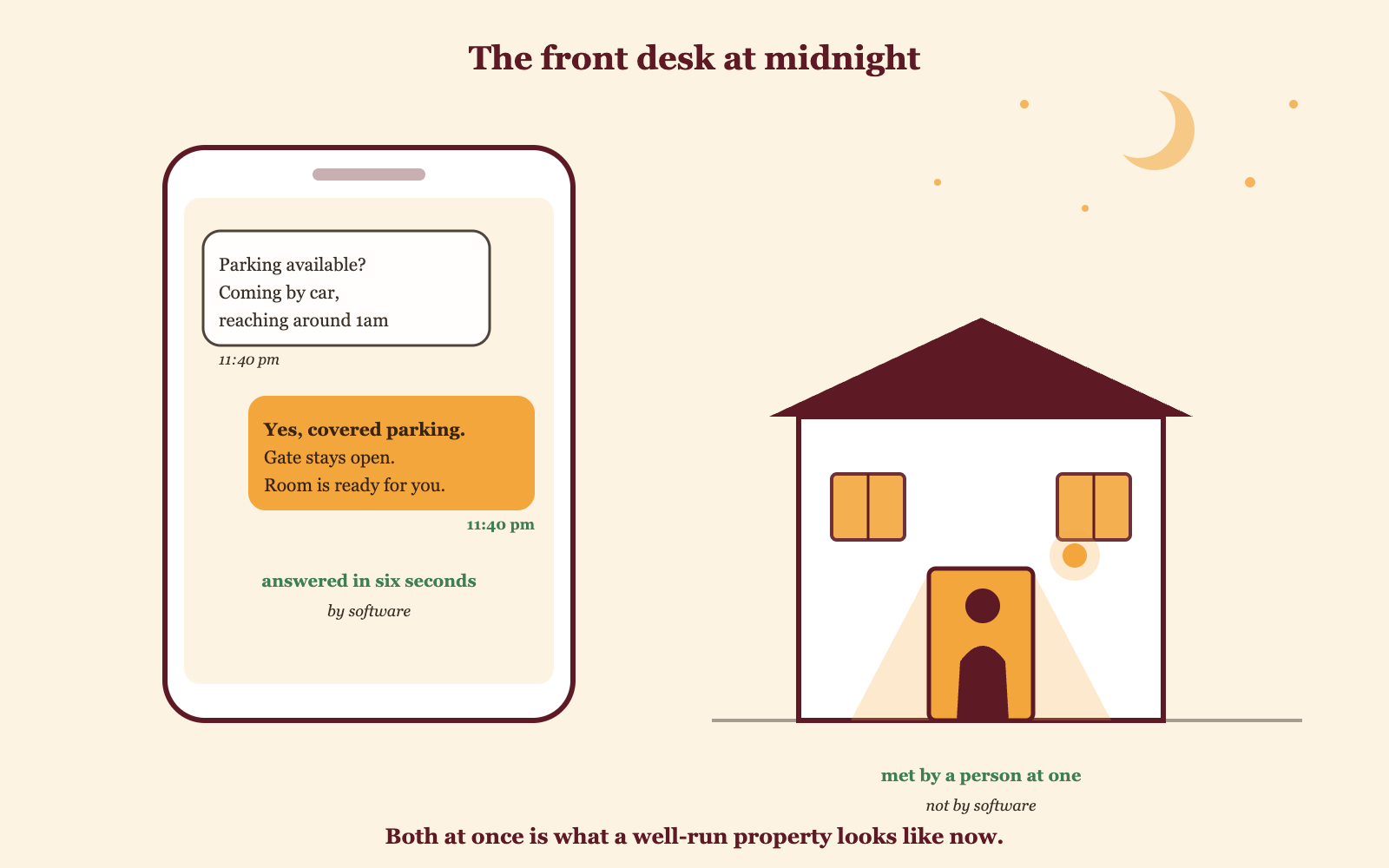
At 11:40 on a Tuesday night, a message arrives at a twelve-room property in a hill town. “Parking available? Driving in, arriving around 1am.” Two years ago that message sat unread until morning, by which time the guest had booked elsewhere. This year it was answered in six seconds, correctly, before anyone at the property had even seen it. The booking closed before breakfast.
At one in the morning the caretaker was awake at the gate anyway, torch in hand, listening for the car on the last bend. Nothing replaced him. Software had simply answered a question three hours earlier, while he was getting the rest he needed for the part of the night that genuinely wanted a person.
Every owner who has watched that happen has then asked the obvious next question, usually with some unease, because the person who used to answer those messages is standing right there. If a machine can handle the enquiry at midnight, the rate question, the directions to the property and the follow-up, what exactly is left for the human at the desk? So this post asks it plainly: will AI replace hotel front desks, or only change what the person behind one does all day? The answer here is an honest one, which means giving neither the sales-pitch version nor the panic version.
What this post covers
Will AI replace hotel front desks? The short answer
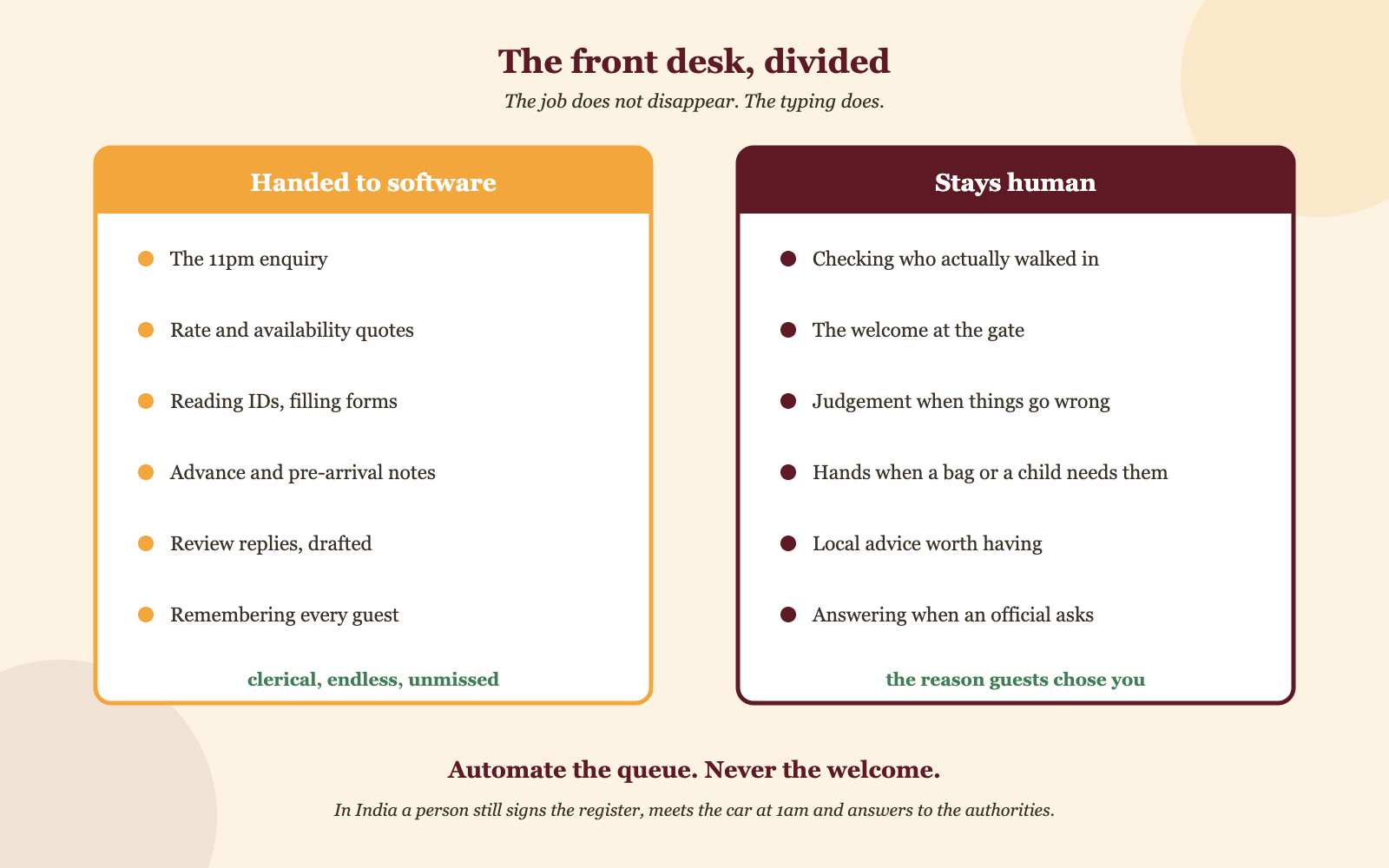
No, not in the next several years. Nor for the reasons most people assume. What AI is already replacing is not the front desk but a specific slice of front desk work: the repetitive enquiry, the rate quote, the drafted reply, the document data entry, the messages that arrive when nobody should be awake. That slice is real and it is large. The rest of the job, the part that carries legal accountability, physical presence and the judgement of a person who can read a tired family at midnight, is not going anywhere.
The more useful way to put it: AI is not competing with your receptionist. It is competing with the vacancy you cannot fill, the enquiry you never answered and the hour you never had. In an industry that is short of trained people almost everywhere, by its own admission, that distinction changes the entire conversation.
What the front desk actually does
Ask anyone outside the trade what a front desk does and they will say check-in. Ask an owner and you get a different list, which is exactly why the replacement question is usually asked wrong.
In a ten or twenty room property, the person at the desk is running the building. They take the phone booking and the chat enquiry. They collect and verify identity documents. They keep the guest register the authorities may ask to see. They receive the advance, reconcile it, remember which family paid by transfer at 2pm. They carry a bag up when the grandmother is struggling with the stairs. They call the plumber when the water heater in 104 fails. They know which room hears the generator.
They tell the couple which viewpoint is worth the drive and which one is a tourist trap. They calm the guest who arrived expecting something the listing photo implied. At night, in many small properties, they are also the only person awake on the premises, which quietly makes them the security arrangement.
The staffing post made the case that in a small property the team is not overhead, it is the product. The front desk is where that is most visible. When guests write in reviews that the staff “made the trip”, they are almost never describing a smooth check-in. They are describing one of the unscripted things in that list.
So the honest framing of this post’s question is not “can software check people in”. It is “how much of that list can software carry, then what happens to the rest”.
What AI already does well
Start with the part that is not speculation, because a good deal of it is already running at small properties this season.
The midnight enquiry is the clearest win. Guest messages do not respect working hours. A property that answers in seconds at 11pm converts enquiries that a property answering at 9am simply loses. It makes no difference whether the question arrives as a text, an email, a WhatsApp message or a note through a booking site’s inbox: the property that answers first usually gets the booking. Software that knows your rates, your policies and your live availability can answer the common ninety percent of those messages accurately and instantly. This is not a robot pretending to be a person. It is the property answering its own phone at an hour when no reasonable human should be.
Drafting is the second win. Replies to reviews, both the glowing ones and the unfair ones, take a surprising amount of an owner’s week. The Google reviews post argued that these responses shape how strangers judge you. AI drafts them in seconds, in a tone you set, leaving the owner to edit and approve rather than compose from a blank screen at eleven at night.
Language is the third and it is underrated. A B&B in Tuscany taking a booking from a family in Seoul, or a lodge in Montana answering a group from Mexico City, is doing business across languages every week. Machine translation that is genuinely good now removes a friction that used to cost bookings quietly.
Then the paperwork. Reading an identity document and extracting the fields correctly is exactly the kind of task machines have become excellent at. Pre-arrival messages, the advance reminder from the advance payment post, the post-checkout thank-you and the review request from the repeat guest post: all of it now runs on a schedule, at a reliability no busy human matches during a holiday rush.
Notice what these have in common. Every one of them is a task nobody at the desk enjoyed, most of them are things small properties were doing badly or not at all. Not one of them is the reason a guest remembers your property.
The legal wall

Here is where the confident predictions usually skip a step. It is also where owners should be most sceptical of them.
Accommodation in much of the world carries identity obligations that a fully unattended property cannot discharge casually. Across the Schengen area, hotels and other accommodation must have foreign guests fill in and sign a registration form and check it against their identity document. Several countries go further: Italy and Spain require guest details to be sent to the police, in most cases within twenty four hours. India requires the same for foreign nationals. Where there is no national register, as in most of the United States, local short-term rental rules, age checks and the property’s own insurance still expect someone to know who is staying. The penalties vary, from fines per unreported guest to licensing trouble for repeat failures, but the principle is the same everywhere it applies: somebody is accountable for knowing who slept in the building.
Software helps enormously with all of this. It can read the document, populate the fields, keep the register searchable and remind you before the deadline passes. What it cannot do is be accountable. It cannot look at the person in front of it and judge whether the face matches the document, whether the group checking in matches the booking, whether something about the arrangement is wrong in a way no field on a form captures. It is the part of the job that rewards care rather than speed.
This is not a temporary technical gap that a better model closes next year. It is a question of who answers when an official asks. That answer is a person. In a small property that person is usually the one at the desk.
The trust wall
The second wall is human. It is stronger than most of the commentary assumes.
Plenty of guests still want to talk to someone. Even after finding you online, even after reading every review, a real share of bookings at small properties are confirmed only after a call or a back-and-forth with a person. That conversation is not really about information. The guest already has the information. It is about deciding whether to trust the property with a family holiday. People make that judgement on how a person sounds.
Arrival works the same way. A family that has driven seven hours with a child asleep in the back does not want a kiosk. They want somebody to say come in, sit down, have some water, the room is ready. The promise a property makes is the thing it must keep. Almost every small property, whether it says so or not, promises a person at the door.
And when something goes wrong, which it will, the entire relationship rests on a human being’s response. The repeat guest post showed that regulars forgive the broken water heater because they have banked good experiences with the people, not with the building. Nobody forgives a machine. A guest who feels processed by software while they were upset does not come back, does not refer and often writes the review that costs you the next ten strangers.
There is a version of automation that ignores all of this. It is easy to spot as a guest. It is also, for a small property, commercially foolish. Recognition and warmth are the only advantages a twelve-room property holds over a chain hotel with better beds and a bigger budget. Automating them away is a strange way to compete.
The shortage AI is actually filling
Now the argument that reframes the whole question. Ask will AI replace hotel front desks in an industry short of trained people and the answer turns out kinder than the headlines suggest.
The hotel industry is not sitting on a surplus of trained front office people waiting to be replaced. It is short of them. In the United States, an American Hotel and Lodging Association survey this year found more than half of hotels still understaffed even though 70 percent had raised wages. An earlier AHLA survey named front desk roles among the hardest to fill, second only to housekeeping. Owners in Europe and elsewhere describe the same pattern. The pressure is worst exactly where small properties sit, in smaller towns and seasonal destinations, where the trained person you hire in March may be gone by September to a bigger property in a bigger town.
Read the technology question against that background and it changes shape. The owner who cannot find a night receptionist is not choosing between a human and a machine. They are choosing between a machine and nobody. As the staffing post worked out, every additional salary at a small property is a real decision. Automation that absorbs the enquiry backlog, the paperwork and the after-hours messages does not push a person out of a job. It makes the job possible for the one person you actually managed to hire and keep.
There is a second effect worth naming. Work a machine handles is work your best people stop doing. If the person at your desk spends two hours a day typing the same four answers about parking, breakfast timing and the distance from the station, those are two hours not spent with guests. Take that away and the same salary buys you more hospitality, not less. That is a better property, not a thinner one.
The hotel with no front desk
The counter example deserves an honest hearing, because it exists and it is growing.
City hotel brands have built whole models without one: self check-in kiosks, digital room keys, no reception counter at all. Some app-run apartment hotels have no staff on site. They are aimed at travellers who would rather not talk to anybody, which is a real and growing segment, particularly for one-night city stays.
Two things about it are instructive. The first is that it works for a specific job. A solo traveller arriving at 1am for a six-hour sleep before a morning meeting genuinely does not want a conversation. That guest is buying a clean bed and a fast entry, nothing else. For them the desk is pure friction.
The second is more telling. Even these models keep people close, walking the lobby as hosts or reachable by phone and chat. The humans moved, they did not disappear. Somebody still cleans, still fixes, still answers when the app fails at midnight and a guest is standing in a corridor with luggage. What the model actually removes is the counter, not the staff. It removes it for a guest segment that a countryside B&B or a family-run beach hotel does not serve.
The lesson for a small property is not to copy the model. It is to notice which of your guests would have preferred the kiosk. If a meaningful share of your bookings are single-night business travellers, some automation of arrival is a service to them. If your guests arrive as families for three nights of holiday, it is a downgrade dressed as progress.
What this means for a ten-room property
Most readers of this blog do not have a front desk in the corporate sense. They have a person, a phone, a register and a table near the door. So translate all of the above into that reality.
Automate the queue, never the welcome. Everything that happens before the guest arrives is fair game: the enquiry reply, the rate quote, the availability check, the advance reminder, the directions, the pre-arrival message. Everything that happens once they are standing in front of you belongs to a person.
Let the machine hold the memory. The repeat guest post argued that recognition is the small property’s superpower and that memory is where it lives. Software remembering that this family took the corner room last summer and that their youngest is allergic to nuts is not automation of warmth. It is the equipment that makes warmth possible at scale, in the way a good notebook always was.
Keep a human name on every thread. Guests can tell within one exchange whether they are talking to a template. The properties that get this right use automation to answer instantly, then let a person take over the moment the conversation becomes a decision. That handover point is the whole craft.
Never let software quote a rate it does not actually know. This is the failure mode that costs real money and it earns its own section below.
Watch what automation frees rather than what it costs. If it buys your desk person ninety minutes a day, the question is what those ninety minutes now go into. Sitting with guests over morning coffee is a better use than sitting behind a counter. The review that follows will say so.
Where AI gets it wrong
An honest post has to name the failures, because they are not hypothetical and small properties feel them harder than chains do.
The confident wrong answer is the biggest one. Language models generate fluent text whether or not they know the fact, so a system that is not wired directly to your live rates, your calendar and your policies will eventually quote a tariff you never set, promise a room you already sold or invent a cancellation policy the guest will later hold you to. During a peak holiday week, when a large share of the year’s real money gets made, one confidently invented rate is an expensive mistake. Any automation worth running must read from the same single source your calendar does, not from a description of your property written six months ago.
Tone is the second failure and it is subtler. Machine replies are relentlessly cheerful. A guest writing at midnight because the room is not what they expected does not want cheerful. Escalation rules matter more than the replies themselves: the moment a message carries frustration, a booking change, a refund question or anything involving money already paid, a person should be reading it.
Third, over-automation of the small courtesies hollows them out. A birthday message that clearly went out on a schedule is worth less than no message at all. The repeat guest post put the division plainly: the machine’s job is to make sure the owner never forgets a family, the owner’s job is to make sure the family never feels like a database row.
Fourth, dependence without a fallback. Connectivity fails, apps fail, power fails. In mountain, rural and coastal areas they often fail together. A property whose arrival process only works when the internet does has built a single point of failure into the worst possible moment of the guest journey.
Every one of those failures is a design fault rather than a law of nature, which is worth saying plainly, because the fixes exist today.
The invented rate has an obvious remedy: never let the system invent. Our own automated rate negotiation works inside a window the owner sets, a floor it will not go below plus an asking price it opens at, both read from the live rate card rather than from a description of the property written months ago. Inside that window it can hold a real conversation, offer the alternative date when the requested one is full, nudge a pending payment, send the pre-arrival note. Outside it, there is nothing to make up. An owner who has set the December floor at a number they can actually live with does not lie awake wondering what the machine quoted while they slept.
That same window turns the discount conversation into something better than a discount. A guest pushing for a lower rate can be offered breakfast, an early check-in or a late checkout instead, courtesies the property can afford and the guest often values more than a small discount. This is a negotiation few tired owners conduct well at eleven at night. Having it run to a rule the owner wrote in daylight is a genuine upgrade rather than a compromise.
Escalation should be built in rather than hoped for. The moment a thread turns into a complaint, a refund, a cancellation or anything an owner would want to answer in their own voice, the right behaviour is to stop and hand over. The exchange stays inside the property’s own conversation thread throughout, so the owner reads the history, takes over mid-conversation and finishes as themselves.
The clerical wins then compound quietly. Guest identity details, including the registration details some countries require for foreign guests, get collected during the booking conversation rather than chased at the gate, so arrival becomes a greeting instead of a paperwork session. The messages that run automatically are the ones with a job to do, the alternative date, the payment reminder, the pre-arrival instructions, rather than manufactured affection. And because the whole exchange lives in a thread the owner already reads on a phone they already carry, a bad night for the internet ends with a person answering a message, not with a guest locked out of a system.
None of that removes the person at the gate at one in the morning. It removes the reason that same person was also typing at eleven.
What the job becomes
By this point, asking will AI replace hotel front desks is less useful than asking what the job becomes. If the desk survives, it does not survive unchanged. The honest prediction is that the role narrows in some directions and deepens in others.
The typing shrinks. The repetitive answering shrinks. The manual copying of passport details into a register shrinks and probably disappears. Nobody will mourn these.
What grows is everything the machine cannot hold. Judgement in the odd situation. Physical presence when a bag, a child or a medical problem needs hands. Local knowledge that is genuinely local rather than scraped. The relationship work that turns a first-time guest into a family that returns every summer. In a small property this was always the real content of the job, buried under clerical work. Removing the clerical work does not diminish the role. It exposes it.
The uncomfortable half of the prediction is that this raises the bar. A front office person whose entire value was speed at repetitive tasks is genuinely more replaceable than one who is good with people. The trade will need fewer typists and more hosts. For small properties, which are rarely short of warmth but often short of process, that is not a bad trade at all.
Where software fits honestly
Since this post is published by a company that builds booking software, the reader deserves to know exactly where we think the line sits, ours included.
The clerical layer should be automated and it should be boring. One calendar so nothing double-books, seasonal and holiday rates applied automatically instead of renegotiated in every chat, the advance-to-confirm discipline enforced without awkwardness, the guest history kept without effort, the review request and thank-you going out on time while the stay is fresh. When these run properly, the property stops leaking money in the small invisible ways the OTA economics post traced.
What software should not do is impersonate the host. We do not think the future of a small property is a guest talking to a machine that pretends to be a person. We think it is a guest who gets an instant accurate answer at midnight and then meets a real human being at the gate, who already knows their name because the software remembered it.
Anybody selling you the other version, the property that runs itself while you sleep, is selling you a chain hotel’s economics without a chain hotel’s balance sheet. The reason guests choose your property over the chain is precisely the thing that version deletes.
The realistic picture for the next five years
Predictions age badly, so here are only the ones that follow from what is already visible.
Enquiry handling will be automated almost everywhere, including at very small properties, because the cost of doing it approaches nothing while the cost of a missed midnight message stays high. Owners who resist this will lose bookings to neighbours who did not, quietly, without ever learning which enquiries they lost.
Arrival will split by segment rather than converge. City and transit properties will move toward faster, lighter, largely self-service entry. Leisure properties, B&Bs and family hotels will move the other way, making arrival more personal, because that contrast becomes their advantage as the rest of the market automates.
Discovery keeps changing faster than operations. The AI recommendations post covered how guests increasingly ask an assistant to shortlist properties rather than scrolling listings themselves. For most owners, that shift will matter more to their bookings over the next five years than anything happening at the desk.
And the shortage will not resolve itself. If the trade cannot fully staff itself even after raising wages, the properties that keep good staff will be the ones that used automation to make those jobs better rather than to justify one fewer salary.
The one-line summary
If this post must fit in one line: AI will not replace hotel front desks, because the parts of that job carrying legal accountability, physical presence and human judgement cannot be handed to software, but it is already replacing a large share of front desk work, so the owners who come out ahead will be the ones who hand over the typing while keeping the welcome firmly human.
The guest messaging at 11:40pm should get an answer in six seconds. The family arriving at 1am should be met by a person. Those two sentences are not in conflict. Running both at once is simply what a well-equipped small property looks like now.
Straight questions, straight answers
Will AI replace hotel front desks?
Not the desk itself. Guest registration rules in many countries place identity obligations on an accountable person, guests at small properties still decide on trust after a human conversation. Arrival at a leisure property is the moment the whole promise is kept. What AI is already replacing is a slice of front desk work: repetitive enquiries, rate quotes, drafted replies, document data entry and after-hours messages. Expect the clerical part of the role to shrink steadily while the hosting part grows.
Can a hotel run fully without a front desk?
Technically yes for some formats. City hotel brands built on self check-in kiosks and digital keys show it can work. Even those models keep people close, walking the lobby as hosts or reachable by phone and chat. They target single-night city travellers rather than families on holiday. For a leisure property, an inn or a family hotel, removing the person at the door removes the reason guests chose you rather than a chain.
What can AI actually do for a small hotel today?
Answer common enquiries instantly at any hour, quote rates and availability from your live calendar, translate between languages, read identity documents and fill forms, send pre-arrival information, advance reminders, thank-you messages and review requests on schedule, plus draft review replies for you to approve. All of this is clerical work most properties were previously doing slowly, inconsistently or not at all.
Does AI at the front desk break guest registration rules?
Automation helps with compliance but does not carry it. Many countries require accommodation providers to register guests, foreign guests in particular. Some require the details to reach the police within twenty four hours. The obligation sits on the property, with fines or licensing consequences for failure. Software should read the document, fill the fields, keep the register and warn you before the deadline. A person stays accountable for verification and for answering when an official asks.
Will AI reduce the number of hotel staff needed?
Unlikely at small properties, for a simple reason: the industry is already short of trained people. In early 2026 more than half of US hotels surveyed by the American Hotel and Lodging Association said they were understaffed, even though 70 percent had raised wages. Front desk roles are among the hardest to fill. Most owners are not choosing between a person and a machine. They are using the machine to cover work the person they could not hire would have done.
Should a small property tell guests when they are talking to AI?
Yes, at no cost to you. Guests accept an instant automated answer about parking or breakfast timing when it is accurate and clearly labelled. What they resent is discovering that warmth they believed was personal came from a template. Automate the information, sign the relationship with a real name, then hand the conversation to a person the moment it involves money, a complaint or a decision.
Image credits: The register photo is by Aaron Burden on Unsplash, free to use under the Unsplash License. The midnight and divided-desk illustrations are original OpenStays artwork.
OpenStays provides booking software for hotels, inns, B&Bs and vacation rentals, but this blog is not about software. It is about running a property well, written for owners, with owners.
Has automation helped or hurt at your property, what is the one thing you would never hand over to software? Tell us in the comments below. The best stories will find their way into future posts, with your permission and full credit.

Leave a Reply