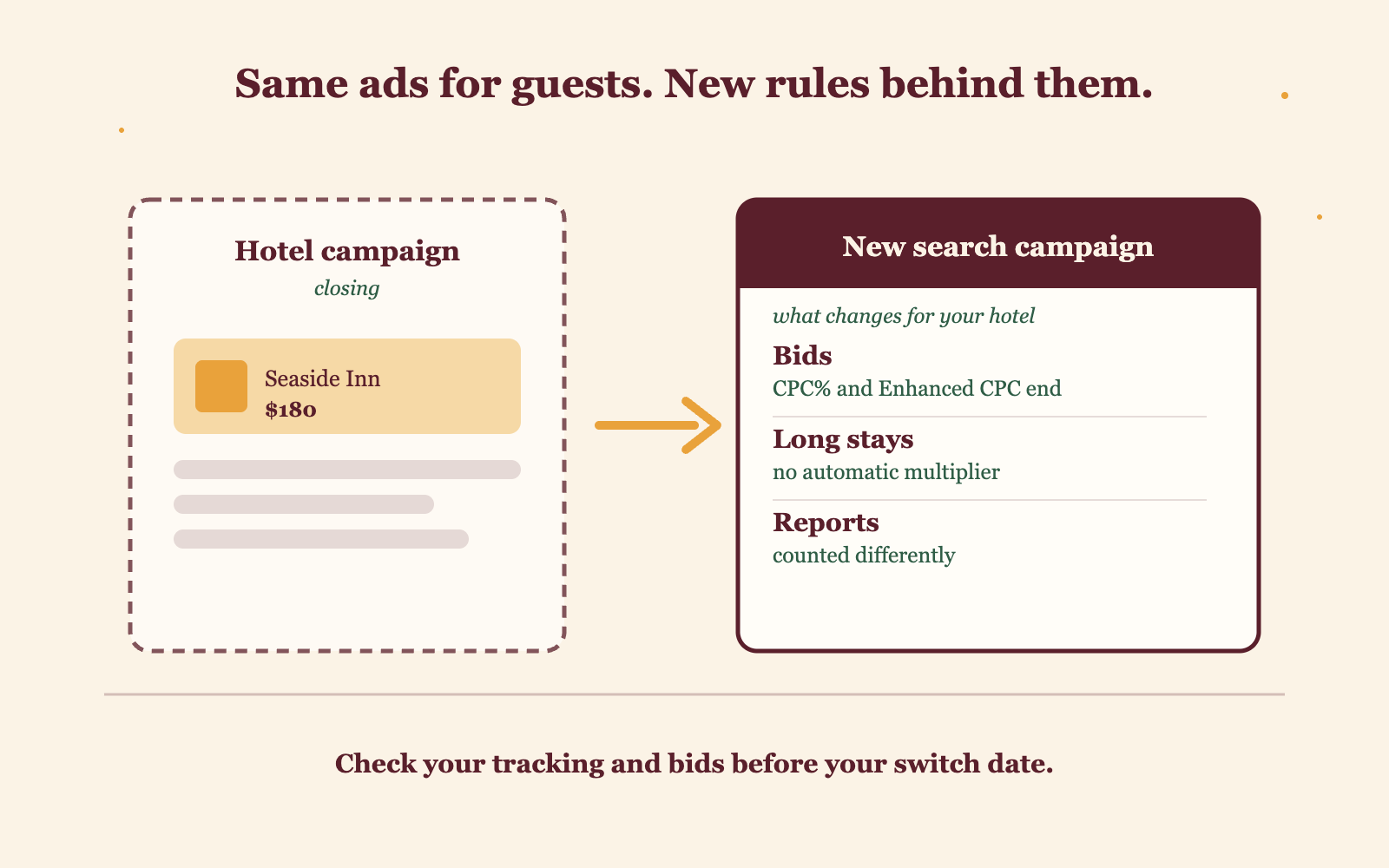
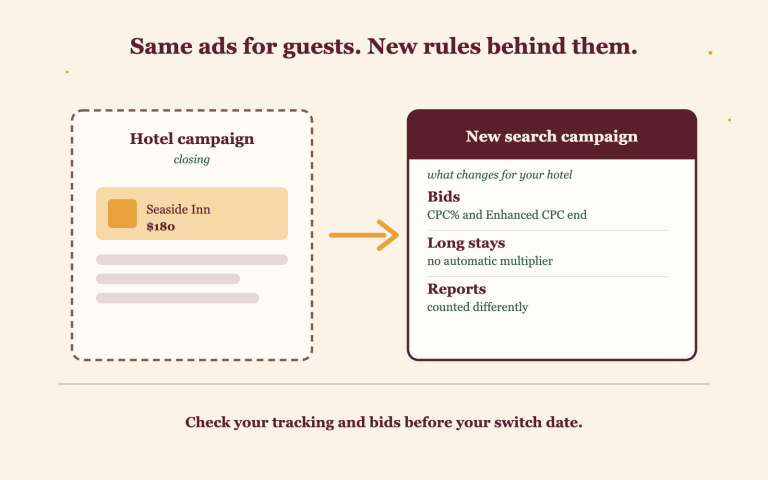
Google Hotel Ads are changing. The campaign type that hotel ads have used for years, called Hotel campaigns, is closing. Your ads will move to a new search campaign that Google calls Search campaigns for Travel.
Guests will still see your price in the same places: the hotel results on Google Search, Google Maps and Google Hotels. What changes is behind the screen: how bids are set, how long stays are priced and how results are counted.
What this post covers
Does this affect you?
It depends on how your hotel shows up on Google today.
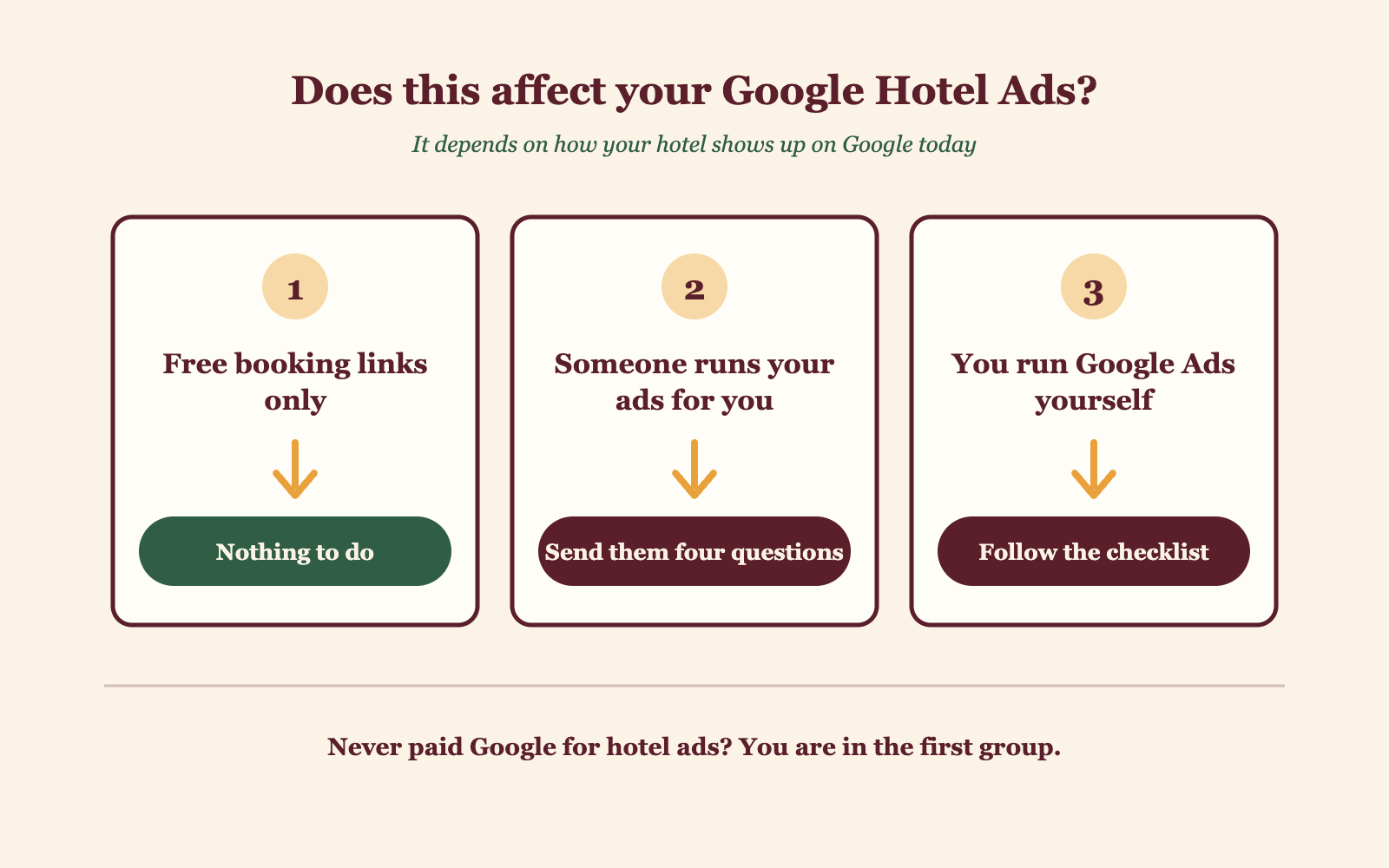
- You only use free booking links. Nothing changes for you. Free booking links are not part of this change.
- Someone runs your Google Hotel Ads for you, such as your booking engine, a channel manager or an agency. This is most hotels. Your job is to ask them the four questions below.
- You run Google Ads yourself. Read the whole post, including the section for whoever runs your ads.
Not sure? Ask whoever looks after your website or bookings. If you have never paid for Google Hotel Ads, you are in the first group.
When it happens
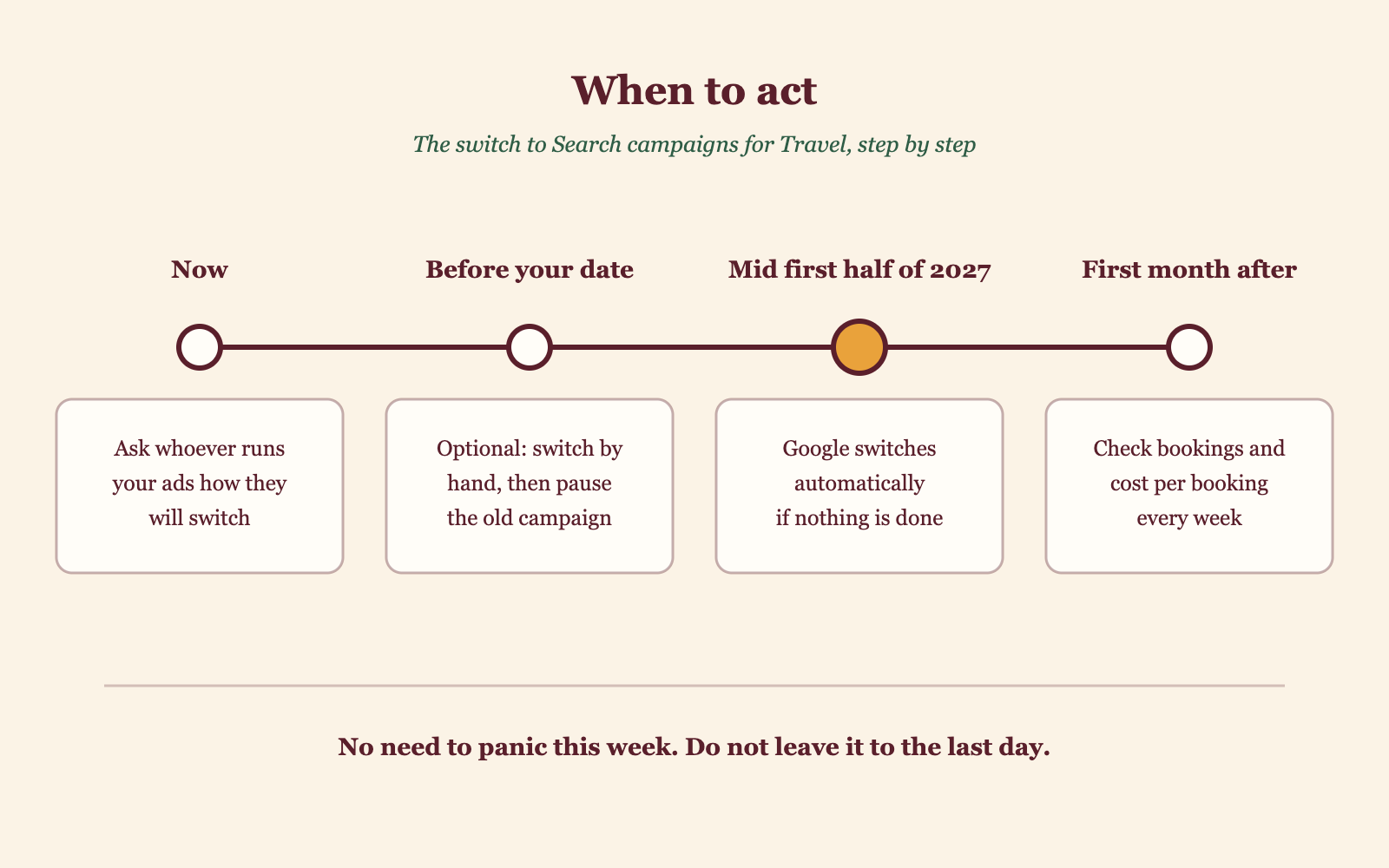
Google’s migration guide says that if nothing is done, the old Hotel campaigns will end and the new campaigns will be created automatically around the middle of the first half of 2027. Google will email each advertiser the exact date closer to the time.
So there is no need to panic this week. But do not leave it to the last day either. Talk to whoever runs your ads in the next few weeks, so you decide how the switch is done instead of finding out afterwards.
There are two ways to switch:
- Automatic: Google ends your old campaign and creates the new one with the closest settings it can. The new campaign starts running on its own.
- By hand, before the date: you or your provider build the new campaign, check it, then pause the old one. Pausing the old campaign stops Google from switching it automatically.
What changes for your hotel
Bids are reset. Many hotels bid as a percentage of the room price. A $200 room with a 3% bid paid up to $6 a click and the bid moved up and down with your rates. This kind of bid is ending. If Google switches your campaign automatically, it becomes a fixed bid per click, set at your average cost per click over the last 30 days. A fixed bid does not rise in your busy season or fall in your quiet season unless someone changes it.
Long stays are bid differently. Until now, a bid was multiplied by the number of nights the guest searched. In the new campaign it is not. To make up for this, Google adds a length-of-stay adjustment when it switches a campaign automatically. If your campaign is rebuilt by hand, someone has to add these adjustments. If nobody does, long stays get much lower bids:
| Old hotel campaign | New search campaign | |
|---|---|---|
| Your bid | $2 | $2 |
| Guest searches for 5 nights | $2 × 5 nights | $2, nights do not count |
| Most you pay for the click | $10 | $2 |
| To bid the same as before | Nothing to do | A 400% adjustment for 5-night stays |
Your Google numbers will look different. Google counts some results in a new way. The numbers in Google Ads will jump on the day of the switch even if nothing real has changed. Judge the new campaign by the bookings in your own booking system, not by the Google Ads screen. Your past results stay in the old campaign.
Will you pay more?
Not necessarily. Your Google Hotel Ads still cost what your bids and budget allow, the same as today. But costs can go up quietly in three ways:
- Google’s AI features in the new campaign can show your ads on more searches than before.
- A fixed bid set at your average can be too high in your quiet season.
- If long-stay adjustments are missing after a switch by hand, you may pay for more short-stay clicks and win fewer long stays.
The number to watch is cost per booking. Say your ads cost $600 last month and brought 12 bookings. That is $50 a booking. If the new campaign spends $750 for the same 12 bookings, each booking now costs $62.50, even though nothing looks wrong on the Google Ads screen.
Two simple protections help. Keep a daily budget you are comfortable with. Then check your cost per booking every week for the first month after the switch.
Four questions to ask whoever runs your ads
Copy these and send them to your booking engine, channel manager or agency:
- Will you switch my Google Hotel Ads by hand before the date, or let Google switch them automatically?
- How do you bid for my hotel today and how will you bid after the switch?
- Will long stays still get a higher bid?
- Does my booking page send each booking back to Google Ads, so you can see which ads bring bookings?
If the answer to the last question is no or not sure, fix that first. Without it, nobody can tell which ads bring bookings.
Words you may hear back
The reply to your questions may use Google’s own terms. Here is what they mean in plain words.
- Booking links: your room price in Google’s hotel results, with a link to your own booking page.
- Sponsored hotel cards: paid hotel listings shown at the top of hotel results. Google also calls them Travel Promotion Ads.
- Hotel Center: the Google account that holds your hotel details, prices and availability. Both paid ads and free booking links use it.
- Price feed: the live connection that sends your rates and availability to Hotel Center, usually through your booking engine or a connected partner.
- CPC%: a bid set as a percentage of the room price. It is ending.
- Enhanced CPC: a fixed bid that Google could raise or lower by itself. It is also ending.
- Manual CPC: a fixed amount you pay per click, which you set yourself.
- Target CPA: Google sets your bids to reach an average cost per booking that you choose.
- Target ROAS: Google sets your bids to reach a return on ad spend that you choose, for example $8 in bookings for every $1 spent. It needs the value of each booking.
- Conversion: an action you count as a result, such as a booking request or an online payment.
- Length-of-stay adjustment: an extra percentage added to your bid for longer stays.
- AI Max: Google’s AI features in the new campaign. They can widen the searches your ads show for, rewrite headlines and choose the landing page.
If a reply still does not make sense, ask your provider to explain it in terms of bookings and cost per booking. Those are the numbers that matter for your hotel.
If your Google Hotel Ads stopped in October
One earlier change caught some hotels by surprise. Until 30 September 2026, Google could fill in a hotel’s price itself, using rates from other sites. Google called these third-party rates. That option has ended and campaigns that depended on it stopped showing in the hotel results.
To show again, your own rates need to reach Google through a price feed, using Hotel Center or a connected partner. The same price feed is what puts your hotel in Google’s free booking links. Our free booking links page explains how that works.
Are Google Hotel Ads still worth paying for?
The switch is a good moment to ask a plain question: do paid hotel ads bring you guests you would not have got anyway?
Many guests who click a hotel ad have already searched for your hotel by name. Some of them would have found your free booking link or your website without the ad. The real value of the ad is the extra bookings it brings, not every booking that passes through it.
A simple test helps. For two or three weeks in a normal period, lower your bids or pause your Google Hotel Ads and keep everything else the same. Compare your direct bookings with the same weeks before. If direct bookings hardly drop, the ads were mostly charging you for guests who were already coming. If they drop a lot, the ads were doing real work.
There is one case where ads on your own hotel name usually pay for themselves: when other sites are bidding on your name. Your own ad then keeps the guest on your booking page. Our comparison of free booking links and hotel ads goes into this in more detail.
For whoever runs your ads
This part is for your agency, booking engine or the person who manages your Google Ads. You can forward it as it is. All points are from Google’s migration guide unless stated.
- Timeline: if no action is taken, active Hotel campaigns end and Search campaigns for Travel are created automatically in mid-H1 2027, with exact dates by email. Only active campaigns are migrated automatically. New campaigns are set to active by default.
- Manual migration: create the new Search campaigns for Travel, then pause the Hotel campaigns to prevent auto-migration. The Google Ads API can also be used.
- Bidding: CPC% and Enhanced CPC are not available. In auto-migration, Enhanced CPC becomes manual CPC with the same bid. CPC% becomes manual CPC set at the entity’s average CPC over the past 30 days. Google recommends Maximise conversions (optional target CPA) or Maximise conversion value (optional target ROAS). Value-based bidding needs booking values in conversion tracking and enough conversions to learn from. (OpenStays note: the OpenStays booking widget sends online payments to Google Ads with the full booking value.)
- Length of stay: final CPC bids are no longer multiplied by the itinerary length. Auto-migration sets length-of-booking adjustments as [length of stay × (1 + original adjustment %)] − 1. CPC% campaigns get adjustments from Google’s length-of-booking calculator. Add these yourself if you migrate by hand.
- Structure and tracking: hotel groups become item groups. Tracking templates and custom parameters move to the ad group level. Search campaigns use parallel tracking, which was optional for Hotel campaigns. Check your URL parameters and booking engine reports after the switch.
- Reporting: sponsored hotel card impressions and impression share are counted differently. History stays in the Hotel campaigns, so export the last 12 to 18 months first, split by ad type, length of stay and days before arrival.
- AI Max and keywords: review final URL expansion and URL exclusions so clicks land on booking pages. Sponsored hotel cards can now be targeted by keyword. Booking links still run from the Hotel Center feed. Review search terms weekly and add negative keywords.
- Hotel Center: check price accuracy, availability and landing pages before the switch.
- After the switch: pause the old campaigns but do not delete them. Compare bookings in Google Ads with bookings in the booking system every week for the first month.
How OpenStays helps
If you would like help moving your Google Hotel Ads to the new campaign, our Google Ads management service can set up your new campaign, choose your bids and manage it for you.
Whoever runs your ads, Google needs to know which clicks became bookings. Ad tracking in your OpenStays dashboard connects your booking widget to Google Ads and Meta. It tells them when a guest makes a booking request, pays online or taps to message you on WhatsApp from your website. You paste one snippet from Google Ads and OpenStays does the rest.
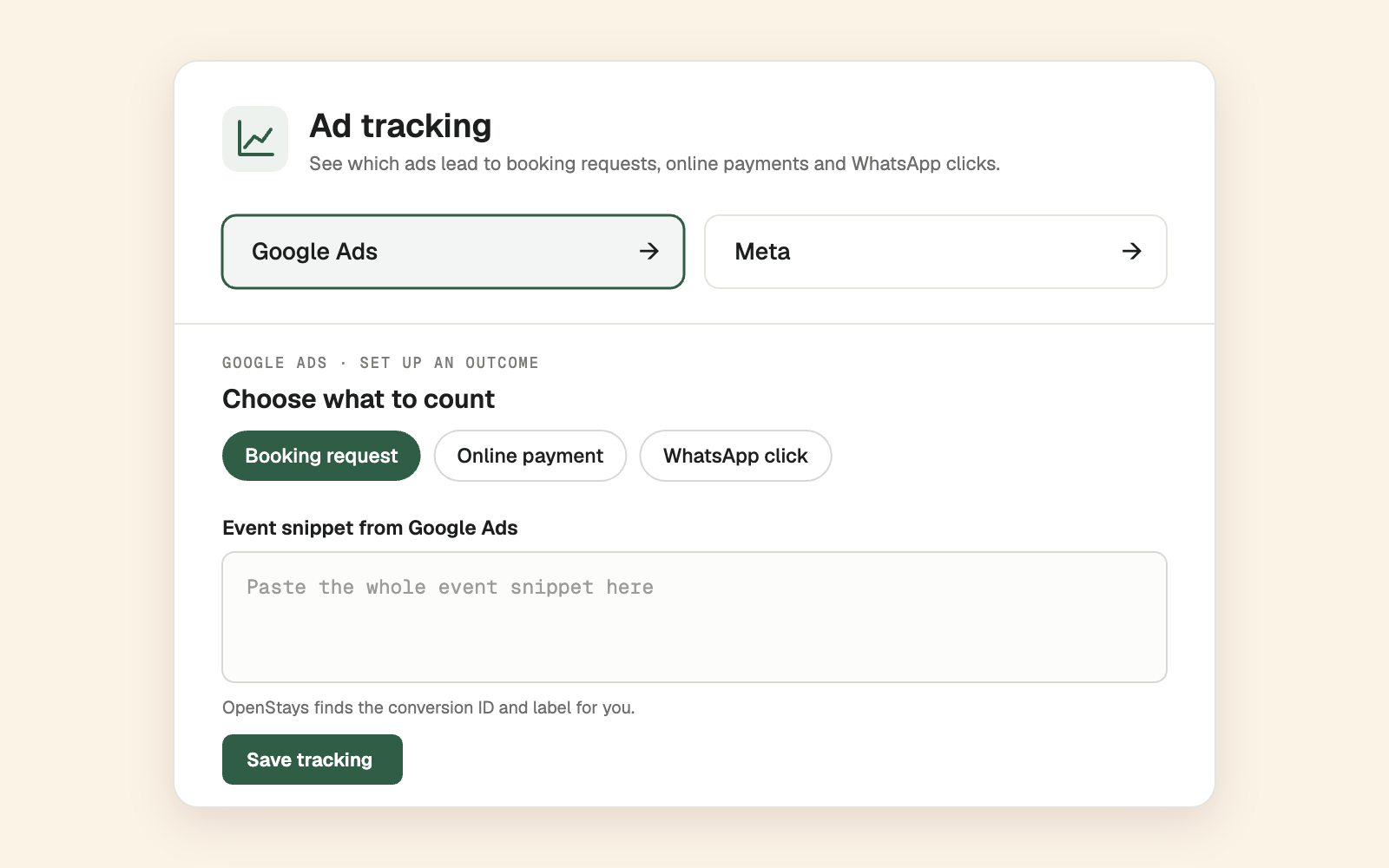
Online payments are sent with the full booking value. This means Google’s bidding by booking value, such as target return on ad spend, can work for your hotel after the switch. With this in place, you can see in Google Ads which ads bring bookings and how much they are worth, before and after the switch. That is the record you need to judge whether the new campaign is working.
The one-line summary
Google Hotel Ads are moving to a new search campaign in the first half of 2027: guests see the same ads, but bids, long stays and reports change, so ask whoever runs your ads how they will handle the switch and judge the result by your own bookings.
Straight questions, straight answers
What is changing in Google Hotel Ads?
Google is closing the separate campaign type used for hotel ads, called Hotel campaigns. Google Hotel Ads will run inside a new type of search campaign called Search campaigns for Travel. Guests see the ads in the same places. The way bids are set, the handling of long stays and the way results are counted all change.
What are Search campaigns for Travel?
Search campaigns for Travel is Google’s new campaign type for travel ads, including Google Hotel Ads. It puts booking links, sponsored hotel cards and text ads in one search campaign, with one budget and one set of reports. Hotel campaigns move to it in the first half of 2027.
When will my Google Hotel Ads campaign switch?
Google’s migration guide says that if nothing is done, Hotel campaigns end and Search campaigns for Travel are created automatically around the middle of the first half of 2027. Google will email the exact date. You can switch earlier by hand.
Do I need to do anything if I only use free booking links?
No. Free booking links are not part of this change. You still need a live price feed through Hotel Center or a connected partner for your price to show.
What happens to percentage bids (CPC%) and Enhanced CPC?
They are not available in the new campaign. In an automatic switch, both become a fixed bid per click. A percentage bid is set at your average cost per click over the last 30 days. Google also adds length-of-stay adjustments. You can choose Google’s automatic bidding instead.
Why did my Google Hotel Ads stop showing in October 2026?
If your campaign used prices that Google filled in from other sites, called third-party rates, it stopped on 30 September 2026. To show again, send your own rates to Google through Hotel Center or a connected partner.
How can I track which Google ads bring bookings?
Create a conversion action in Google Ads, then paste its event snippet into Ad tracking in your OpenStays dashboard. Choose what to count: booking requests, online payments or WhatsApp taps. Online payments carry the full booking value, so Google can bid by booking value.
Image credit: the illustrations are original OpenStays artwork.
Has your hotel heard from Google about the switch yet? Tell us in the comments below what your provider told you to expect.

Leave a Reply