
FOR HOMESTAYS, HOTELS & RESORTS
WhatsApp conversion reports
Response and conversion reports show how fast enquiries actually get answered, how many turn into bookings and where in the conversation guests are dropping off, instead of a general sense that WhatsApp is going fine.
No setup fee. Reports update automatically as conversations happen.
ILLUSTRATIVE FEATURE OVERVIEW
Enquiry reporting
Guest enquiries
Review the incoming conversations
Response activity
See how enquiries are handled
Booking outcomes
Track enquiries through to reservations
Your decisions
Use the reports to improve your follow-up
See what happens after an enquiry
What happens without response and conversion reports
The same data a marketing team would kill for, already sitting inside every conversation your property has this month.
Most properties can say, in general terms, that WhatsApp enquiries are going reasonably well. Replies go out, some guests book, some do not and the overall impression is fine, but almost nobody can answer the more specific version of that question with an actual number.
How many enquiries came in this month is usually a guess. How many of those turned into a confirmed booking is a bigger guess still and how long it typically takes to reply to a new enquiry, the single biggest factor in whether a guest sticks around or messages a competing property instead, is rarely known at all.
The conversation itself hides its own failure points. A guest who asks about dates, gets a reply, asks about the rate, then simply goes quiet, has not cancelled or said no, they have just stopped responding and without something specifically tracking that, the drop-off is invisible until the booking that never happened is long forgotten.
Multiple staff handling WhatsApp enquiries makes the picture even fuzzier. One person might reply within a minute and close half their enquiries into bookings, another might take an hour and rarely convert one and without a report broken down this way, that gap stays completely invisible, even though it is probably the single most fixable thing about the property’s WhatsApp performance.
Shift changes make this worse in a specific, predictable way. An enquiry that arrives just before a handover can sit unanswered for longer than usual, not through anyone’s fault exactly, simply because it falls into the gap between one person’s shift ending and the next person picking up the phone, a pattern that only becomes visible once response times are actually being measured.
Marketing spend adds its own blind spot. A property running Instagram ads or paying for a booking widget on its website has no easy way to see whether enquiries from that channel actually convert better or worse than enquiries that come in through a direct WhatsApp number, so money keeps getting spent without any real evidence of what it is actually producing.
None of this is because owners do not care about their conversion rate. It is because the data genuinely exists, scattered across hundreds of individual WhatsApp conversations, in a form nobody has the time to manually read back through and tally up.
By the time a property notices something feels off, enquiries seem to be drying up, or bookings feel harder to close than they used to, there is no historical record to check against, only a vague sense that something has changed, with no way to say what or when.
A new hire handling enquiries for the first few weeks makes the gap even more obvious in hindsight, without a baseline to compare against, nobody can say whether their response time and conversion rate are actually on par with the rest of the team, or quietly lagging behind in a way nobody has noticed yet.
The problem is not that this data is hard to imagine wanting. Most owners, asked directly, would say they would like to know their conversion rate. The problem is that nothing currently produces that number without hours of manual work nobody has time to do.
A property running seasonal promotions faces a sharper version of the same blind spot. Without a way to see how enquiries responded to a specific offer, there is no real way to tell whether a promotion actually worked or whether that month’s bookings would have happened anyway, at the regular rate.
What flying blind on WhatsApp performance actually costs
The most direct cost is a slow response time nobody can see. Guests comparing a few properties tend to book with whichever one replies first and a property with no visibility into its own response time has no way to know if it is winning or losing that race, enquiry after enquiry.
There is a cost in where training effort goes. Without knowing which staff member converts well and which does not, a manager has no way to identify who could use coaching on handling enquiries and ends up either training everyone the same way or nobody at all.
There is a cost in marketing decisions made on guesswork. A property cannot responsibly increase or cut spend on a channel, Instagram ads, a booking widget, a listing site, without knowing whether enquiries from that specific channel are actually converting, which means budget tends to get allocated on instinct rather than evidence.
There is a cost hidden in the drop-off itself. A guest who goes quiet after asking about the rate represents a specific, identifiable moment where something in the conversation did not land, a price that felt too high, a question left unanswered, a reply that came too slowly and without visibility into where drop-off actually happens, that pattern can repeat indefinitely without anyone noticing.
There is a seasonal cost too. A property cannot tell whether its conversion rate genuinely dips during a slow season, or whether the same enquiries are arriving but simply not being handled as promptly because staff attention is elsewhere, two very different problems that call for very different fixes.
There is a cost in the conversation that never gets reopened. A guest who did not book last month is not lost forever, they represent a specific pool of people who showed real interest, but without a system tracking who those guests actually are, they are indistinguishable from anyone who never enquired at all.
There is a compounding cost across a full year. A conversion rate that is quietly two or three points lower than it could be, multiplied across every enquiry a property receives over twelve months, adds up to a meaningful amount of booking revenue that never gets identified as missing, because nobody had the number to compare it against.
There is a cost in how confidently a property can defend its own performance too. An owner asked by a co-investor or a bank how well the direct booking channel is actually converting has nothing more concrete to offer than an impression, when a specific, trackable number would make that conversation considerably easier.
There is also a cost in how a genuinely good month gets understood. A property that has an unusually strong month of bookings has no way to tell whether that came from a real improvement in how enquiries were handled, worth repeating deliberately, or simply a lucky run of easy, high-intent guests that happened to land in the same few weeks.
What response and conversion reports actually give you
Every WhatsApp enquiry a property receives is tracked automatically from the moment it arrives, through however many replies it takes, to whichever outcome it ends in, a confirmed booking or a conversation that goes quiet.
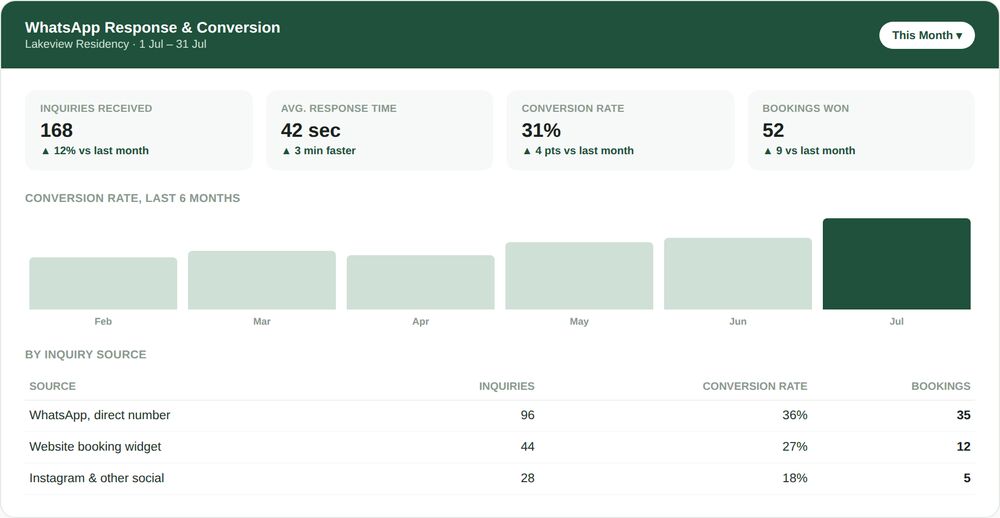
Inquiries, response time, conversion rate and bookings won, tracked automatically and broken down by source.
The headline numbers are always visible at a glance, how many enquiries came in, how quickly they were typically answered, what share turned into a booking and how many bookings that represents, for whatever period a property wants to look at.
Below that sits a breakdown by source, so a property can see whether enquiries arriving through its direct WhatsApp number convert differently than ones coming from the website booking widget or from Instagram, real evidence rather than a guess about where marketing effort is actually paying off.
None of this requires anyone to manually track or tally anything. Every enquiry, every reply and every outcome is already captured as it happens, the report simply organises what was already there into numbers an owner can actually use.
What a response and conversion reports setup actually covers
Response time, tracked automatically
See exactly how quickly enquiries are typically answered, overall and broken down by whoever is handling them, without anyone timing it manually.
Conversion rate you can actually trust
Know what share of enquiries turn into confirmed bookings, for any period, rather than a general impression of how things are going.
Broken down by inquiry source
Compare how enquiries from WhatsApp, the website widget or social channels actually convert, so marketing decisions rest on evidence.
See exactly where guests drop off
A conversation funnel shows how many enquiries make it from a first reply through to dates discussed, a rate quoted and a booking confirmed.
SEE IT IN ACTION
Lakeview residency finds out where its bookings are actually being lost
Lakeview Residency has always assumed its WhatsApp enquiries convert reasonably well, without ever having an actual number to check that assumption against. At the end of July, the owner opens the response and conversion report for the first time and finally has one.
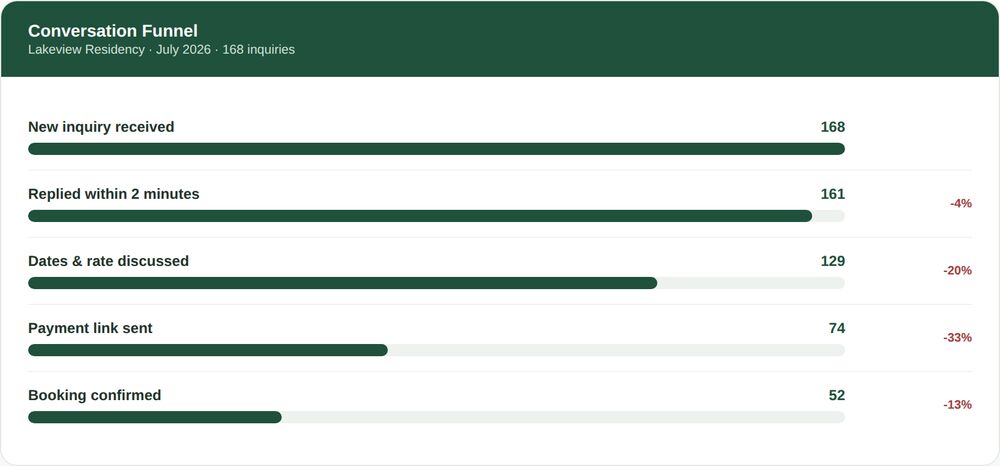
Of 168 enquiries in July, the steepest drop happens right after the rate is discussed, before a payment link even goes out.
The month started with 168 enquiries and the funnel shows exactly where they thinned out. Almost all of them, 161, got a reply within two minutes. By the time dates and rate had been discussed, that number had dropped to 129 and by the time a payment link actually went out, only 74 remained, the single steepest drop in the entire funnel.
That gap, between discussing a rate and sending a payment link, is exactly the kind of thing that would have stayed invisible without the report. It suggests guests are asking about price, hearing an answer and then a meaningful number of them are not moving forward, a pattern worth investigating rather than a vague sense that some enquiries just do not pan out.
The breakdown by source adds a second insight. Enquiries coming in through the direct WhatsApp number convert at 36 percent, noticeably higher than the 18 percent conversion rate from Instagram and other social enquiries, useful evidence the next time a decision comes up about where to put marketing effort.
The owner brings the payment link drop-off to the next team check-in and the property starts testing a small change, sending the payment link immediately alongside the quoted rate instead of waiting for the guest to ask for it. It is a specific, testable fix, the kind that only becomes obvious once the funnel actually shows where enquiries are being lost.
Mistakes properties make without this visibility
- Assuming WhatsApp enquiries are converting well based on a general feeling, rather than an actual, checkable number.
- Having no idea how quickly enquiries typically get answered, even though response speed is one of the biggest factors in whether a guest books.
- Treating every staff member’s enquiry handling as equivalent, with no way to see who converts well and who could use coaching.
- Spending on marketing channels with no evidence of whether enquiries from that specific channel actually convert into bookings.
- Never noticing where in a conversation guests typically go quiet, so the same drop-off point keeps costing bookings indefinitely.
- Losing track of guests who enquired and did not book, treating them the same as someone who never showed interest at all.
- Only reacting to a slow month after it is already over, rather than noticing a dip in response time or conversion while it is still happening.
None of these come from a property not caring about its numbers. They come from the numbers genuinely not existing anywhere, scattered across individual WhatsApp threads with no practical way to add them up by hand.
Even a property that genuinely wanted to fix this by hand runs into the same wall eventually, reading back through a month of conversations to manually count enquiries, replies and outcomes takes far longer than the insight would be worth, so the attempt tends to get abandoned after the first busy week.
The same tracking, every conversation, every day
Every enquiry gets tracked the same way regardless of which staff member handles it, what time of day it arrives, or which channel it came in through. Nothing depends on someone remembering to log it or note it down somewhere.
It holds up across busy and quiet periods equally. A property does not need to do anything differently during a rush of festival season enquiries versus a slow Tuesday in the off season, the same numbers keep accumulating automatically either way.
For a group running more than one property, each location’s response time and conversion rate are tracked and visible independently, so a manager overseeing several properties can see at a glance which one is performing well and which one might need attention.
This consistency is what makes the numbers actually trustworthy. A report that only sometimes captures an enquiry, or that depends on manual logging by a busy staff member, would not be a report anyone could confidently make decisions from.
It also means a comparison between two staff members, two properties, or two months, is always a fair, like-for-like comparison, built from data captured the exact same way each time, rather than one period being more thoroughly logged than another purely by chance.
Who actually uses this data
An owner running a property personally gets a direct, practical use for it, a clear answer to how the business is actually performing on its busiest enquiry channel, without relying on gut feel or a vague monthly impression.
A manager overseeing a front desk or reservations team benefits from the staff-level breakdown specifically, seeing who responds fastest and who converts best turns coaching from a guess into something grounded in actual numbers.
Someone responsible for marketing spend, whether that is the owner personally or a hired consultant, gets a genuinely useful evidence base, knowing which channel’s enquiries actually convert changes how a budget gets allocated the next time it is reviewed.
A property working with an accountant or a co-owner not involved in daily bookings benefits too, conversion and response numbers give a concrete, checkable way to discuss how the direct booking side of the business is actually trending, separate from occupancy or revenue alone.
A property planning to grow, adding a second location or hiring additional staff to handle enquiries, benefits from having a proven baseline first, a clear sense of what good response time and conversion actually look like before scaling the same process across more people or more properties.
Anyone training a new front desk or reservations hire benefits directly too, response and conversion reports give a concrete, current benchmark to train against, rather than a vague instruction to reply quickly and be helpful, with no actual number attached to what quickly or helpful should mean in practice.
A property considering whether to invest in a paid booking widget, a listing site subscription, or a new ad channel gets a clearer basis for that decision too, comparing the conversion rate of enquiries already coming through similar sources gives a reasonable estimate of what a new channel might actually be worth before spending anything on it.
How this fits with the rest of OpenStays
Revenue and occupancy reports show what a property actually earned and how full it was. Response and conversion reports sit one step earlier in that same story, showing how well enquiries are being turned into the bookings that later show up in those revenue figures.
Every enquiry tracked this way runs through the same conversations covered by AI WhatsApp concierge and rate negotiation, so a property already using either of those sees the resulting response time and conversion improvements reflected directly in this same report. Who can view these reports is controlled the same way as everything else, under staff logins with roles and for a group managing more than one location, reporting extends cleanly through multi-property management.
Response and conversion reports vs. The alternatives
Most properties compare this against whatever they currently use to judge WhatsApp performance, usually a general impression, or manually scrolling back through conversations to try to reconstruct a rough sense of how things went.
| General impression | Manually reviewing chats | Response and conversion reports | |
|---|---|---|---|
| Actual response time, not a guess | No | Only if reconstructed by hand | Yes, tracked automatically |
| A real conversion rate for any period | No | Very slow to calculate manually | Yes, instantly |
| Shows where guests drop off | No | Possible, but extremely time consuming | Yes, in the conversation funnel |
| Breaks results down by staff member or source | No | Rarely and error prone | Yes, for any period |
| Setup effort | None, but no real visibility either | High and never kept up consistently | None, tracked from the first enquiry |
GETTING STARTED
Setting up response and conversion reports
How to set up response and conversion reports on OpenStays.
1. Nothing to configure to start
Every WhatsApp enquiry is tracked automatically from the moment it arrives, so the report starts filling in from day one without any setup.
2. Choose the period to review
Look at this week, this month, or any custom date range, to see enquiries, response time and conversion for exactly that window.
3. Check the breakdown by source
See how enquiries from the direct WhatsApp number, the website widget or social channels compare, to inform where marketing effort goes.
4. Review the conversation funnel
See exactly how many enquiries make it from a first reply through to a confirmed booking and where the steepest drop happens.
5. Revisit regularly, not just at month end
Check in on response time and conversion through the month, so a dip gets noticed while it is still happening, not after.
What to check in any WhatsApp reporting setup
- Does it track response time automatically, or does someone need to manually time and log replies?
- Can you see conversion rate broken down by staff member, to know who might benefit from coaching?
- Can you see conversion rate broken down by inquiry source, to make evidence-based marketing decisions?
- Does it show where in a conversation guests typically drop off, or just a final conversion number with no detail behind it?
- Is the data available for any custom period, or only fixed monthly snapshots?
- Does this work the same way across every property, if the account covers more than one location?
A setup that cannot answer these clearly is really only offering a single top-line number, without the detail that actually makes it useful for improving anything.
It is also worth checking how far back the data goes. A report that only shows the current month is of limited use for spotting a genuine seasonal pattern, while one that retains history across a full year makes it possible to tell a real trend apart from ordinary, expected variation.
A quick way to test this in practice is to pick last month’s slowest week and last month’s busiest week and compare response time and conversion rate across the two. A system worth trusting should be able to answer that comparison in seconds, not require pulling anything together by hand.
It is worth testing this against a real, specific question rather than taking a features list at face value. Ask, right now, what the property’s actual conversion rate was last month and how it compares to the month before. If that answer requires reconstructing anything by hand, that gap is exactly what this closes and it pairs naturally with what already shows up in revenue and occupancy reports.
What actually gets measured and how
Response time is measured from the moment a new enquiry arrives to the first reply it receives, whether that reply comes from a staff member or an automated response and is averaged across whatever period is being reviewed.
Conversion is measured against confirmed bookings specifically, not just a conversation that trails off politely or a guest who says they will think about it. A booking has to actually be confirmed for an enquiry to count as converted.
The conversation funnel breaks a full enquiry down into the stages that matter, replied to, dates and rate discussed, a payment link sent and finally a confirmed booking, so a property can see exactly which stage loses the most enquiries rather than only knowing the final outcome.
Enquiries are attributed to a source automatically, based on how the conversation began, a direct WhatsApp message, a click from the website’s booking widget, or a link shared on social media, so the source breakdown does not depend on anyone tagging conversations by hand.
None of this requires a property to change how it actually handles enquiries. The same conversations that were always happening on WhatsApp are simply measured as they go, with nothing different for staff or guests to do.
An enquiry that starts through one channel and continues through another, a guest who first messages after clicking an Instagram link and later calls the direct WhatsApp number, is still tracked back to its original source, so switching channels partway through does not distort where the enquiry actually gets credited.
Historical data stays available as further months accumulate, so a property can compare this month against the same month a year earlier, useful for a seasonal business trying to tell a genuine trend apart from ordinary month to month variation.
A conversation that eventually converts after a longer back and forth, several days of questions before a guest finally confirms, still counts correctly, response time and funnel stage are measured at each individual reply, not assumed from how the conversation eventually turned out.
Frequently asked questions
What exactly do response and conversion reports measure?
How quickly WhatsApp enquiries get answered, what share turn into confirmed bookings and where in the conversation guests tend to drop off.
Do I need to set anything up before the data starts appearing?
No, every enquiry is tracked automatically from the moment it arrives, so the report fills in from day one.
Can I see conversion rate by individual staff member?
Yes, response time and conversion can be broken down by whoever is handling the conversation.
Can I compare enquiries from different sources?
Yes, enquiries are attributed automatically to their source, WhatsApp, the website widget or social channels, so conversion can be compared across them.
What counts as a conversion?
A confirmed booking specifically, not just a conversation that trails off or a guest who says they will think about it.
Can I choose a custom date range instead of a fixed month?
Yes, any period can be selected, from a single week to a full year.
Does this work if multiple staff members share the same WhatsApp number?
Yes, replies are attributed to whoever sends them, so the breakdown by staff member still works correctly.
Can I see where guests typically stop responding?
Yes, the conversation funnel shows how many enquiries make it through each stage, so the steepest drop-off point is visible.
Is historical data kept for comparison?
Yes, past months remain available, useful for comparing a given month against the same period a year earlier.
Does this cover enquiries from OTAs as well as WhatsApp?
This specifically tracks WhatsApp conversations, the channel most direct enquiries actually come through.
Can I see this broken down for each property in a group?
Yes, each property’s response time and conversion are tracked and visible independently within the same account.
Who can view these reports?
That depends on the role assigned under staff logins with roles, viewing reports can be given without extending further access.
Does slow response time actually affect conversion in a measurable way?
The report makes that relationship visible for your own property specifically, rather than relying on a general assumption.
Can this help decide where to spend on marketing?
Yes, seeing which source’s enquiries actually convert is exactly the evidence that decision needs.
What changes in the first month
There is nothing to set up, so the very first month already produces a real report, response time, conversion rate and a conversation funnel built entirely from enquiries that were happening anyway.
The first genuinely useful moment tends to come the first time an owner actually opens the report and sees a real conversion rate for the first time, often confirming a suspicion, or occasionally revealing that performance is noticeably better or worse than assumed.
A quieter change follows once the drop-off point becomes visible. A property that notices enquiries stalling right after the rate is quoted has an actual, specific thing to investigate and fix, rather than a vague sense that some enquiries just do not convert.
By the second or third month, most owners describe a similar shift, decisions about staffing, response habits and even marketing spend start referencing an actual number instead of a guess and conversations about WhatsApp performance become concrete rather than impressionistic.
For a property heading into its first peak season with this visibility in place, the advantage compounds, a dip in response time or conversion gets noticed while the season is still underway, early enough to actually do something about it, rather than only being obvious in hindsight once the season has already passed.
A year in, response and conversion reports tend to have quietly become one of the numbers an owner checks out of habit, alongside occupancy and revenue, simply because it answers a question that used to be genuinely unanswerable, how well is the property actually doing at turning interest into bookings.
Some of the most useful moments come from small surprises along the way, a staff member nobody thought of as especially strong on WhatsApp turning out to have the best conversion rate on the team, simply because they happen to reply fastest, a pattern that would have stayed completely invisible without the numbers to show it.
See exactly how your WhatsApp enquiries turn into bookings
No setup fee. Reports update automatically as conversations happen.