
FOR HOMESTAYS, HOTELS & RESORTS
WhatsApp AI upsells
WhatsApp AI upsells let a guest browse and book add-ons like breakfast, late checkout, a spa slot or an airport pickup right inside the same chat, priced and billed automatically, without anyone at the property having to ask.
No setup fee. No commission on what you already sell.
ILLUSTRATIVE FEATURE OVERVIEW
Configured add-ons
Your services
Choose the extras you offer
Your prices
Set the rates and availability
Guest conversation
Offer eligible options in context
Reservation
Keep accepted extras with the stay
Offer the extras guests can book
What happens without a way to offer add-ons in the moment
Every add-on you already offer, just easier for a guest to actually say yes to, at the exact moment they are thinking about it.
Most properties have a real list of things they can offer beyond the room, breakfast, a late checkout, an airport pickup, a spa session, a candlelight dinner on the lawn. The list usually exists somewhere, on a laminated card in the room or in the owner’s head, but it rarely reaches the guest at a moment when saying yes is actually easy.
A guest who might happily pay for breakfast tomorrow morning has to think to ask about it, find someone to ask and then wait for an answer, three small pieces of friction stacked on top of what would otherwise be a quick, easy decision.
The reverse is just as common, staff know a guest might want something, an anniversary couple who could be offered a room upgrade, a family who might want an early check-in, but there is no natural, non-awkward moment to bring it up without it feeling like a sales pitch.
Pricing adds its own friction. If an add-on’s price is not immediately obvious, the conversation stalls while someone checks, quotes a number and waits for a decision, by which point the guest has often moved on mentally to something else, or checked out for the day already.
None of this is because staff are not trying. It happens because upselling depends on a member of staff noticing the right moment, remembering the full list of what is available and having a quick way to confirm and bill it, three things that are hard to do consistently across every single guest, every single day.
Peak season makes it worse rather than better. Exactly when a property is busiest and has the most guests who might say yes to an add-on, is exactly when staff have the least spare attention to notice the moment and start that conversation.
A guest who never gets asked simply never says yes, not because they would have said no, but because the opportunity to say anything at all never actually reached them.
Language and confidence add a smaller but real friction of their own. A guest more comfortable typing than speaking, or simply shy about asking what something costs, is even less likely to bring up an add-on out loud, which quietly rules out an entire group of guests who might otherwise have said yes without hesitation.
Timing works against a property too. The moment a guest is actually thinking about breakfast is usually late at night, planning the next day, or first thing in the morning, rarely exactly when a staff member happens to be standing nearby with the full list of options ready to offer.
What missed add-on moments actually cost
The most direct cost is straightforward, revenue the property was fully capable of earning simply never gets asked for. A breakfast a guest would have paid for, a late checkout they would have valued, a spa slot that goes unbooked, all represent real, already-available revenue that depended entirely on someone remembering to offer it.
There is a margin cost specifically, add-ons like breakfast, a spa session or a late checkout tend to carry a healthier margin than the room rate itself, so missing them is not just missed revenue, it is missed revenue of a particularly valuable kind.
There is a consistency cost. One staff member might be a natural at mentioning the breakfast add-on to every guest at check-in, while another never thinks to bring it up at all, which means how much a property earns from add-ons ends up depending heavily on who happens to be on duty.
There is a guest experience cost too, one that runs the other way. A guest who genuinely wanted an airport pickup or a late checkout and never found an easy way to ask for it ends up mildly inconvenienced by something the property could easily have provided, if only the option had been surfaced at the right time.
There is a scaling cost for a property that grows. A single owner personally remembering to mention add-ons to every guest is workable at a small scale. A property with more rooms, more staff and more guests per day cannot rely on the same personal habit holding up consistently across every shift.
There is a peak season cost that compounds the rest, the exact days when a property has the most guests and therefore the most add-on revenue sitting on the table, are the days when staff have the least time to individually offer anything to anyone.
There is a quieter cost in what a guest assumes. A guest who is never offered breakfast simply assumes it is not available at all, rather than assuming it exists but nobody mentioned it, so a missed upsell moment can look, from the guest’s side, exactly like a missing amenity.
There is a competitive cost too, one that is easy to overlook. A guest comparing two similar properties is quietly more impressed by the one that made saying yes to breakfast or a late checkout effortless, even if the other property offered exactly the same things, just less visibly.
What WhatsApp AI upsells actually give you
A property sets up its list of add-ons once, breakfast, late checkout, airport pickup, a spa session, whatever it actually offers, along with the price for each. From then on, the AI already knows what to offer and what it costs, without anyone needing to check or quote it fresh each time.
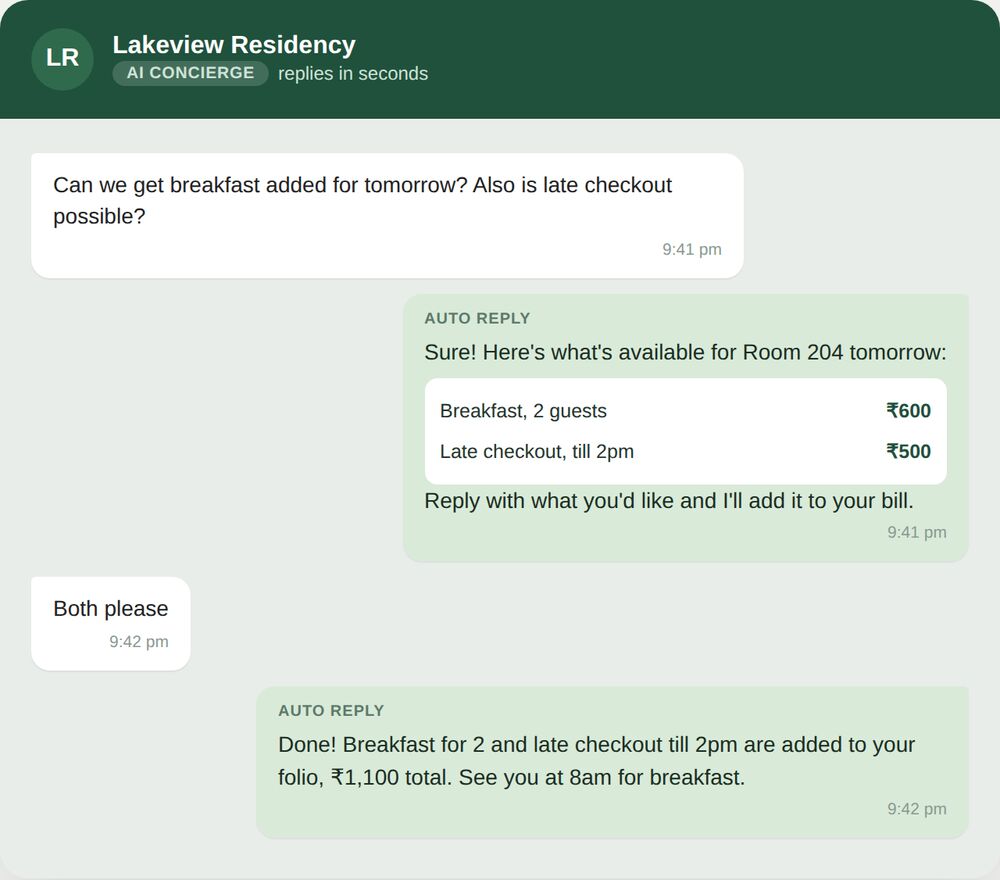
A guest asks a simple question and gets a priced menu back immediately, confirmed and billed in the same reply.
When a guest asks about something, or when the moment naturally comes up in conversation, the AI shares the relevant options with their price, right there in the chat. A guest confirms what they want in plain language and it gets added to their bill automatically, no separate form, no waiting for someone to check availability or come back with a number.
Nothing about this replaces a genuine human recommendation. A staff member can still personally suggest something special, the AI simply makes sure the easy, obvious asks, the ones a guest was already halfway inclined to say yes to, never quietly go unanswered because nobody happened to be free to respond.
What a WhatsApp AI upsells setup actually covers
Add-ons priced and ready
Set your list of add-ons and their prices once and the AI has them ready to offer correctly in any conversation, without anyone needing to check or quote them fresh.
Confirmed and billed instantly
A guest’s yes gets added straight to their folio in the same reply, with nothing for staff to manually enter or reconcile later.
Offered at the moment that matters
The AI can surface a relevant add-on when a guest is already asking a related question, rather than waiting for a staff member to notice the opening.
Every add-on tracked automatically
Every accepted add-on is recorded against the booking, so a property can see exactly what guests are actually saying yes to and how much it is worth.
SEE IT IN ACTION
Lakeview residency turns a wifi question into extra revenue every week
Lakeview Residency has always offered breakfast, a spa session, an airport pickup and a late checkout, all genuinely available, all quietly under-sold because front desk staff simply did not have a natural moment to mention them to every single guest.
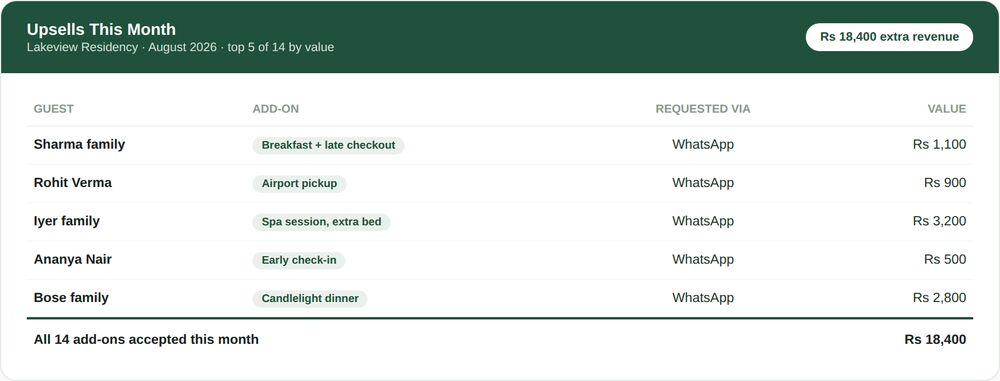
Fourteen add-ons accepted this month, each one requested and confirmed entirely inside WhatsApp.
A guest checking in messages to ask if breakfast can be added for the next morning and separately whether a late checkout is possible. The AI replies with both options priced clearly, ₹600 for breakfast and ₹500 for a late checkout until 2pm and the guest confirms both in one short reply. The whole exchange takes under a minute and never once involves a staff member.
By the end of the month, the owner opens the account and sees fourteen add-ons accepted this way, worth ₹18,400 in extra revenue, spa sessions, airport pickups, an early check-in, a candlelight dinner, each one requested by a guest who simply asked a question and got a clear, priced answer back immediately.
None of these guests were pressured into anything. Each one asked a fairly ordinary question, about breakfast, about checkout timing, about what else was available and the AI simply made sure the answer included exactly what the property could actually offer, at a price the guest could accept on the spot.
A few weeks later, the owner notices that airport pickup requests have become one of the more consistent add-ons on the list, something that was always offered but rarely actually booked before, simply because guests now see it mentioned naturally whenever they ask about arrival or departure logistics.
Mistakes properties make with informal upselling
- Relying on staff to remember and mention every add-on personally, so how much gets offered depends entirely on who is on duty that day.
- Leaving prices for add-ons undecided until a guest actually asks, so a simple question turns into a delay while someone checks.
- Only offering add-ons at check-in and missing the moments mid-stay when a guest is actually most likely to want one.
- Having no record of which add-ons guests actually say yes to, so there is no way to tell which ones are worth promoting more.
- Assuming a guest who does not ask is not interested, rather than a guest who was simply never given an easy way to ask.
- Losing track of an accepted add-on between the conversation and the final bill, so it never actually gets charged.
- Treating every guest the same regardless of what they have already shown interest in, rather than offering what is actually relevant to them.
None of these come from a lack of things to sell. They come from an upsell process that depends on a busy staff member noticing the right moment, remembering the full list and following through, for every guest, every single day.
Some of these mistakes compound each other in ways that are easy to miss. A property that has never tracked which add-ons sell also has no clear signal for which ones are worth improving or promoting harder, so the same underperforming offer can sit quietly on the list, unchanged, for years.
A newer property especially tends to default to the safest option, offering nothing beyond the room at all, simply because building out a proper add-on menu and a reliable way to sell it feels like more setup than it is actually worth for the handful of guests likely to ask directly.
The same offer, whoever is on duty and however busy the day is
The AI offers the same add-ons at the same prices regardless of who is working that shift, or how busy the property is at that particular moment. A guest checking in during the calmest hour of the week gets exactly the same opportunity to say yes as one arriving in the middle of a fully booked Saturday.
It does not depend on a staff member happening to remember the full list either. Every add-on the property has set up is available to be offered correctly, every time, without anyone needing to have it memorised or written down nearby.
For a group running more than one property, each location’s add-ons and pricing are set independently, so a resort’s spa and dinner options never accidentally get offered at a homestay that has neither and each property’s guests see only what is genuinely available to them.
This consistency is what actually grows add-on revenue over time, rather than leaving it dependent on a handful of especially attentive staff members. Every guest gets asked, not just the ones lucky enough to arrive when someone had a spare moment to mention it.
It holds up outside normal working hours too. A guest messaging late at night to ask about breakfast the next morning gets the same clear, priced answer as one asking at midday, without a night shift worker needing to know the full add-on list by heart.
Who actually benefits from this
An owner running a homestay personally gets a direct benefit, add-on revenue that used to depend entirely on remembering to mention things at check-in now happens whether or not the owner is free to bring it up in person.
A manager running a hotel or resort with a front desk team benefits from the consistency more than anything else, add-on revenue is no longer shaped by which staff member happens to be working a given shift and newer staff do not need to be trained on the full list before they can sell it well.
A guest benefits in a fairly simple way, a genuine question gets a clear, priced answer immediately, rather than a vague response and a wait while someone checks, which tends to make the guest more likely to say yes in the moment rather than letting the idea drop.
A guest travelling with family or a larger group benefits particularly, since add-ons that apply to the whole party, extra beds, additional breakfasts, a bigger airport pickup, can be confirmed for everyone in one exchange rather than negotiated item by item at the desk.
A property that has grown past a size where the owner personally handles every guest interaction gets a particular benefit, add-on revenue stops being tied to any one person’s attentiveness and instead becomes a reliable, visible part of the property’s numbers.
A property working with an accountant or a co-owner not involved day to day benefits too, add-on revenue is tracked automatically against each booking, so answering how much of this month’s income came from extras beyond the room rate is a lookup, not a guess.
A property just starting to build out its list of add-ons benefits from a lower-pressure way to test what actually appeals to guests, WhatsApp AI upsells make it easy to see which offers get accepted and which barely get asked about, information that is otherwise difficult to gather from casual, in-person conversations alone.
A property that already runs a strong personal, high-touch style of hospitality benefits too, in a way that might not be obvious at first. Handling the routine, easy-to-answer add-on questions this way frees up exactly the kind of personal attention and warmth that guests actually remember, for moments that genuinely call for it.
How this fits with the rest of OpenStays
AI WhatsApp concierge handles the everyday questions a guest asks during a stay, wifi, checkout time, local recommendations. WhatsApp AI upsells sit inside that same conversation, so a question about checkout time can turn into an accepted late checkout add-on without the guest ever needing to switch channels or start a new conversation.
Every add-on accepted this way flows into the same booking record used across the account, visible alongside the rest of a stay’s detail in the hotel reservations dashboard and rolls up into revenue and occupancy reports the same way any other charge does. What a specific guest has already shown interest in is visible in their guest CRM record too, useful context the next time they stay.
WhatsApp AI upsells vs. The alternatives
Most properties compare this against how they currently handle add-ons, either relying on staff to mention them personally, or a printed card left in the room that a guest may or may not notice.
| Staff mention it personally | A printed card in the room | WhatsApp AI upsells | |
|---|---|---|---|
| Offered to every guest, consistently | Depends on who is on duty | Only if the guest reads it | Yes, every time |
| Answers a question with a price immediately | Only if staff know the price offhand | No, static information only | Yes, instantly |
| Confirmed and billed without extra steps | Manual, staff have to remember | No, requires a follow-up conversation | Yes, automatically |
| Tracked so you know what sells | Rarely, hard to reconstruct | No | Yes, for any period |
| Setup effort | None, but relies on memory | Low, but easy to ignore | A few minutes per add-on, once |
GETTING STARTED
Setting up WhatsApp AI upsells
How to set up WhatsApp AI upsells on OpenStays.
1. List your add-ons
Add each add-on the property genuinely offers, breakfast, late checkout, airport pickup, spa, or anything else, with a short description.
2. Set a price for each
Enter what each add-on costs, so the AI can quote it correctly without checking with anyone.
3. The AI offers them naturally
When a guest asks a related question, or the moment fits, the AI shares the relevant, priced options in the same conversation.
4. A guest confirms in plain language
They simply say yes to what they want and it is added to their bill without any extra steps.
5. Review what sold and adjust
See which add-ons guests actually accept and update pricing or offerings based on what the data actually shows.
What to check in any WhatsApp AI upsells setup
- Are add-ons offered to every guest consistently, or does it still depend on which staff member happens to be on duty?
- Does a guest get a clear price immediately, or does a question still trigger a delay while someone checks?
- Is an accepted add-on billed automatically, or does it depend on someone remembering to enter it later?
- Can you see which add-ons actually sell and for how much, over any period?
- Does this work the same way across every property in a group, with each one’s own add-ons and pricing?
- Does saying yes to an add-on feel like a natural answer to a question, rather than a sales pitch the guest did not ask for?
A setup that cannot answer these clearly is really still relying on staff memory and attention, just with an extra step layered on top, rather than actually solving the problem of missed add-on revenue.
It is also worth checking whether pricing can be adjusted without a lengthy setup process each time. A property that wants to test a slightly higher spa price during peak season, or offer a discounted late checkout on quieter weekdays, needs that flexibility to actually be simple, not a reason to leave prices untouched indefinitely.
It is worth testing this against a real week rather than taking a features list at face value. Pick a recent week and try to answer, honestly, how many guests were offered breakfast, a late checkout or an airport pickup and how many said yes. If that number is hard to reconstruct, that gap is exactly what this closes and it is worth checking against actual figures in revenue and occupancy reports rather than a guess.
What actually happens when a guest says yes
When a guest asks about an add-on, or the AI recognises a natural moment to mention one, it shares the relevant options with their price directly in the conversation, drawn from exactly what the property has set up, nothing invented or approximated.
A guest confirming in ordinary language, both please, or just breakfast is fine, is enough. The AI adds the accepted add-on to the guest’s folio immediately, without a separate form or a follow-up message needed from either side.
If a guest asks for something that is not actually available, the AI says so plainly rather than guessing or improvising and can point to what is available instead, so a guest is never told yes to something the property cannot actually deliver.
Every accepted add-on stays attached to the booking through its full record, visible in the guest’s final bill and in whatever reporting the property pulls later, so nothing agreed over WhatsApp quietly disappears before checkout.
A property can update its add-on list or pricing at any time and the change applies to conversations from that point forward, while add-ons already confirmed under the old price stay exactly as they were agreed.
None of this requires a guest to know this is an AI feature at all. It simply reads, from the guest’s side, like a fast, well informed reply to a completely ordinary question about what is available during their stay.
A property can also review a running total of accepted add-ons at any point in a stay, not just at checkout, which makes it easy to see, mid-stay, whether a guest has already said yes to enough extras that a personal thank-you or a small additional gesture might be worth offering.
Frequently asked questions
What are WhatsApp AI upsells exactly?
A way for a guest to browse, ask about and confirm paid add-ons like breakfast or a late checkout directly inside a WhatsApp conversation, priced and billed automatically.
What kind of add-ons can be offered this way?
Anything the property genuinely provides, breakfast, late checkout, airport pickup, spa sessions, extra beds, or any other paid extra.
Does the guest need to ask, or can the AI bring it up first?
Both, it answers direct questions with priced options and can also mention a relevant add-on when the moment naturally fits the conversation.
How does an accepted add-on get billed?
It is added to the guest’s folio automatically the moment they confirm, with nothing for staff to manually enter.
Can I change prices after they are set?
Yes, at any time and the new price applies to conversations from that point forward, while anything already confirmed keeps its original price.
What if a guest asks for something the property does not offer?
The AI says so clearly and can suggest what is actually available, rather than guessing.
Can I see which add-ons are actually selling?
Yes, accepted add-ons are tracked by guest, type and value, visible for any period.
Does this work differently for a resort with more add-ons than a homestay?
No, each property sets up its own list and pricing and the AI only ever offers what that specific property actually has.
Can a staff member still personally suggest something special?
Yes, this does not replace a genuine human recommendation, it makes sure the obvious, easy asks never go unanswered.
Is there a limit to how many add-ons I can list?
No, a property can list as many add-ons as it genuinely offers.
Does a guest need to speak to a person to confirm an add-on?
No, confirming in the WhatsApp conversation is enough, the same thread they are already using.
Can add-ons be different for different room types?
Add-ons are generally set at the property level, though pricing can reflect what makes sense for the stay.
What happens if a guest changes their mind after confirming?
A staff member can remove or adjust it from the booking the same way any other charge would be corrected.
Does this work for group bookings?
Yes, each guest or the person managing the group booking can request add-ons the same way.
Can front desk staff see which add-ons a guest has accepted?
Yes, accepted add-ons are visible against the booking in the reservations dashboard.
Is this available across every property in a multi-property account?
Yes, each property manages its own add-ons and pricing independently within the same account.
What changes in the first month
Setting up a property’s first list of add-ons is mostly a matter of writing down what already genuinely exists, breakfast, late checkout, whatever else is on offer, along with a price for each, which for most properties takes well under an hour.
The first noticeable change tends to show up within the first week or two, a guest asking an ordinary question about breakfast or checkout and getting a clear, priced answer immediately, followed by a quick yes that would previously have taken a slower back and forth, or simply never happened at all.
A quieter change follows soon after, in how add-on revenue looks at the end of the month. Instead of a vague sense that a few guests took the spa or the airport pickup, there is an actual number, broken down by add-on and by guest, sitting in the account.
By the second or third month, most owners describe a similar shift, add-ons that used to feel occasional and dependent on which staff member was on duty start showing up reliably, week after week, as a genuine, visible part of the property’s revenue.
For a property heading into its first peak season with this switched on, the effect tends to compound, more guests overall means more of these small, easy yeses adding up, at exactly the time of year a property has the least spare staff attention to have been chasing them manually.
Many owners find the more lasting change is less about the revenue figure itself and more about no longer wondering whether add-on income could be better. WhatsApp AI upsells replace that uncertainty with an actual number, broken down clearly enough to know precisely where it is coming from.
Let every easy yes actually get asked for
No setup fee. No commission on what you already sell. Add your first add-on in a few minutes.