
FOR HOMESTAYS, HOTELS & RESORTS
AI WhatsApp concierge
Guests message from the room, not just before they book. An AI WhatsApp concierge for hotels answers wifi, checkout and local questions in seconds, any hour, without anyone standing at a desk.
Built by property owners for property owners · 0% commission · WhatsApp AI live
ILLUSTRATIVE FEATURE OVERVIEW
Guest assistance
Property information
Wi-Fi, house rules and check-out details
Local guidance
Recommendations configured by your property
Guest requests
Replies based on your services and policies
Your team
Join the conversation whenever you choose
Help throughout the stay
The questions that arrive after check-in, not before
This is not the booking conversation. It is what happens after a guest has already checked in and needs something, a password, a recommendation, a late checkout and the person who could once answer that is asleep, on another call, or three floors away.
This page covers what an AI WhatsApp concierge actually handles on its own, what it is built to hand back to you and how it differs from the booking-side WhatsApp automation most properties set up first.
Most WhatsApp automation on a hospitality site is built for one moment: turning an enquiry into a booking. That is real, valuable work and it is also only half the guest relationship. The other half starts the second a guest walks in with their bags and it does not stop until they leave a review.
A guest who cannot find the wifi password does not wait patiently. They message. A guest wondering if the restaurant down the road is worth the walk does not consult a printed guide left in the room, if one even exists, they message. A guest who wants a late checkout on Sunday morning, when your entire team is either asleep or dealing with three other checkouts, messages and hopes someone sees it in time.
None of these are booking questions. All of them are the kind of small, immediate and slightly inconvenient interruptions that used to be somebody’s job to catch, at the exact hour they are hardest to catch. A homestay run by one family. A ten-room hotel with two shifts. A resort where the front office closes at 10 pm but guests are awake past midnight. In every one of these, an AI WhatsApp concierge for hotels is answering the questions your desk cannot always be there for.
The pattern repeats across property types with small variations. A homestay owner is often the entire staff, cooking breakfast while a guest three rooms away wonders if checkout can slide to noon. A hotel with a night manager still has one person covering a lobby, a phone line and a stream of WhatsApp messages simultaneously. A resort spread across several acres has guests who message rather than walk to reception, simply because the walk itself is inconvenient at 9 pm. Different scale, same underlying gap: a question with a known, simple answer, arriving at a moment when getting that answer to the guest takes longer than it should.
What an unanswered in-stay message actually costs
The cost here rarely shows up as a cancelled booking, the guest already paid, already arrived, already committed to the stay. It shows up somewhere quieter: the review.
Guests do not usually write “the room was lovely” and stop there if something during the stay felt neglected. “Asked twice about late checkout and never heard back” or “took an hour to get the wifi password” are the kind of lines that turn a four-star stay into a three-star review, even when the room itself was spotless and the location was exactly as advertised. Reviews are compounding assets for a small property, a pattern of small, unanswered in-stay moments erodes them slowly, one guest at a time, in ways that are hard to trace back to a single cause months later.
There is a second, more direct cost too: guests who would have said yes to something you sell, a late checkout fee, a bonfire setup, an airport pickup, simply do not ask, because the friction of getting an answer outweighs the convenience. A guest debating whether to ask for a late checkout, unsure if anyone will reply in time, often just packs up and leaves at the standard hour rather than risk an awkward wait at the door. That is a small transaction that never happened, multiplied across every guest who quietly decided asking was not worth the uncertainty.
An AI WhatsApp concierge for hotels closes both gaps at once. It answers before the guest has time to feel ignored and it says yes to the upsells you have already priced and would happily provide, at the exact moment a guest is in the mood to ask. Neither of these requires a bigger team. Both simply require the answer to arrive fast enough that the guest never has to wonder whether it is coming.
Put a number on it, roughly: a property doing forty stays a month, where even a quarter of guests would have taken a paid late checkout or an add-on if asked at the right moment, is turning down ten small transactions every month for no reason other than timing. None of those guests said no. They just never got asked while the answer still mattered to them.
What an AI WhatsApp concierge for hotels actually is
It is the same WhatsApp number your property already uses for enquiries and booking confirmations, given a second job: once a guest has a confirmed reservation, the assistant recognises them as a current or upcoming guest and switches from booking mode into concierge mode.
A guest messages a question. The assistant checks whether it is something it is configured to answer directly, wifi details, house rules, checkout time, nearby recommendations, a request for a service you already offer and replies immediately, in the same chat thread the guest already has open. If the question falls outside what it is allowed to resolve on its own, a refund dispute, a maintenance complaint, anything that needs judgement rather than information, it says so plainly and flags it to you, instead of guessing at an answer it has no business giving.
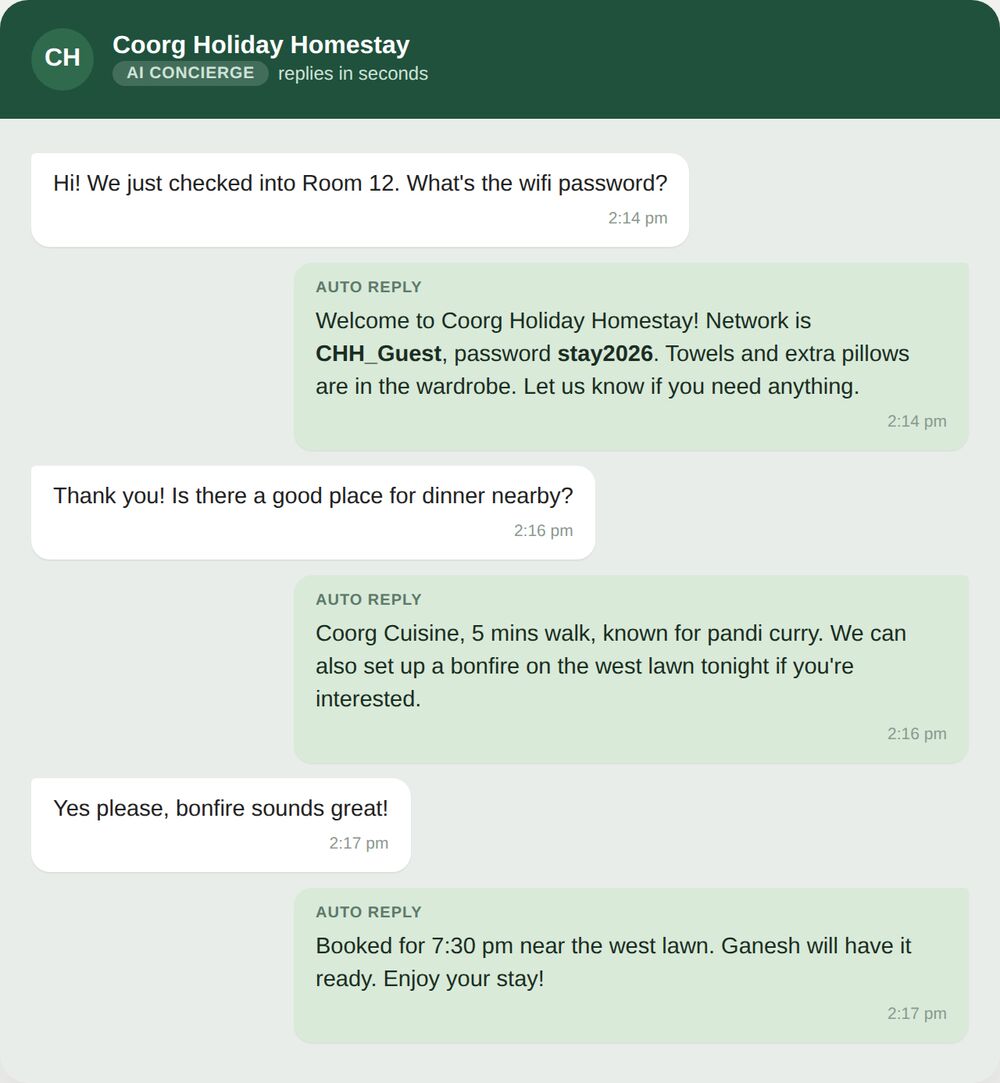
Nothing about this replaces a front desk or a host’s own relationship with their guests. It replaces the specific failure mode where a simple, answerable question sits unread for forty minutes because everyone available is busy doing something else. The guest still gets a personal stay; they simply are not left waiting on the parts of it that were always going to have the same answer regardless of who typed it.
The assistant also keeps a record of every conversation it has, searchable later if a guest disputes what they were told, or if you simply want to see what your property’s guests actually ask about most. Over a season, that log becomes its own kind of feedback: which local recommendations guests act on, which house rules generate the most confusion, which add-ons guests request unprompted once the friction of asking is removed.
It is worth being precise about what “AI” means here, since the term gets stretched to cover everything from a simple keyword-matching script to something genuinely adaptive. The concierge reads a guest’s message, matches it against the categories of information and requests you have configured and replies from that configured content. It is not inventing facts about your property and it is not trained on other properties’ guest conversations. The intelligence is in recognising what a guest is actually asking, in whatever words they happen to use and routing it correctly, not in generating creative answers from nowhere.
What the concierge is built to handle
Practical stay details
Wifi network and password, checkin and checkout times, parking instructions, house rules, where the extra towels are kept. The questions every guest asks, answered identically at 3 pm and 3 am, from the same information every time.
Local recommendations
Restaurants, sights, transport options and distances near the property, drawn from what you tell the assistant about your own area rather than a generic city guide that has never heard of your street.
Requests within limits you set
Late checkout, an extra bed, a bonfire, an early breakfast, approved automatically when they fall inside the boundaries you configure, so guests get a yes without anyone needing to type it out.
A clean handoff on anything else
Complaints, refund questions, anything involving money back or a safety issue go straight to you with the full conversation attached, not silently mishandled by software guessing at an answer it should not give.
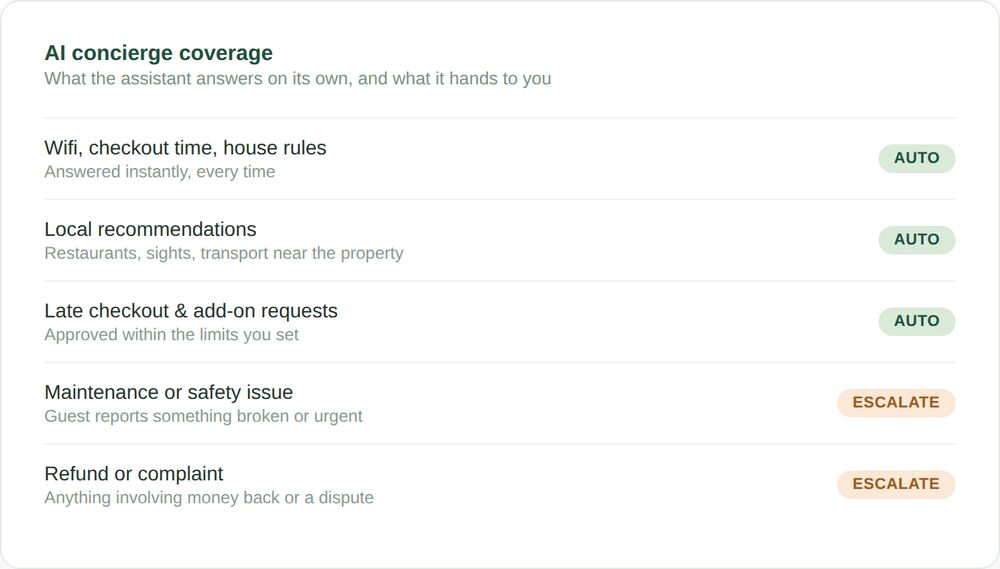
That split, what gets answered automatically and what always reaches a human, is something you configure rather than something fixed in advance. A property that wants every add-on request reviewed personally can set it that way; one that would rather approve routine requests instantly and only see the exceptions can set it the other way. Neither answer is wrong and the setting can change as you get comfortable with what the assistant handles well.
What guests actually message about, once they have checked in
Look at any property’s WhatsApp thread with a guest after arrival and the same handful of categories show up again and again, regardless of whether the property is a homestay in the hills or a hotel in a business district.
Getting settled
Wifi password, where the switch for the water heater is, whether the kitchen is shared, what time breakfast is served. Questions a guest asks in the first hour, often within minutes of walking in.
Getting around
Nearest ATM, which auto stand is reliable, how far the market is, whether a cab can be arranged for an early morning train. Questions that depend entirely on local knowledge, not a generic answer.
Eating well
Where to get a good meal nearby, whether the property serves dinner, if a particular dietary need can be accommodated. Often the single most common category across a full stay.
Changing the plan
An extra night, a late checkout, an early checkin, one more guest joining midway through the stay. Requests that touch the calendar and the rate, not just information.
An AI WhatsApp concierge for hotels is built around exactly this shape of conversation: high frequency, mostly low judgement, almost entirely answerable from information the property already has. The exceptions, the fifth category that shows up far less often but matters far more, are complaints and problems. Those are deliberately treated differently, escalated rather than answered, because getting them wrong costs more than any time saved by answering instantly.
SEE IT IN ACTION
A Friday night at a homestay in Coorg
Meera runs a four-room homestay outside Madikeri with her husband and one part-time housekeeper. On a normal Friday, two rooms turn over and two stay through the weekend and questions do not wait for daylight.
7:40 pm. A guest in Room 2 messages asking for the wifi password. The AI WhatsApp concierge replies in under a minute with the network name and password, the same answer Meera would have given, without her phone buzzing during dinner with her own family.
8:15 pm. A different guest asks if there is somewhere nearby for dinner that is not the property’s own kitchen. The assistant suggests two places within walking distance that Meera had described when setting it up, with roughly how far each one is and what they are known for.
9:50 pm. A guest messages asking for a late checkout on Sunday, past the usual 10 am. Meera had already set a rule allowing checkouts up to noon when the next booking permits it. The assistant checks the calendar, sees Sunday is open until 2 pm and confirms noon on the spot.
11:30 pm. A guest reports the geyser in Room 4 is not heating water. This is not a question the assistant answers on its own, it tells the guest someone will look into it first thing and immediately notifies Meera’s housekeeper, who fixes it before the guest is even awake the next morning.
Meera did not lose her evening to four separate interruptions. Three were handled before she even saw them; the fourth reached exactly the person who needed to see it, with nothing lost between the guest’s message and her housekeeper’s notification. She found out about all four the next morning, reading through the conversation log with her coffee, rather than fielding them one by one through the night.
A night shift at a 20-room hotel in Manali
Ravi’s hotel runs one person on the night shift, covering the lobby, a ringing phone and whatever comes in on WhatsApp between 10 pm and 7 am. Before the concierge, that meant guests either got an answer whenever the night manager had a free minute, or gave up and asked at breakfast instead.
On a Thursday night with the hotel near full, the concierge answered fourteen separate in-stay messages: six about wifi and room amenities, three asking for restaurant recommendations near the mall road, two requesting a late checkout, one asking whether the hotel could arrange a taxi to the bus stand at 5 am and two about the breakfast timing on a public holiday. Every one of those got an immediate, correct answer. Only one message that night needed the night manager directly, a guest reporting a leaking tap and it reached him within seconds, flagged clearly rather than mixed in with the other thirteen.
By morning, Ravi could see the whole night in the conversation log rather than piecing it together from what his night manager remembered. Nothing about the guest experience felt automated from the guest’s side, they asked a question on WhatsApp and got an answer, the same as they would with any hotel that happened to have someone free to reply instantly.
Five ways properties get less out of an AI WhatsApp concierge
None of these are complicated fixes, they are mostly about treating the first month as a setup period rather than a finished product, the same way any new front-desk process needs a few weeks to bed in.
- Leaving the local recommendations blank. An assistant with no information about the neighbourhood either says nothing useful or, worse, nothing at all when a guest asks the single most common in-stay question there is.
- Setting every approval to require manual review. Reviewing every late checkout request personally defeats the purpose; guests wait exactly as long as they did before, just with an extra step in between.
- Never reading the conversation log. The first few weeks are when a property learns what its own guests actually ask, information that should shape house rules and welcome messages, not just sit unread in a dashboard.
- Assuming it replaces a human on serious issues. Anything involving a refund, a safety concern or a guest who is genuinely upset needs a person and the concierge is built to hand those over immediately, not attempt them.
- Not telling returning guests it exists. A guest who does not know they can just ask on WhatsApp will still call, or wait until they see someone in person, missing the entire point of an instant answer being available.
It answers every current guest, not just the ones who booked direct
A guest who booked through an OTA and a guest who booked directly through your website ask the same in-stay questions once they have arrived. The wifi password does not care which channel brought the booking in and neither does the concierge.
Any guest with a confirmed stay on your calendar, however that booking reached you, gets the same instant answers once they message your WhatsApp number. This matters because in-stay experience is one of the few places where OTA-sourced guests and direct guests are treated identically and it is often the in-stay experience, not the booking process, that decides whether an OTA guest becomes a direct guest the next time they visit.
Properties do not need to migrate every booking onto OpenStays to benefit here. Manually adding an OTA reservation to the calendar is enough for the concierge to recognise that guest and start answering their messages the same way it would for anyone else.
This is also where the economics work slightly differently from the booking-side automation. A WhatsApp booking system saves the most on direct bookings, since it is converting an enquiry that would otherwise have gone to an OTA. An AI WhatsApp concierge for hotels saves time and improves reviews across every guest on the calendar, regardless of channel, because an in-stay question does not know or care where the booking came from.
AI WhatsApp concierge vs. The alternatives
| AI WhatsApp concierge | Owner or staff on call | Printed guest folder | |
|---|---|---|---|
| Answers at 2 am | Yes, instantly | Only if someone is awake | Only if the guest reads it |
| Cost per question answered | Included in your plan | Interrupted sleep or family time | One-time printing cost |
| Consistency across staff | Same answer every time | Depends who is on shift | Consistent, but easy to miss |
| Handles local recommendations | Yes, from what you configure | Yes, if the person knows the area | Static, goes stale over time |
| Escalates real problems to you | Yes, automatically | You are the escalation point | No mechanism at all |
| Upsells at the right moment | Yes, when a guest asks | Only if staff remember to offer | No |
A printed folder in the room is not a bad idea, it is just a one-way channel that cannot answer a follow-up question or adapt when your rules change. A person on call is the real safety net for anything that needs judgement and the concierge is built to reach that person quickly, not replace them. What it removes is the narrow, high-frequency band of questions that have one correct answer and no reason to wait for a human to type it out.
Worth naming plainly: none of this is about cutting staff. A ten-room hotel does not run itself on software and a homestay’s charm is largely the owner’s own presence. What changes is which conversations reach a person. The concierge absorbs the repetitive, low-judgement ones so the owner’s attention goes to the guest standing in front of them, or the maintenance issue that actually needs a decision, instead of typing out the wifi password for the fourth time that day.
SETUP
How to set up an AI WhatsApp concierge for hotels
The concierge uses the same WhatsApp number and OpenStays account as your booking automation. If you already have a WhatsApp booking system running, most of this is already in place and setup is mostly filling in the details the concierge will answer from.
Setting up an AI WhatsApp concierge for hotels with OpenStays takes about 20 minutes for the first pass, with room to refine the answers over the following weeks.
1. Confirm your WhatsApp number is connected
If you already take bookings through OpenStays on WhatsApp, this step is done. If not, the same guided wizard that sets up booking automation activates the concierge on the same number, no second number or second app for guests to find.
2. Fill in your property’s practical details
Wifi network and password, checkin and checkout times, house rules, parking instructions. This is the base layer the assistant answers from on its own and the part most guests ask about first.
3. Add local recommendations in your own words
Restaurants, sights, transport, whatever you would tell a guest yourself. The assistant only recommends what you have told it about; it does not invent local knowledge or pull in generic listings.
4. Set the boundaries for automatic approvals
Decide what a guest can get a yes to without you, a late checkout up to a certain hour, an extra bed, a bonfire and what always waits for your review before anything is confirmed.
5. Watch the first week of conversations
Every conversation is visible in your dashboard. The first week is for confirming the answers sound like your property, not a generic script and adjusting anything that reads oddly or misses context a guest needed.
The booking engine and WhatsApp AI concierge are live. Sign up on OpenStays to join.
BEFORE YOU CHOOSE
How to evaluate any AI WhatsApp concierge for hotels
“AI concierge” gets used loosely and not every tool wearing the label is built for what a hospitality stay actually needs. Some are a generic chatbot with no real idea what property it is answering for; others are a booking assistant stretched to also handle in-stay questions it was never designed around, quoting rates confidently to a guest who was really just asking about breakfast timing. Whatever you shortlist as an AI WhatsApp concierge for hotels, including us, these are worth checking before you commit:
- Does it know which guests are currently checked in, not just who has a booking? A concierge that cannot tell an arriving guest from a departed one will answer confidently and wrongly, which is worse than not answering at all.
- Can you set hard boundaries on what it approves automatically? A late checkout policy that the assistant cannot be told to respect is a liability, not a convenience, the first time it approves something you needed to say no to.
- Does it escalate cleanly, or does it try to resolve everything itself? A complaint or safety issue handled badly by software is worse than one that waited an extra ten minutes for a human who could actually fix it.
- Is the local knowledge yours, or generic? A recommendation engine that has never heard of your actual neighbourhood is a worse concierge than a laminated card at the desk written by someone who lives there.
- Can you read every conversation afterward? You should be able to see exactly what a guest was told, especially in the first weeks while you are still building trust in what the system gets right.
- Does it work on the number guests already have saved? A concierge on a second, unfamiliar number adds friction exactly where the whole point was to remove it.
OpenStays was built by property owners living the same in-stay questions on their own WhatsApp, at their own odd hours. See the full WhatsApp booking system for hotels for the booking-side automation this concierge sits alongside and the guest ID software for how the same conversations handle compliance.
What happens to a guest’s conversation
A guest messaging about their stay is sharing more than a booking form ever collects, sometimes a room number, sometimes travel plans, occasionally a passing mention of who they are travelling with. None of that is treated casually.
Conversations are stored against the reservation they belong to, visible to the property that guest is staying at and not shared across unrelated properties. The assistant answers from what the property has configured about itself, it does not learn from or repeat one property’s guest conversations to another property’s guests. Anything collected for compliance, an ID shared for verification, follows the same handling as the rest of OpenStays’ guest ID storage, covered in detail in the guest ID compliance guide.
A guest who would rather speak to a person can always ask for one and staff can step into any conversation at any point without the guest needing to repeat themselves.
None of this is unique to the concierge feature specifically, it follows the same handling as every other conversation OpenStays carries on a property’s behalf, booking enquiries included. The concierge does not introduce a separate, less careful standard just because the messages happen after check-in rather than before it.
QUESTIONS
Frequently asked questions about the AI WhatsApp concierge
Is this the same as the WhatsApp booking system?
No. The WhatsApp booking system for hotels handles enquiries before a booking exists, quoting, bargaining, collecting payment. The AI WhatsApp concierge for hotels picks up once a guest has a confirmed reservation and starts answering in-stay questions. Both run on the same WhatsApp number and most properties use them together, one covering the guest before arrival and the other covering them once they are on site.
What happens if a guest asks something the concierge cannot answer?
It says so, plainly, rather than guessing and immediately notifies you or your staff with the full conversation. Nothing about how it responds is designed to sound more confident than it actually should be.
Can I control what it is allowed to approve on its own?
Yes. Late checkout limits, which add-ons it can confirm without asking you and which topics always escalate are all configured by you, not fixed defaults you have no say over.
Will it sound like a generic chatbot?
The wifi details, house rules and local recommendations all come from what you tell it about your own property. It answers from your information, not a stock script written for no property in particular.
Does it work for a homestay as well as a hotel?
Yes. A one-family homestay and a multi-shift hotel have the same underlying problem, a guest question arriving when nobody who could answer it is free and the concierge is built around that, regardless of property size.
What languages does it handle?
Text conversations work in the languages your guests actually type, including Hinglish. A multilingual voice assistant covering Hindi, Kannada, Tamil, Malayalam, Telugu, Bengali and more Indian languages is on the roadmap.
Is this feature available today?
The booking engine and WhatsApp AI concierge are live.
Does it cost extra?
Pricing details live on the OpenStays pricing page rather than here, since plans change over time. The concierge runs on the same WhatsApp communication credits as the rest of your automated messaging.
Can my staff take over a conversation from the assistant?
Yes, at any point, with the full conversation history visible. Nothing the assistant does locks a human out of the chat or hides what was already said.
What if I do not want it answering certain topics at all?
Any topic can be excluded from automatic answers and routed straight to you instead. The default settings are a starting point, not a fixed behaviour you are stuck with.
Does it know the difference between a current guest and someone still deciding whether to book?
Yes, that distinction is the whole basis for how it responds. A message from someone still enquiring is handled by the booking side; a message from someone with a confirmed, current or upcoming stay is handled by the concierge.
What happens to what a guest tells the assistant?
Conversations are stored against that guest’s reservation and visible to your property, not shared across other properties on OpenStays. Anything collected for identity verification follows the same handling as the rest of your guest ID storage.
Can I turn it off for a specific guest or booking?
Yes. Group bookings, VIP guests you would rather handle personally, or a stay you know will need extra attention can all be excluded from automatic answers on a per-booking basis.
How is an AI WhatsApp concierge for hotels different from a hotel chatbot on our website?
A website chatbot waits for a guest to visit the website again, which rarely happens mid-stay. An AI WhatsApp concierge for hotels lives inside the same chat thread the guest already used to book or confirm, so there is no second app or page to remember while they are out exploring or unpacking.
Does every property need this on day one?
No. Properties usually turn on WhatsApp booking automation first, since that affects revenue directly and add the AI WhatsApp concierge once they are comfortable with how OpenStays handles conversations. Nothing about setup requires doing both at once.
Do I have to give up my current WhatsApp number to turn on the AI concierge?
No. WhatsApp coexistence lets the ordinary WhatsApp Business app and the API that powers this concierge run on the same number at the same time, so your existing number, contacts and recent chat history stay exactly where they are.
What changes in the first month
The first thing most owners notice is quieter evenings. The wifi question, the checkout question, the “where should we eat” question, the ones that used to interrupt dinner or wake someone at midnight, get answered without a phone ever buzzing on the owner’s side.
By the second or third week, a second pattern shows up in the conversation history: guests asking for things they might not have bothered asking a busy front desk for, a late checkout, a bonfire, an extra service, because the answer arrives fast enough that asking feels worth it. Small amounts individually, real revenue across a month of guests who would otherwise have just packed up and left at the standard hour.
The complaints and real problems still reach a human, the same as before, except now they arrive flagged and isolated from the routine questions instead of buried in the same inbox as everything else. Owners who read through a week of conversation logs often say the same thing: most of what the concierge handled were questions they would have answered anyway, just not always in time and not always without it costing them an evening.
That is what an AI WhatsApp concierge for hotels is for: not replacing the relationship a host has with their guests, but protecting it from the hours nobody can realistically be awake for. The stay still feels personal because the answers still come from what the owner actually told the assistant about their own property. What disappears is the specific, avoidable disappointment of a simple question going unanswered for longer than it should.
A few weeks in, most owners stop thinking of it as a separate system and start thinking of it the way they think of a good night manager: someone who handles the routine stuff competently and knows exactly when to wake you up. The difference is this one never actually needs the sleep, never takes a day off and never has an off shift where the answers get a little less reliable.
None of that is a claim that software feels warmer than a person. It does not and it is not trying to. What it changes is far narrower and far more useful: the gap between a guest having a simple question and getting a correct answer stops depending on the time of day, or who happens to be free.
Let your guests get an answer at any hour.
The AI WhatsApp concierge runs on the same number and the same OpenStays account as your booking automation. Nothing new to install.