
FOR HOMESTAYS, HOTELS & RESORTS
Enquiry management
Enquiry management software pulls every enquiry from WhatsApp, your website, phone calls and walk-ins into one list, gives each one a status and an owner and reminds someone to follow up before it goes cold.
No setup fee. Connected WhatsApp enquiries and enquiries recorded by your team stay in one workflow.
ILLUSTRATIVE FEATURE OVERVIEW
Enquiry pipeline
New enquiry
Guest details and stay requirements
Quote shared
Keep the offer with the enquiry
Follow-up
See which guests need a reply
Reservation
Track the enquiry through to booking
Keep every lead in view
What happens without enquiry management software
The enquiries were never the problem. Losing track of them in between five different places was.
A property rarely gets enquiries from just one place. Someone messages on WhatsApp, someone else fills in a form on the website, a third guest calls the front desk directly and a fourth simply walks in and asks at the counter. Each of those arrives in a different place and nothing connects them into a single list anyone can actually look at.
WhatsApp alone becomes its own kind of mess once a property gets busy. A dozen open conversations sit in the same chat list as guests who are already checked in, past guests saying thank you and suppliers asking about a delivery, with no way to tell at a glance which threads are still live enquiries waiting on a reply.
Without an owner attached to each enquiry, everyone assumes someone else is handling it. A guest who asked about a weekend in October gets answered by whoever happens to notice the message first, or does not get answered at all, because three different staff members each assumed a colleague already replied.
A quote goes out and then nothing happens next. The guest was sent a rate, seemed interested and then the conversation simply stopped being anyone’s responsibility to chase, not because nobody cared, but because nothing was tracking the fact that a follow up was due.
Shift changes make the gap worse in a specific, predictable way. An enquiry that arrives right before a handover can sit untouched for hours, not because anyone dropped it deliberately, but because it fell into the space between one person clocking off and the next person picking up the phone.
A property running a small team feels this even more sharply than a large one. With two or three people handling enquiries alongside everything else they do that day, a lead that needed a two line follow up message quietly slips two or three days without anyone noticing, by which point the guest has usually already booked somewhere else.
None of this happens because a property does not care about winning the booking. It happens because enquiries are scattered across WhatsApp, a website inbox, a phone log and a notebook by the front desk, in a form nobody has the time to manually pull together into one place every single day.
By the time an owner asks how many enquiries came in this month and how many turned into bookings, there is no real answer, only a guess pieced together from memory and whichever WhatsApp threads happen to still be visible near the top of the chat list.
A new hire handling enquiries for the first time makes the gap obvious in a different way. Without a clear list of who owns what and what still needs a reply, a new team member either double messages a guest someone else already answered, or misses one entirely, simply because there was never a single place to check.
A festive weekend or a long holiday makes all of this worse at exactly the moment it matters most. Enquiries arrive faster than usual, across every channel at once and the same scattered process that was merely inconvenient on a quiet week starts genuinely losing bookings on the busiest one.
What a scattered enquiry process actually costs
The most direct cost is the enquiry that quietly dies waiting on a reply nobody sent. A guest comparing two or three properties tends to book with whichever one answers first and follows up and an enquiry sitting unassigned in a busy WhatsApp thread has no one actively working to win it.
There is a cost in the quote that never gets chased. A guest who was sent a rate and went quiet represents real, already expressed interest and without something flagging that a follow up is overdue, that interest simply evaporates instead of turning into a second message and, often, a booking.
There is a cost in duplicated and missed replies both at once. Two staff members answering the same guest at slightly different times looks unprofessional and a guest nobody answers at all looks like the property was never interested, two very different problems that both come from the same missing piece, nobody assigned to that specific enquiry.
There is a cost in never knowing which channel actually brings in enquiries worth chasing. Without enquiries tagged by where they came from, a property cannot tell whether the phone line, the website form or WhatsApp is producing the leads that are actually worth a team member’s time to follow up carefully.
There is a cost in training a new hire. Without a clear pipeline showing what a new enquiry looks like, what a quoted one looks like and what closing one looks like, a new team member has to learn the process by watching over someone’s shoulder rather than being able to see it laid out.
There is a cost that compounds across a full season. A handful of enquiries that stall out every week because nobody followed up in time does not feel dramatic in the moment, but multiplied across a busy quarter, it adds up to a meaningful amount of booking revenue that never gets identified as missing, because nobody had a way to see it slipping through.
There is a cost in how confidently an owner can explain the business to a partner, a bank or an investor. Being asked how many enquiries came in last month and how many converted and having no real number to answer with, makes the direct booking side of the business harder to defend than it needs to be.
There is also a cost in the guest experience itself. A guest who has to repeat their dates and requirements a second time because whoever replied this time cannot see the earlier conversation comes away with the impression of a disorganised property, even if the room itself would have suited them perfectly.
There is a cost in the enquiries that never get compared against each other at all. Without a single pipeline to look back across, a property has no easy way to notice that most of last month’s lost enquiries asked the same question early on, a pattern that stays invisible until someone can actually see every lost enquiry sitting next to each other.
What enquiry management software actually gives you
Every enquiry, whichever channel it arrives through, WhatsApp, the website, a phone call logged by the front desk, or a walk in, lands in one pipeline, tagged with the guest, the dates they asked about and where it came from.
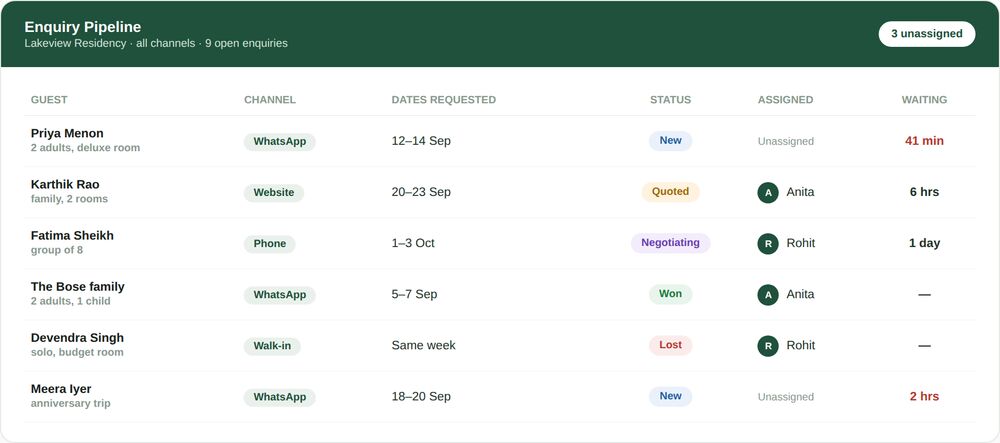
Every enquiry in one list, tagged by channel, status, assigned staff member and how long it has been waiting.
Each enquiry carries a status that reflects exactly where it stands, new and not yet actioned, quoted and waiting on the guest, actively being negotiated, or closed as won or lost, so anyone glancing at the list knows immediately what still needs attention.
Every enquiry can be assigned to a specific staff member, so it stops being everyone’s shared responsibility and nobody’s actual job. An unassigned enquiry sitting unattended for too long is visible at a glance, rather than quietly forgotten inside a long WhatsApp thread.
None of this requires a property to change how it actually talks to guests. The same WhatsApp conversations, the same phone calls and the same walk in enquiries still happen exactly as they do now, enquiry management software simply gives all of them one shared home instead of five separate ones.
What an enquiry management software setup actually covers
A shared enquiry pipeline
WhatsApp, website enquiries, phone calls and walk-ins all land in the same list instead of five different places nobody checks together.
A status for exactly where things stand
New, quoted, negotiating, won or lost, so anyone can see at a glance what still needs a reply and what has already closed.
Assigned to an actual person
Every enquiry has an owner, so nothing sits waiting on the assumption that someone else is already handling it.
Follow-up reminders that catch what would slip
Quotes that have gone quiet and enquiries overdue for a reply surface automatically, before the guest has already booked elsewhere.
SEE IT IN ACTION
Lakeview residency stops losing quoted guests to silence
Lakeview Residency has always had a reasonable flow of enquiries, WhatsApp messages, a handful of website forms and the occasional phone call from a guest who found the number online. What it never had was a single place to see all of them at once, or a way to know which ones were still waiting on a reply.
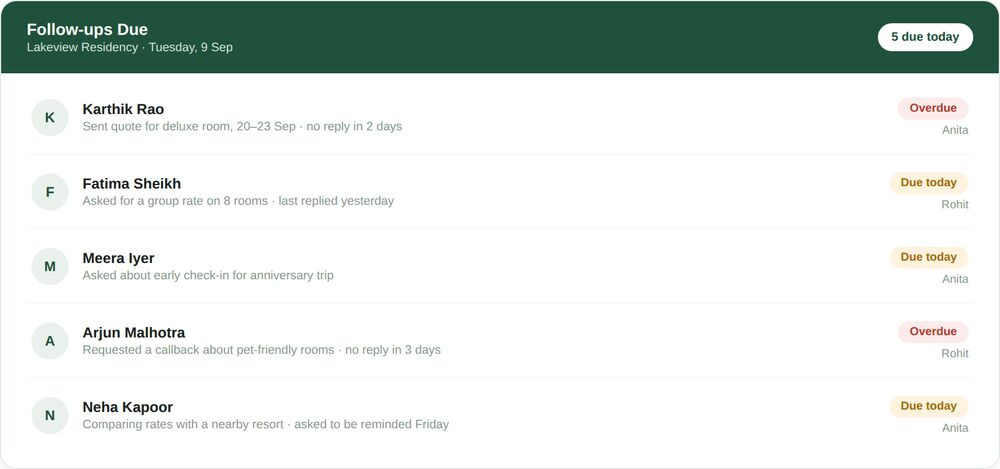
Five follow-ups due on a Tuesday morning, two of them already overdue, each with an owner attached.
On a Tuesday morning, the follow-ups due list shows five enquiries that need attention, two of them already overdue. Karthik Rao was quoted a deluxe room for a September weekend and has not replied in two days and Arjun Malhotra asked about pet friendly rooms three days ago and never heard back.
Before this, both of those would have quietly sat inside a WhatsApp thread that nobody was actively watching, indistinguishable from dozens of other conversations. With a follow up flagged and assigned to Anita and Rohit respectively, both guests get a short message that same morning, nothing complicated, just a nudge that the room is still available and the offer still stands.
Karthik replies within the hour and confirms the booking. Arjun says he has already booked elsewhere, which is a real answer rather than the enquiry simply fading into nothing and Lakeview Residency now knows to ask a quick follow up question about pet friendly rooms earlier in the conversation next time, since it seems to matter to more guests than expected.
Over the following month, the pipeline view shows something else worth noticing, enquiries coming in through the website form take noticeably longer to get a first reply than ones arriving on WhatsApp, simply because staff check WhatsApp far more often. That gap becomes an actual, fixable thing to address, instead of a pattern nobody had any way to see.
Mistakes properties make without this in place
- Letting enquiries from different channels sit in separate places, with nothing pulling WhatsApp, website forms and phone calls into one list.
- Assuming a quoted guest who has gone quiet will come back on their own, instead of following up before they book elsewhere.
- Leaving enquiries unassigned, so everyone assumes someone else is already replying and, often, nobody actually is.
- Losing track of which staff member is handling which guest, especially when more than one person shares the same WhatsApp number.
- Having no idea which channel, WhatsApp, the website form or the phone, actually produces enquiries worth the time it takes to chase them.
- Only noticing a slow week after it is already over, rather than seeing enquiries stall out while there is still time to follow up.
- Training a new hire by having them shadow someone, because there was never a clear pipeline to show them what a new enquiry looks like next to a closed one.
None of these come from a property not wanting to win the booking. They come from enquiries genuinely being scattered across too many places for anyone to reliably track by memory alone.
Even a property that tries to fix this with a shared spreadsheet runs into the same wall eventually, someone has to remember to update it after every single conversation and the first busy week is usually when that habit quietly stops.
The same pipeline, every enquiry, every day
Every new enquiry lands in the pipeline the same way, whether it arrives at nine in the morning or nine at night, on a quiet Tuesday or the busiest Saturday of the festive season. Nothing depends on someone remembering to add it manually.
It holds up the same way regardless of which staff member is on shift. A guest who messages during a handover is just as visible in the pipeline as one who messages in the middle of a calm afternoon, with the same status, the same assignment logic and the same follow up reminders either way.
For a property running more than one location, each one’s enquiries stay in their own pipeline, so a manager overseeing several properties can see exactly how many open enquiries each one is sitting on, without mixing guests asking about one property with guests asking about another.
Keep the pipeline current by recording phone calls and walk-ins as they happen. Connected WhatsApp enquiries can enter the workflow automatically. The record is only complete when staff log enquiries from other channels.
It also means a comparison between two staff members, or two weeks, is a fair one, built from enquiries captured the exact same way each time, rather than one period simply being more thoroughly tracked than another by chance.
Who actually uses this pipeline
An owner running a property personally gets a direct answer to a question that used to be a guess, how many enquiries actually came in this week and how many of them are still waiting on a reply right now.
A manager overseeing a front desk or reservations team benefits from the assignment view specifically, seeing exactly who is handling which enquiry turns coaching from a vague conversation into something grounded in actual, visible workload.
Someone who splits their time between guest facing work and enquiries, which describes most small property owners, benefits from the follow up reminders in particular, a quoted guest who has gone quiet gets flagged automatically instead of relying on memory during an already busy day.
A property with more than one person answering the same WhatsApp number benefits from assignment and status together, so two staff members do not both reply to the same guest and neither assumes the other has already handled it.
A property planning to grow, adding a second location or hiring more staff to handle enquiries, benefits from having a proven pipeline first, a clear sense of how enquiries should move from new to quoted to won before scaling the same process across more people.
Anyone training a new front desk or reservations hire benefits directly too, a live pipeline gives a new team member something concrete to look at, this enquiry is new and unassigned, this one is quoted and needs a follow up, rather than a vague instruction to keep an eye on WhatsApp.
A property that relies on phone enquiries as much as WhatsApp, common for guests who prefer to speak to someone directly, benefits from having those calls logged into the same pipeline, so a conversation that started on the phone does not simply disappear the moment the call ends.
A property owner who is often travelling or away from the front desk for stretches of the day benefits from being able to check the pipeline remotely, seeing exactly what came in and what is still waiting, without needing to be physically present to ask a staff member for an update.
How this fits with the rest of OpenStays
Response and conversion reports show how well enquiries are converting overall, response time, conversion rate and where guests drop off. Enquiry management software sits one step earlier in that same story, it is the actual pipeline of individual enquiries that those reports are measuring.
Enquiries that arrive through AI WhatsApp concierge land directly in the same pipeline, already tagged by channel. Once an enquiry is won, the guest carries straight through into guest CRM, so the history that started as a pre-booking enquiry does not get lost the moment a booking is confirmed. Who can view and be assigned enquiries is controlled the same way as everything else, under staff logins with roles and for a group managing more than one location, the pipeline extends cleanly through multi-property management.
Enquiry management software vs. The alternatives
Most properties compare this against whatever they currently use to keep track of enquiries, usually the WhatsApp chat list itself, or a shared spreadsheet someone updates when they remember to.
| WhatsApp chat list alone | A shared spreadsheet | Enquiry management software | |
|---|---|---|---|
| Enquiries from multiple channels in one place | No, WhatsApp only | Only if someone adds every one by hand | WhatsApp plus enquiries logged by your team |
| A status for where each enquiry stands | No | Only if kept updated manually | Yes, always current |
| A clear owner for every enquiry | No, assumed by whoever notices first | Only if assigned and remembered | Yes, assigned directly |
| Follow-up reminders before a quote goes cold | No | No | Yes, automatic |
| Setup effort | None, but nothing is tracked either | High and rarely kept up consistently | None, tracked from the first enquiry |
GETTING STARTED
Setting up enquiry management software
How to set up enquiry management software on OpenStays.
1. Nothing to configure to start
Connected WhatsApp enquiries enter the workflow. Your team records phone enquiries, walk-ins and requests from other channels so the pipeline reflects the full picture.
2. Assign enquiries to your team
Give each new enquiry an owner, so it stops being everyone’s shared responsibility and nobody’s actual job.
3. Move enquiries through their status
Mark an enquiry as quoted once a rate goes out, negotiating while discussions continue and won or lost once it closes.
4. Let follow-up reminders do the chasing
Quotes that have gone quiet and enquiries overdue for a reply surface automatically, so nothing has to be remembered by hand.
5. Check the pipeline daily, not just at month end
A quick look each morning shows exactly what is new, what needs a follow-up and what is still open from yesterday.
What to check in any enquiry management setup
- Does it pull in enquiries from every channel automatically, or only from WhatsApp, leaving website and phone enquiries to be added by hand?
- Can every enquiry be assigned to a specific staff member, so it has one clear owner rather than shared, ambiguous responsibility?
- Does it flag a quoted guest who has gone quiet, or does a follow-up only happen if someone happens to remember?
- Can you see, at a glance, how many enquiries are new, quoted, negotiating, or already closed, without opening each one individually?
- Does it work the same way if more than one staff member shares the same WhatsApp number?
- Does this extend cleanly across more than one property, if the account covers more than one location?
A setup that cannot answer these clearly is really only offering a slightly tidier version of the same WhatsApp chat list, without the actual tracking that keeps enquiries from quietly slipping through.
It is also worth checking whether closed enquiries stay visible afterwards. A pipeline that only shows what is currently open loses the history of what was won, what was lost and why, which is exactly the pattern worth reviewing every few months.
A quick way to test this in practice is to pick a guest who enquired and did not book last month and see how long it takes to find that conversation and understand what happened. A system worth trusting should answer that in seconds, not require scrolling back through old WhatsApp threads.
It is worth testing this against a real, specific question rather than taking a features list at face value. Ask, right now, how many enquiries came in this week and how many are still waiting on a reply. If that answer requires checking four different places, that gap is exactly what this closes and it pairs naturally with what already shows up in response and conversion reports.
What actually gets tracked and how
Every enquiry captures the guest, the dates they asked about and the channel it arrived through, WhatsApp, the website enquiry form, a phone call logged by whoever answered it, or a walk-in noted at the front desk.
Status moves along a simple, consistent path. New covers anything not yet actioned, quoted means a rate has gone out and the property is waiting on the guest, negotiating covers active back and forth and won or lost marks where the enquiry finally ended up.
Assignment is explicit rather than assumed. An enquiry stays visibly unassigned until someone actually takes it on, so a manager can see at a glance whether anything is sitting without an owner, rather than discovering it days later.
Follow-up reminders are based on how long an enquiry has been waiting at its current status, a quote with no reply after a set number of days surfaces automatically, so chasing it does not depend on any one person remembering.
None of this requires a property to change how it actually talks to guests. The same WhatsApp replies, the same phone calls and the same conversations at the front desk happen exactly as before, enquiry management software simply keeps track of all of it in one place as it happens.
An enquiry that starts on one channel and continues on another, a guest who first messages on WhatsApp and later calls to confirm a detail, stays as a single enquiry rather than splitting into two disconnected conversations that nobody can tell are the same person.
Closed enquiries, won and lost both, stay available afterwards, so a property can look back at what a typical won enquiry looked like versus a typical lost one and use that pattern to improve how the next batch of enquiries gets handled.
For a group running more than one property, each location’s pipeline stays independent, so an enquiry about one property never gets confused with one about another, even when the same staff member is handling both.
Reassigning an enquiry stays simple when someone goes on leave or a shift changes hands partway through the day. The full conversation history moves with it, so the next person picking it up can see exactly what was already discussed, rather than starting the guest’s story over from nothing.
Frequently asked questions
What exactly does enquiry management software do?
It pulls every enquiry from WhatsApp, the website, phone calls and walk-ins into one pipeline, gives each one a status and an owner and reminds someone to follow up before it goes cold.
Do I need to set anything up before enquiries start appearing?
No, every new enquiry from a connected channel lands in the pipeline automatically from day one.
Can I assign an enquiry to a specific staff member?
Yes, every enquiry can be given an owner, so it stops being shared, ambiguous responsibility.
Does this cover enquiries that come in by phone or as a walk-in, not just WhatsApp?
Yes, a phone call or walk-in can be logged into the same pipeline as any WhatsApp or website enquiry.
What happens if a quoted guest stops replying?
The enquiry gets flagged as overdue for a follow-up automatically, so it surfaces before the guest is forgotten.
Can I see how many enquiries are open right now, without checking each one?
Yes, the pipeline shows every enquiry’s current status at a glance, new, quoted, negotiating, won or lost.
Does this work if more than one staff member shares the same WhatsApp number?
Yes, each enquiry is assigned individually, so overlapping replies and missed guests both become visible and avoidable.
What happens to an enquiry once it turns into a booking?
It carries through into guest CRM, so the history that started before the booking is not lost once the guest checks in.
Can I see which channel actually produces enquiries worth following up?
Yes, every enquiry is tagged by the channel it arrived through, so that comparison is visible directly in the pipeline.
Is there a limit to how many enquiries can be tracked at once?
No, every enquiry a property receives is tracked, regardless of how many are open at the same time.
Can I see this broken down for each property in a group?
Yes, each property’s pipeline is tracked and visible independently within the same account.
Who can view and be assigned enquiries?
That depends on the role assigned under staff logins with roles, so access can be given without extending further permissions.
Does a closed enquiry disappear once it is marked won or lost?
No, closed enquiries stay visible afterwards, useful for reviewing what a typical won or lost enquiry actually looked like.
Can this help me decide which channel to invest more time in?
Yes, seeing which channel’s enquiries actually convert is exactly the evidence that decision needs.
What changes in the first month
There is nothing to set up, so the very first week already produces a real pipeline, every enquiry from WhatsApp, the website and any logged phone calls appearing in one list from day one.
The first genuinely useful moment tends to come the first time a follow-up reminder catches a quote that would otherwise have gone quiet, often turning into a booking that would have simply been lost.
A quieter change follows once assignment becomes normal. Enquiries stop being everyone’s shared responsibility and a manager can see, at a glance, whether anything is sitting unassigned that needs to be picked up.
By the second or third month, most owners describe a similar shift, checking the pipeline each morning becomes as routine as checking the booking calendar and conversations about enquiries start referencing an actual list instead of a memory of what was said on WhatsApp last week.
For a property heading into its first busy season with this in place, the advantage compounds, a rush of enquiries no longer means some of them silently slip through the gaps, because every single one lands in the same pipeline regardless of how many arrive in a day.
A year in, enquiry management software tends to have quietly become the first thing a manager checks each morning, alongside the booking calendar, simply because it answers a question that used to be genuinely unanswerable, what is still open and who is actually working on it.
Some of the most useful moments come from small surprises along the way, a channel nobody thought produced serious enquiries, phone calls, say, turning out to convert better than expected once someone could finally see the numbers next to WhatsApp and the website side by side.
A property that goes through this shift once rarely wants to go back. Once a manager has seen exactly how many enquiries are open on any given morning, going back to piecing that number together from memory feels like a genuine step backwards rather than a simpler way of working.
Stop losing enquiries between five different places
No setup fee. Connected WhatsApp enquiries and enquiries recorded by your team stay in one workflow.