
FOR HOMESTAYS, HOTELS & RESORTS
Guest CRM
A guest who has stayed with you three times deserves to be recognised on the fourth, not asked the same questions again from scratch. A guest CRM is what quietly builds that memory, turning every booking, every WhatsApp conversation and every preference mentioned in passing into a profile the next conversation can draw on automatically.
Built by property owners for property owners · 0% commission · Core feature, live today
ILLUSTRATIVE FEATURE OVERVIEW
Guest profile
Guest details
Keep contact information with the guest
Stay history
Find the reservations linked to each guest
Preferences and notes
Keep useful context for your team
Your relationship
Recognise returning guests
Every guest. Every stay.
What happens to everything you learn about a guest
Guest ID software stores identity documents for legal record keeping and the dashboard shows today’s bookings. This is about the relationship, who has stayed before, what they like and how to recognise them the moment they message again.
This page covers what this actually tracks, what most small properties are relying on instead, how OpenStays builds a guest profile automatically from bookings and WhatsApp conversations and how to evaluate any option you are considering, OpenStays included.
A guest mentions during their stay that they are vegetarian, or that they are celebrating an anniversary, or that they always want a late checkout if one is available. A good host remembers this in the moment and acts on it. The trouble is what happens six months later when the same guest books again and the person answering this time was not there for the original conversation.
Most properties have no formal place this information goes. It lives in a staff member’s memory, in old WhatsApp scrollback nobody has time to search, or nowhere at all once the conversation ends. A returning guest gets treated exactly like a first time guest, asked the same questions, offered the same generic welcome and the relationship that should have been building with every stay effectively resets each time.
This is not a failure of hospitality instinct. Independent property owners are often genuinely good at remembering guests personally, for a while. The problem is scale and staff turnover: the owner who remembers everyone eventually has a manager covering shifts, or the property grows past the point where one person’s memory can hold every guest’s history.
It also compounds quietly in the other direction. A property that has been operating for three or four years has, whether it realises it or not, accumulated a genuinely valuable list of people who already trust it enough to have stayed once. Without anything tracking who those people are, that accumulated trust simply evaporates instead of becoming an asset the property can actually put to use.
This exists to make that memory durable and shared, so recognising a returning guest does not depend on whether the one person who met them last time happens to be on shift today.
The gap is easiest to see at the front desk, but it shows up just as often over WhatsApp, where a returning guest who already mentioned a dietary preference or an anniversary last year gets asked the same questions again because nothing carried that detail forward.
What forgetting repeat guests actually costs
The most direct cost is a missed chance to reward loyalty. A guest who has booked directly three times, without ever being thanked or recognised for it, has no particular reason to keep choosing the direct channel over an OTA next time, since nothing about the experience reflected that history.
There is a service cost too. A returning guest who has to repeat a dietary requirement or a room preference every single stay experiences a property that, from their side, does not seem to know them, however warmly they are greeted at the door. Small hospitality businesses compete partly on feeling personal and forgetting a guest’s basic preferences undercuts exactly that.
There is a marketing cost that is easy to overlook. A property with no record of who its repeat guests actually are cannot reach out to them specifically, cannot let them know about a quiet season rate, cannot invite them back for an anniversary they mentioned once. That entire category of low cost, high trust marketing simply does not exist without a record to work from.
And there is a quieter operational cost: a staff member spending the first few minutes of every repeat guest’s check in relearning things that were already said months ago, time that a visible profile would have saved entirely.
None of these costs show up on a monthly statement the way a commission or a utility bill does, which is exactly why they are easy to underestimate. A property that has been quietly losing a portion of its repeat guests back to OTAs for years, simply because nothing about the direct experience ever improved with familiarity, rarely notices the pattern until someone points it out.
There is a slower cost too, one that compounds across seasons rather than showing up in any single month. A guest who is recognised and treated a little better each time they return tends to keep coming back and to mention the property to friends planning a similar trip, while a guest who is treated as a stranger every visit has no particular reason to feel any more loyal the fifth time than the first.
What a guest CRM actually builds, automatically
Every guest who books on OpenStays, through any channel, gets a profile that accumulates automatically over time. There is nothing separate to fill in. A booking adds a stay to their history. A WhatsApp conversation where a guest mentions a dietary need or a preference gets noted against their profile rather than lost in chat history.
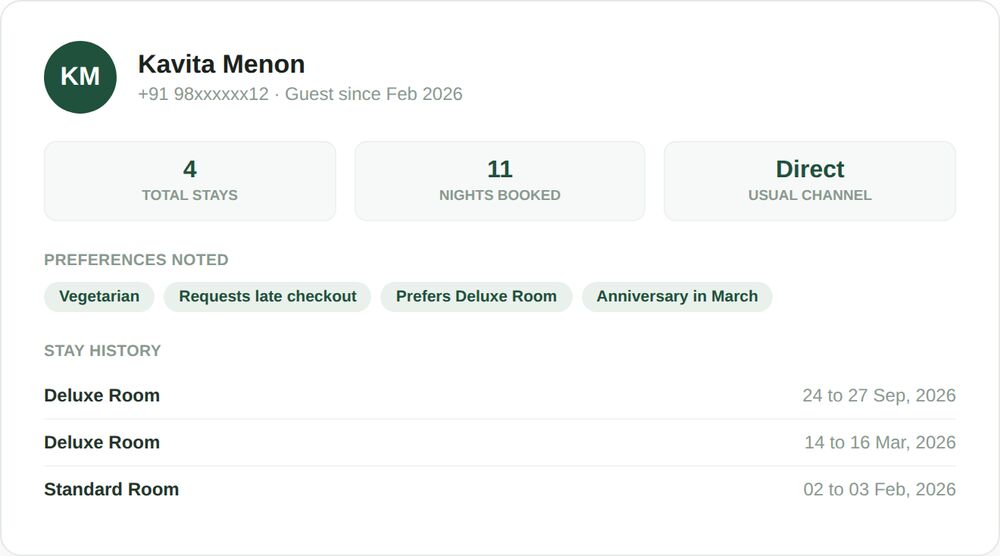
The profile shows what matters at a glance: how many times this guest has stayed, how many nights in total, which channel they usually book through and a short list of preferences worth remembering, dietary needs, room preferences, anything mentioned that is worth acting on next time without asking again.
A full stay history sits underneath, every previous booking with its dates and room, so a question like which room did they have last time has an immediate answer instead of requiring a search through old records.
None of this requires a guest to sign up for anything or fill out a profile form. It builds itself from the bookings and conversations that were already happening, the same way a good host’s memory would, except it does not depend on one person being the one who remembers.
The profile also updates itself with no ongoing maintenance. A guest who stays again automatically adds another entry to their history, a preference mentioned in a new conversation joins the ones already noted and none of it requires a staff member to remember to go update a separate record afterward.
What happens when a returning guest messages again
Recognised the moment they message
When a guest who has booked before messages on WhatsApp, the AI concierge sees their history immediately, past stays, preferences, usual channel, before a single reply is sent.
A warmer, more accurate first reply
A returning guest gets welcomed back by name with the room they usually prefer already in mind, rather than the same generic opening message a first time guest receives.
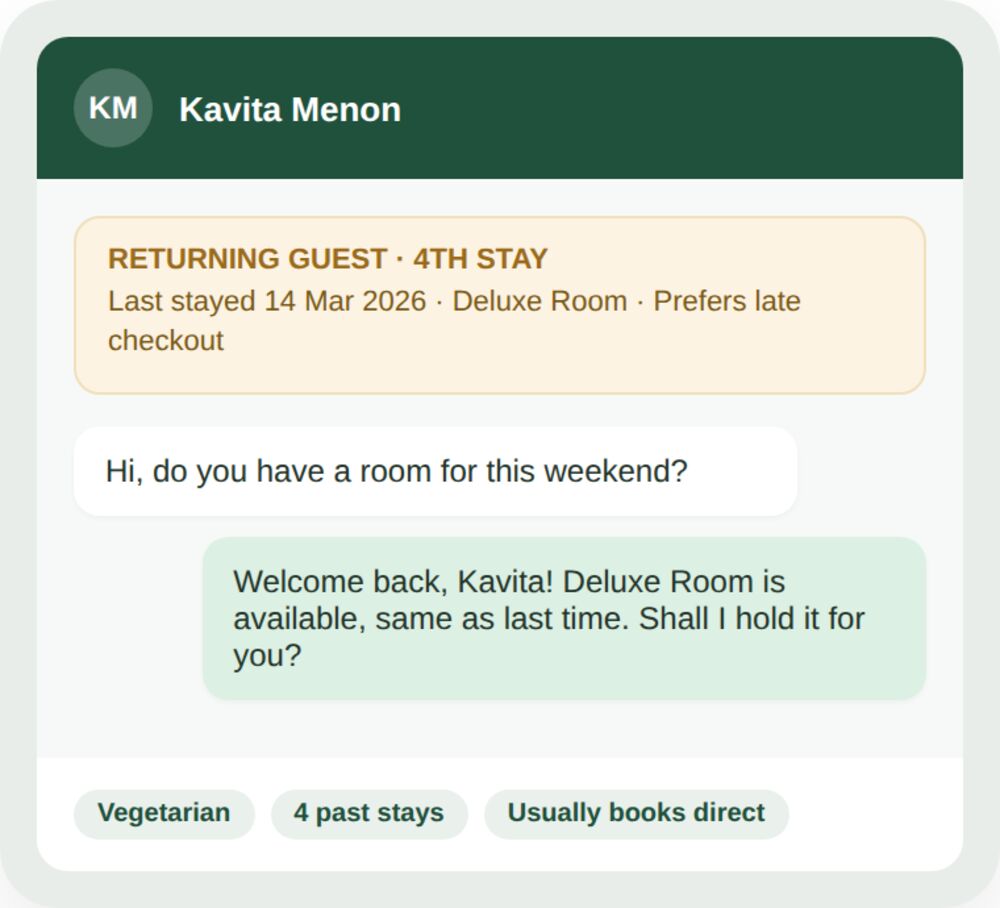
This works the same way whether a staff member is handling the conversation personally or the WhatsApp AI concierge is answering automatically. Either way, the guest’s history is right there, not buried in a scroll through months of old messages.
What a guest profile actually holds
A useful one stays focused on information that changes how you actually treat a guest, not a sprawling record of everything that was ever said.
Stay history
Every previous booking, its dates, room type and channel, giving an immediate answer to how many times someone has stayed and what they usually book.
Preferences worth acting on
Dietary needs, room preferences, requests like late checkout, noted once during a conversation and available automatically on every future booking.
Booking channel pattern
Whether a guest usually books direct, through an OTA, or over WhatsApp, useful context when deciding how to reach out to them later.
Special occasions mentioned in passing
An anniversary, a birthday, a reason for the trip, noted once and available to acknowledge the next time that guest books around the same time of year.
What deliberately does not belong here is anything sensitive beyond what a guest volunteered for their stay. It is a record of hospitality preferences, not a surveillance file and it holds only what helps serve that guest better next time.
The line is worth being deliberate about. A note that a guest prefers a quiet room away from the lift is useful and welcome. Anything that starts to feel like tracking a person rather than serving a guest belongs nowhere near this record and a property is well served by simply asking whether a given note would embarrass anyone if the guest saw it themselves.
SEE IT IN ACTION
A homestay in Coorg turns a one time guest into a regular
Divya runs a four room homestay and had a guest, Rahul, stay once for a weekend trip. He mentioned during checkout that he travels through Coorg for work every couple of months and usually just books whatever is convenient near his meeting.
Six weeks later, Rahul messages on WhatsApp asking about availability. The AI concierge recognises him instantly as a returning guest and the reply welcomes him back and offers the same room he had before, with no need for him to explain his preferences again. He books on the spot and mentions he appreciated not having to repeat himself.
Over the following months, Divya notices Rahul becoming a genuine regular, five stays by the end of the year, entirely because the second interaction felt like being remembered rather than starting over. He has since recommended the homestay to two colleagues who travel the same route, neither of whom Divya would have any way of connecting back to Rahul’s original stay without his profile showing the pattern.
A twelve room hotel in Munnar avoids a repeat mistake
Arvind’s hotel had a guest mention a shellfish allergy during one stay, information that was passed to the kitchen verbally that week but never written down anywhere formal. On her next visit four months later, a different staff member was on shift and had no idea about the allergy at all.
With the preference noted against her guest profile the first time, her second stay carries the same information forward automatically, visible to whichever staff member is handling her booking, not dependent on the original person remembering to mention it during a shift handover.
Arvind now treats noting a preference during a stay as a two second habit rather than something that might or might not get passed along, because it only has to be said once. He has since started a short handover routine where staff check a returning guest’s profile before their shift starts, which has caught two more allergy mentions that would previously have relied on the same fragile verbal chain.
A resort in Goa runs a simple win back campaign
Priyanka’s resort wanted to fill a quiet week in the shoulder season and, instead of guessing who to reach out to, pulled up guests who had stayed at least twice and usually booked direct. That list, built automatically from stay history rather than assembled by hand, became the basis of a short WhatsApp message offering a quiet season rate to guests who already knew the property.
The response rate was meaningfully higher than a generic broadcast would have gotten, since every message went to someone with an actual reason to trust the resort already. A handful of bookings from that one message alone covered what would otherwise have been an empty week. Priyanka has since made the same targeted message a routine part of how she handles any quiet stretch on the calendar, rather than a one off idea she happened to try.
Mistakes properties make without one
- Treating every guest as a first time guest by default, missing the chance to acknowledge a return that guests genuinely notice and appreciate.
- Noting preferences verbally during a stay with no record that survives past that shift or that staff member.
- Having no way to identify actual repeat guests for a win back offer, so loyalty marketing never happens at all.
- Losing useful context, an allergy, a past complaint, a reason for the trip, the moment the conversation that surfaced it scrolls out of view.
- Relying on one long serving staff member to be the institutional memory for every regular guest, a single point of failure that leaves the moment they are unavailable or move on.
- Storing a guest’s stated preferences in a personal notebook or a private note on someone’s phone, invisible to anyone else who might handle that guest’s next booking.
None of these are failures of intent. They are what happens when guest memory lives in people rather than in a system that outlasts any one person’s shift or tenure. Each one is also invisible to the property itself in the moment it happens, which is exactly what makes them easy to keep repeating without ever quite noticing the pattern.
The fix for all of them is the same and it is not a discipline someone has to maintain. Once a preference or a stay is recorded automatically at the moment it happens, there is nothing left to forget to do.
One profile, regardless of how a guest books
A guest’s profile builds the same way whether they book through the direct booking engine, message first on WhatsApp, arrive through a connected OTA, or are entered manually after a phone call. The system recognises a returning guest by their phone number, so the channel they used the first time does not need to match the channel they use the next time for the history to connect correctly.
This matters because guests do not always book the same way twice. A guest who found a property on an OTA once might message directly on WhatsApp the second time and a system that only worked within one channel would miss that connection entirely.
The same logic applies to walk-ins. A guest who stayed once after simply arriving at the gate and messages on WhatsApp for their next visit is still recognised, since the connection is the guest’s phone number rather than the specific way they happened to book the first time.
How this fits with the rest of OpenStays
A guest profile draws on the same reservation records the online reservation system tracks and preferences noted here are what the WhatsApp AI concierge uses to recognise and respond to a returning guest appropriately.
It stays separate from guest ID compliance, which handles the legal record of who stayed against which document and from the reservations dashboard, which stays focused on today’s operations. Together with the rest of the OpenStays stack, guest history becomes one more thing every module can draw on rather than a separate system to maintain.
Guest CRM vs. The alternatives
| Guest CRM | Staff memory | A personal notes app or spreadsheet | |
|---|---|---|---|
| Recognises a returning guest automatically | Yes, on any channel | Only if the same staff member is there | No, requires manually checking |
| Preferences survive a staff change | Yes | No | Only if consistently updated |
| Can identify repeat guests for a win back offer | Yes, in seconds | Not really, no structured list | Possible, but tedious to compile |
| Works across every booking channel | Yes | Depends who took the original booking | Only if manually cross referenced |
| Setup effort | None, builds automatically | None, but unreliable | Ongoing manual entry |
| Risk of a regular guest being treated as new | Low | High | Moderate |
Staff memory is genuinely good at small scale and costs nothing, which is exactly why most small properties rely on it and rarely notice a problem until growth or staff turnover exposes the gap. A personal spreadsheet is a real step up, but it depends entirely on someone remembering to update it every time, with no automatic connection to the bookings and conversations that generated the information in the first place.
One that builds itself from bookings and conversations already happening removes that dependency, which is the honest difference: not that it knows something staff memory could not, but that it does not forget.
It is also worth being honest about what none of these options solve on their own. None of them make a guest want to return, that still comes down to the actual stay. What they change is whether a guest who already wanted to come back gets treated, on arrival, like someone the property remembers, or like a stranger walking in for the first time.
SETUP
Getting your guest profiles working for you
There is nothing to configure to start. Guest profiles build automatically the moment bookings and WhatsApp conversations start happening on your account.
Guest profiles build automatically from your first bookings, with no separate setup required.
1. Keep taking bookings as normal
Every reservation, on any channel, automatically adds to that guest’s profile with no extra step required.
2. Note preferences when a guest mentions them
A dietary need, a room preference, a reason for the trip, worth a quick note against the guest’s profile the moment it comes up.
3. Check a guest’s profile before their next stay
A quick look before a returning guest arrives surfaces what they liked last time, useful for a small, genuine touch at check in.
4. Use stay history to spot your actual regulars
Filtering by number of stays surfaces who is genuinely coming back, useful for deciding who to reach out to directly.
5. Reach out to repeat guests deliberately
A short, personal message to guests who have stayed more than once tends to convert better than a generic broadcast to everyone.
BEFORE YOU CHOOSE
What to check in any guest CRM
- Does it recognise a returning guest across every channel they might use, or only within the one they booked through the first time?
- Do preferences noted during a stay actually get saved somewhere, or do they live only in that one conversation?
- Can you filter or list guests by number of stays, useful for identifying who is actually a regular?
- Does building a guest profile require manual data entry, or does it happen automatically from bookings that were already happening?
- Is guest information kept separate from identity document compliance, or are the two conflated in a way that makes either harder to use?
- Can staff see a guest’s relevant history without digging through old messages or asking whoever handled the original booking?
This applies whether or not you choose OpenStays. Worth checking against any WhatsApp AI concierge or automated guest messaging tool you are already evaluating, since this is only as useful as what the rest of your stack does with it.
Who can see a guest’s profile
Guest profiles are visible to staff with access to your OpenStays dashboard, the same access controls that apply to the rest of your account, rather than a separate system with its own permissions to manage.
A preference or note added to a guest’s profile is visible the moment it is saved, so a staff member handling a returning guest’s next booking sees the same information regardless of who originally noted it.
Guest profiles hold only what is useful for hospitality, stay history, preferences, contact details, not sensitive personal information beyond what a guest shared in the context of their stay.
If a guest ever asks what a property knows about them, the honest answer should be simple enough to say out loud, their past stays and whatever they themselves mentioned along the way. Keeping the record to that standard is not just good practice, it is what keeps the whole thing feeling like hospitality rather than something a guest would be uncomfortable learning about.
QUESTIONS
Frequently asked questions
What is a guest CRM for a hotel or homestay?
A guest CRM is a system that builds a profile for each guest automatically from their bookings and conversations, tracking stay history and preferences so a returning guest is recognised rather than treated as new.
How is this different from guest ID software?
Guest ID software stores identity documents for legal compliance, C-Form flags and register exports. This tracks the hospitality relationship, stay history and preferences and the two are kept separate.
Do I need to manually create a profile for each guest?
No, a profile builds automatically the first time a guest books and grows with every subsequent stay and conversation.
How does OpenStays recognise a returning guest?
By phone number, so a guest is recognised as the same person even if they book through a different channel than they used previously.
Can I see which guests have stayed more than once?
Yes, guest profiles show total stays, which makes it straightforward to identify your actual repeat guests rather than guessing.
Where do preferences come from?
Mostly from WhatsApp conversations and notes added by staff during or after a stay, whenever a guest mentions something worth remembering.
Does the WhatsApp AI concierge use this information automatically?
Yes, when a returning guest messages, the concierge has their history available and can reference it in how it responds, rather than starting the conversation from zero.
Is guest data shared with other properties on OpenStays?
No, a guest’s profile belongs to your property and is not visible to or shared with other properties using OpenStays.
Can I use this to send a win back offer to past guests?
Yes, filtering guests by stay count and recency makes it straightforward to identify who to reach out to for a returning guest offer.
What happens if a guest’s phone number changes?
A new number creates a new profile unless the connection is made manually, so it helps to confirm a guest’s number matches their previous booking where possible.
Does this work for walk-in and phone guests too?
Yes, any guest entered manually still gets a profile that grows with future stays, the same as a guest who books through the engine or WhatsApp.
Is there a limit to how much guest history is kept?
No practical limit, a guest’s full stay history remains available regardless of how many times they have booked.
Can staff add their own notes to a guest’s profile?
Yes, staff can add preferences or context they learn during a stay and it becomes visible to anyone else handling that guest’s future bookings.
Does a cancelled or no-show booking affect a guest’s profile?
It remains part of their history for context, though it is distinguishable from a completed stay so it does not misrepresent how many times they have actually visited.
Is this included in the base OpenStays plan?
Yes, it is part of the core platform rather than a separate add on. Current plan details are on the pricing page.
Can I export my guest list?
Guest information can be exported for your own records, useful for offline marketing or migrating data if you ever needed to.
Does this replace the need to greet guests personally?
No, it removes the memory burden so that personal greeting can be genuinely informed, a host who knows a guest’s preferences can focus on hospitality rather than on recalling details.
What changes in the first month
The most immediate change is small and easy to miss: the first returning guest who gets welcomed back by name with their usual room already in mind, rather than asked the same onboarding questions as a first time guest.
By the second or third week, staff start checking a guest’s profile as a matter of habit before a stay, the same way they would glance at a booking’s dates and room and preferences noted during a stay start reliably surviving past that one conversation.
Within the first month, it usually becomes possible to see, for the first time with any real clarity, how many guests are actually repeat visitors, a number most properties have never had an accurate answer to before.
None of this requires guests to do anything differently. What changes is that the property finally has a shared, durable memory of who has stayed before, instead of that memory living only in whoever happened to be there the first time.
A quieter change shows up around the second or third month, once there has been enough time for a real cohort of guests to return. That is usually when an owner first gets a genuine, numbers backed sense of what share of business is actually repeat, often higher than they assumed once it is finally visible rather than guessed at.
Who a guest CRM actually helps
Homestays and small properties with a genuinely personal style of hospitality benefit from formalising what a good host already tries to do naturally, remembering guests, without it depending entirely on one person’s memory.
Properties with staff turnover or shift based teams benefit most directly, since guest history that used to leave with whoever originally handled a booking now stays with the property instead.
Properties near a business district, pilgrimage circuit or recurring event benefit from a genuinely repeat guest base, where recognising a regular on their fifth or sixth stay meaningfully changes how welcome they feel.
Any property that has ever wanted to run a win back offer or a loyalty gesture but had no reliable way to identify who to send it to gets that capability essentially for free once guest history is being tracked.
Owners planning to eventually hand day to day operations to a manager or a family member benefit from building this record early, since a guest history that already exists is a much easier thing to hand over than an expectation that the next person will somehow absorb years of accumulated personal memory.
Every guest, remembered, on their next visit and every one after.
Guest CRM on OpenStays builds automatically from the same account as your booking engine, WhatsApp concierge and reservation system. Nothing new to install.