
FOR HOMESTAYS, HOTELS & RESORTS
WhatsApp remote check-in
Remote check-in lets a guest send their ID and confirm your house rules over WhatsApp before they arrive, so the front desk becomes a key handover instead of a paperwork queue.
No setup fee. Works on any phone, no app required.
ILLUSTRATIVE FEATURE OVERVIEW
Pre-arrival workflow
Confirmed stay
Start with the guest’s reservation
Guest details
Request information before arrival
ID records
Collect through your configured workflow
Ready for arrival
Review the details with your team
Prepare before your guests arrive
What happens without remote check-in
No app to download, no printed form to fill in at a busy check-in hour, just the same WhatsApp thread the guest was already using to plan the trip.
Most independent properties still handle check-in the same way regardless of how the booking was made, a guest arrives, stands at the desk with their luggage and waits while someone finds a register, copies down ID details by hand and explains the house rules out loud for the first time.
On a normal day that is a five or ten minute wait. On a Saturday, when four or five bookings all arrive within the same two hour window, it becomes a small queue, guests standing behind each other in a lobby that was never designed to hold a line, each one waiting on the property to finish the guest ahead of them before their own check-in can even start.
For a homestay or a small resort, the person handling check-in is very often the owner and the owner is very often in the middle of something else, cooking, out buying vegetables, dealing with a delivery, when a guest’s cab pulls in early. Check-in either waits for the owner to be free, or gets rushed through in a way that skips steps that matter.
ID collection is usually the part that suffers most under time pressure. A guest’s identity document gets a quick glance and a hurried note rather than a proper photograph, which is exactly the record a property needs to have ready if a police station, an FRRO officer or an auditor ever asks for it later and exactly the kind of record that is hardest to reconstruct after the fact.
Group bookings make the bottleneck worse. A family of six or a small wedding party arriving together means six IDs to collect and six names to confirm against the booking, all at once, all while everyone else in the lobby is still waiting their turn behind them.
A booking made on an OTA adds its own wrinkle. The guest arriving is often a stranger to the property until the exact moment they walk in, with no ID or party details captured anywhere ahead of time, so the very first interaction is also the first chance to verify who has actually shown up.
None of this reflects badly on the property or the staff running it. It reflects a check-in process built around a single physical moment, the guest standing at the desk, when nothing about identity verification or house rules actually requires the guest to be standing there in person to complete it.
The guest experience takes the real hit. Someone who has just finished a long drive or a delayed flight wants to reach their room, not stand in a lobby answering the same questions the property asks every single guest, questions that could just as easily have been answered from the back seat of the cab on the way over.
Staff turnover makes the whole process more fragile than it looks. A seasonal hire covering the front desk for the first time is learning the property’s specific check-in habits on the job, exactly when a guest is standing in front of them waiting, rather than following a process that works the same way regardless of who happens to be handling it that day.
What a slow, in-person check-in actually costs
The most immediate cost is the first impression. A guest’s opinion of a stay starts forming the moment they arrive and a wait at the desk after a long day of travel is a rough way to start something the property has otherwise worked hard to get right.
There is a staffing cost too. A property that only processes check-in at the desk needs someone available and free at exactly the moments guests tend to arrive, which for most independent properties means the busiest, least convenient hours to be pulled away from everything else that needs doing.
There is a compliance cost hiding inside the rush. An ID captured quickly at a crowded desk is more likely to be blurry, incomplete, or simply skipped when the queue gets long and that gap does not surface until someone actually needs the record, by which point there is no good way to go back and get it properly.
A related cost sits in how those records are kept once collected. A photocopy handed over at a busy desk gets filed, or misplaced, along with dozens of others from the same week and finding one specific guest’s ID later, weeks or months on, becomes its own small research project rather than a quick lookup.
There is a cost that is specific to smaller properties, the owner who cannot leave the desk unattended cannot also be running the kitchen, meeting a supplier, or handling anything else that keeps a small property running and check-in ends up competing directly with everything else on the owner’s plate.
Group bookings carry their own cost. Getting six guests checked in one at a time, at the desk, in sequence, takes noticeably longer than getting six guests checked in independently before they even arrive and the difference shows up most on exactly the busy weekends when a property can least afford it.
There is a reputational cost too, a small but real one. Reviews mentioning a slow or disorganised check-in are common enough on booking platforms to matter and a queue at the desk is one of the more visible, easily noticed failures a guest can point to afterward.
There is also a quieter opportunity cost. Every minute spent manually copying ID details or repeating house rules out loud is a minute not spent on something a guest would actually notice and appreciate, a warm welcome, a quick orientation to the property, or simply getting them settled faster.
There is a cost that only shows up over a full season rather than on any single day, the cumulative hours a property spends processing check-in manually, week after week, add up to something considerable once totalled, time that a smaller property in particular could have spent on tasks that actually grow the business rather than repeating the same paperwork for every arrival.
What remote check-in actually gives you
Guests complete the whole process over WhatsApp before they arrive, usually the evening before or a few hours ahead, inside the exact same conversation thread they already used to book or ask questions.
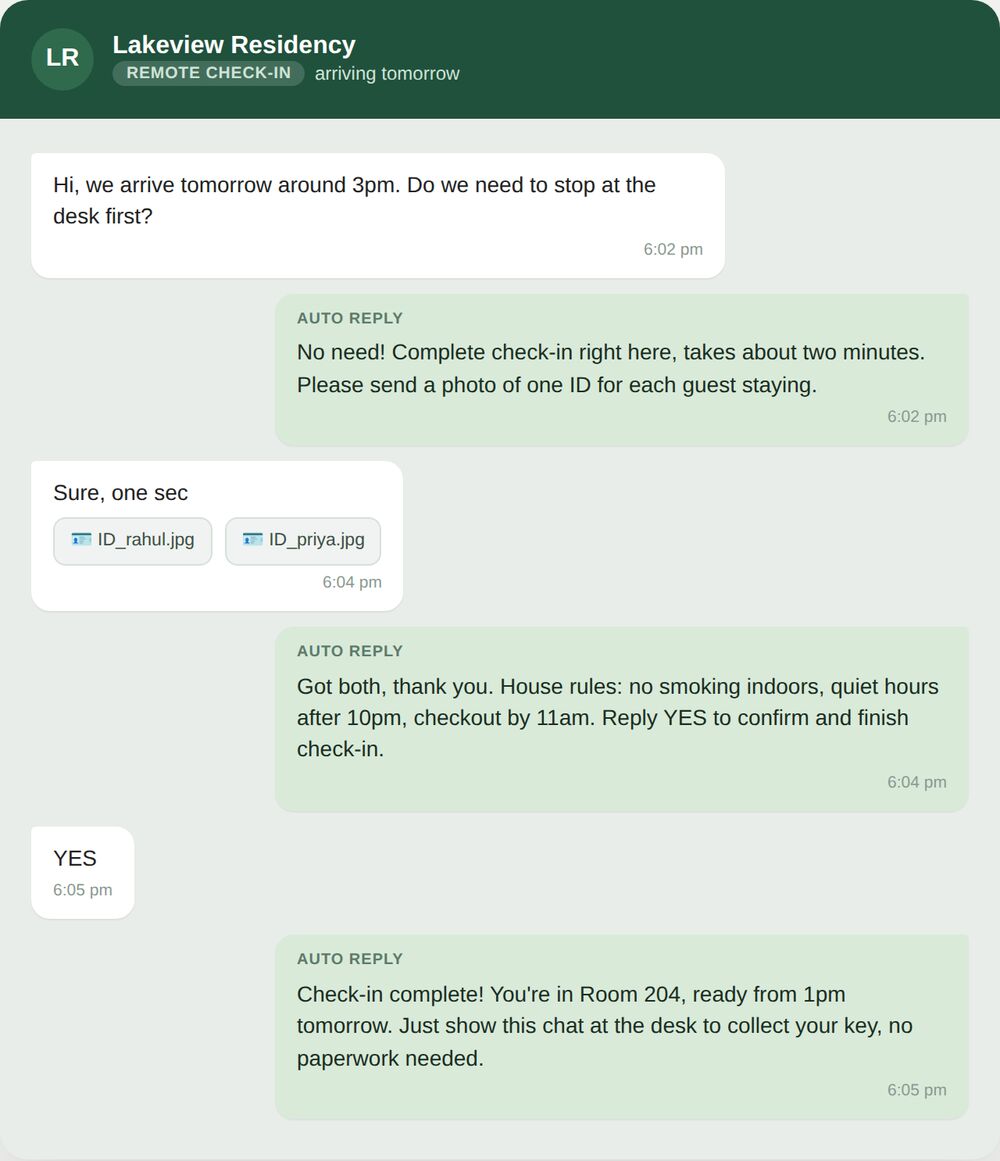
Check-in finished the evening before arrival, entirely inside the same WhatsApp thread.
The guest is asked to send a photo of one ID per person staying and to confirm the property’s house rules with a simple reply. Both are recorded against the booking automatically, with nothing for the property to manually type or file away afterward.
On the property side, each booking shows a clear status, checked in remotely or still pending, so staff know exactly which arrivals are already sorted and which ones still need a nudge, well before anyone actually walks through the door.
When the guest does arrive, there is nothing left to process. Front desk simply confirms the name and hands over the key or shows the way to the room, because the ID is already on file and the house rules have already been agreed, in writing, days or hours earlier.
What a remote check-in setup actually covers
ID collected before arrival
Every guest sends a photo of their ID over WhatsApp ahead of time, recorded against the booking automatically, properly and legibly, without anyone rushing through it at a crowded desk.
House rules confirmed in writing
The guest reads and confirms the property’s house rules before they arrive, so nothing about smoking, quiet hours or checkout time is a surprise on arrival day.
Front desk sees who’s ready
A clear status per booking, checked in remotely or still pending, so staff know at a glance which arrivals need a reminder and which are already sorted.
Works without an app or login
The entire process runs inside WhatsApp, the app the guest already has open, with no download, no account and nothing new to learn.
SEE IT IN ACTION
Lakeview residency turns arrival day into a key handover
Lakeview Residency has four bookings arriving on a busy Saturday, all somewhere between noon and five in the evening, exactly the kind of afternoon that used to mean a small queue at the desk and a stressful few hours for whoever was on duty.
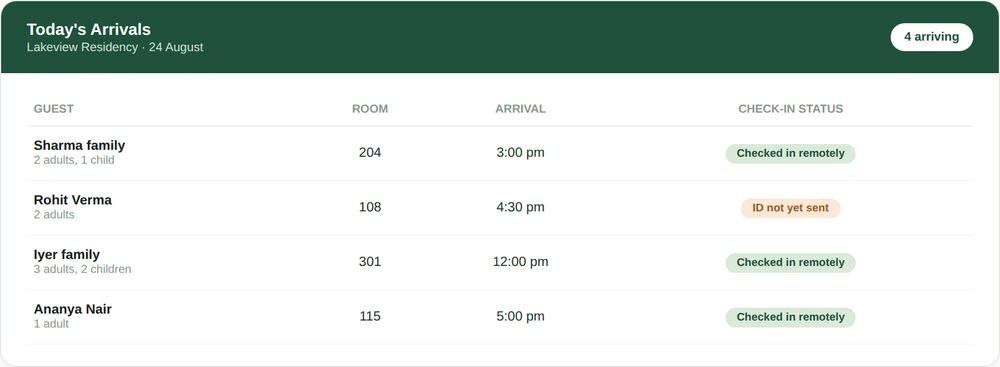
By early afternoon, three of the four Saturday arrivals are already checked in, before anyone has reached the property.
By early afternoon, three of the four bookings already show as checked in remotely. The Sharma family sent their IDs and confirmed the house rules the previous evening and the Iyer family, arriving earliest at noon, did the same first thing that morning from their cab.
Only Rohit Verma’s booking still shows pending, so the property sends a short WhatsApp nudge two hours ahead of his listed arrival time, a quick reminder rather than something anyone has to remember to chase manually. He completes it within minutes, sending his ID and confirming the rules from the road.
When the Sharma family actually arrives at 3pm, there is no queue and no form to fill in. The person at the desk confirms the name, hands over the key to Room 204 and the family is settled in within a couple of minutes of walking through the door, well ahead of the other three arrivals still to come that afternoon.
The Iyer family’s arrival at noon goes the same way, a name check and a key, nothing more, even though they are travelling with two children and enough luggage that a desk-side ID collection would ordinarily have taken a good few extra minutes on its own.
By the end of that Saturday, the person who was on duty at the desk has spent the afternoon actually welcoming guests rather than processing paperwork for each one and the only real interruption to the day was the two hour nudge sent to a single pending booking, handled automatically without anyone needing to remember to send it.
Mistakes properties make with in-person-only check-in
- Collecting ID at a crowded desk, where a quick glance and a rushed note stand in for a proper, legible record.
- Explaining house rules verbally for the first time at check-in, when a guest already tired from travel is least likely to properly absorb them.
- Having no way to tell which of the day’s arrivals are ready to go and which still need ID or confirmation, until they are standing at the desk.
- Leaving the owner or a single staff member unable to step away, because check-in only happens if someone is physically at the desk to process it.
- Processing a group booking one guest at a time in person, when every guest in that group could have completed their own ID and confirmation independently, ahead of time.
- Discovering a missing or unclear ID photo only when a compliance record is actually needed, long after the guest has already checked out.
- Filing paper ID copies loosely by week or by desk drawer, so finding one specific guest’s record later takes far longer than it should.
- Treating a slow, queued check-in as an unavoidable cost of a busy weekend, rather than a bottleneck built entirely around one physical moment.
None of these come from a property being careless. They come from a check-in process still built entirely around a guest standing at a desk, for a step that, once ID and house rules are involved, never actually needed them to be standing there at all.
The same check-in, whoever is arriving and whoever is on duty
The process works the same way for every booking, whether it came in through a direct WhatsApp conversation, a booking widget on the property’s website, or an OTA reservation synced into the same calendar. The guest gets the same request, in the same place, regardless of how they originally booked.
It does not depend on who happens to be on duty when the guest arrives either. A booking checked in remotely the evening before is just as ready at 7am with a new weekend hire at the desk as it would be with the owner personally handling it, because the ID and the confirmation are already sitting on the booking, not in anyone’s memory.
For a group running more than one property, it works the same way at each location, so a manager overseeing several properties sees arrival status in a consistent shape everywhere, rather than one property doing it well and another still relying on a desk-side scramble.
This consistency is what actually removes the bottleneck, rather than just moving it around. A property is not trading a busy front desk for a busy phone, the same handful of minutes of ID collection and rule confirmation simply get spread out across the hours before arrival, instead of stacking all of it into the same narrow check-in window.
Who actually benefits from this
An owner running a homestay personally, without full-time front desk staff, gets the most immediate relief, arrivals no longer have to wait for the owner to be free and the owner is no longer choosing between finishing a task and keeping a guest standing at the door.
A manager handling a small hotel or resort with a front desk team benefits differently, arrival status is visible before the afternoon rush starts, so staff can plan for a quiet, quick handover instead of reacting to a queue that has already formed by the time anyone notices it.
A guest benefits too, even without ever thinking about it as a feature. Completing ID and house rules from a cab or a train, at a moment that suits them, is simply a smoother start to a stay than doing the same thing standing at an unfamiliar desk with luggage still in hand.
A property handling a lot of group and family bookings gets a particular advantage, every guest in a party can complete their own check-in independently and at their own pace, rather than the whole group waiting on a single, sequential process once they are all standing in the lobby together.
A property working with an accountant or a compliance-minded co-owner benefits in a quieter way, ID records arrive already organised and legible against each booking, rather than as a stack of photocopies that need sorting out only when someone actually goes looking for a specific one.
A property that relies heavily on seasonal or weekend-only staff benefits from a different angle, a new hire does not need to be trained on how to run a smooth check-in, because most of the actual work is already done before that staff member’s shift even begins.
How this fits with the rest of OpenStays
Hotel Guest ID software is where every ID collected through remote check-in actually lives, stored and organised for C-form and police verification requirements. Remote check-in is the guest-facing side of that same record, the moment the ID is actually captured, done before arrival instead of at a rushed desk.
The reminder that nudges a guest to complete check-in is one of the scheduled messages covered under automated guest messaging, sent automatically ahead of arrival without anyone needing to track who has and has not responded yet. Once a guest has checked in, the same WhatsApp thread carries straight on into AI WhatsApp concierge support for anything they need during the stay and who can view or manage arrival status is controlled the same way as everything else, under staff logins with roles.
Remote check-in vs. The alternatives
Most properties compare this against how they currently handle arrival day, either everything happens at the desk, or a printed form gets handed to the guest to fill in on the spot.
| Desk-only check-in | A printed form at arrival | Remote check-in | |
|---|---|---|---|
| ID collected before the guest arrives | No | No | Yes, usually the evening before |
| Guest waits at the desk to be processed | Yes, especially at busy times | Yes, while filling the form | No, just a key handover |
| Needs staff free at exact arrival time | Yes | Yes | No, spread out over the hours before |
| Works the same for every guest in a group | One at a time, in sequence | One at a time, in sequence | Yes, everyone completes it independently |
| Setup effort | None, but every arrival costs time | Low, but still manual per guest | A few minutes to turn on, once |
GETTING STARTED
Setting up remote check-in
How to set up remote check-in on OpenStays.
1. Turn on check-in for the property
Switch it on once from the account settings and it applies to every booking going forward, regardless of how the guest booked.
2. Set what needs to be collected
Choose whether one ID per guest is required and add or edit the house rules the guest will be asked to confirm.
3. It goes out automatically before arrival
A check-in request is sent over WhatsApp ahead of the stay, timed to reach the guest with enough notice to complete it comfortably.
4. The guest completes it in the same thread
They send ID photos and confirm the house rules with a simple reply, without leaving WhatsApp or downloading anything.
5. See status before anyone arrives
Each booking shows checked in remotely or still pending, so staff know exactly what to expect before the day’s arrivals begin.
What to check in any remote check-in setup
- Does the guest complete it entirely inside WhatsApp, or does it require downloading a separate app or creating an account?
- Is the ID captured clearly enough to actually be usable for a C-form or police verification requirement later?
- Can staff see, before the day’s arrivals begin, exactly which bookings are ready and which still need a nudge?
- Does every guest in a group booking complete it independently, or does the whole party still have to go through it together at the desk?
- What happens if a guest simply does not complete it before arriving, does check-in still work at the desk as a fallback?
- Does the reminder go out automatically, or does someone on staff have to remember to chase each booking manually?
A setup that cannot answer these clearly is really just moving the same desk-side paperwork onto a screen, without actually solving the queue it was meant to remove.
It is worth testing this against a specific, busy day rather than taking a features list at face value. Pick the property’s busiest recent Saturday and ask, honestly, how many of that day’s arrivals would have shown as ready before anyone reached the desk. If the honest answer is none, that gap is exactly what this closes and it pairs directly with how the property already handles guest ID records once collected.
What actually happens behind the scenes
The request goes out automatically ahead of arrival, timed with enough notice for the guest to complete it without feeling rushed and it arrives in the same WhatsApp thread the guest has already been using, not a new number or a separate channel to notice and trust.
If an ID photo comes through blurry or a page is missing, the guest is simply asked to resend it, right there in the same conversation, before the booking is marked as checked in. Nothing moves forward on an ID that is not actually legible.
For a group booking, each guest completes their own ID and confirmation independently. The booking as a whole only shows as fully checked in once every guest in the party has completed their part, so the front desk knows exactly whether the entire group is ready or just some of them.
If a guest does not complete this before arriving, nothing is lost, the desk simply falls back to collecting ID and confirming house rules in person, exactly as it would have without the feature at all. It is an addition to the process, not a replacement that leaves a property stuck if a guest misses it.
A date change on the booking does not carry an old status forward incorrectly. If the arrival date moves, the request and its reminder are timed against the new date, not the original one, so it always lands with the right amount of notice.
Everything collected, the ID photos and the confirmed house rules, is stored against the booking the same way it would be if collected at the desk, ready for the same compliance and record-keeping needs, just captured earlier and more reliably.
A property can change what it asks for at any point, adding a second ID type during a high verification season, for instance, or adjusting the house rules text after a policy change, without affecting bookings that already completed check-in under the older version.
None of this requires a guest to have used the process before either. A first-time guest gets exactly the same clear, short set of instructions as a repeat guest, so there is no learning curve on the guest’s side that would make this harder for a first booking than a fifth one.
Frequently asked questions
What is remote check-in and does the guest need to download an app?
It lets a guest send ID and confirm house rules over WhatsApp before arriving, no app or account needed, just their regular WhatsApp.
How far ahead of arrival does the check-in request go out?
It is timed to give the guest enough notice to complete it comfortably, typically the evening before or a few hours ahead of arrival and this can be adjusted.
What if a guest does not complete it before arriving?
Check-in simply falls back to the normal in-person process at the desk, nothing about the booking is blocked.
Can every guest in a group booking complete their own check-in?
Yes, each guest sends their own ID and confirms the house rules independently and the booking shows fully checked in once everyone has done so.
What happens if an ID photo is unclear?
The guest is asked to resend it in the same conversation before the booking is marked as checked in.
Is the ID collected this way stored the same way as one collected at the desk?
Yes, it is stored against the booking the same way, ready for the same compliance and verification needs.
Does this work for bookings made on an OTA?
Yes, it works the same way regardless of how the booking was originally made, once it is synced into the property’s calendar.
Can staff see which arrivals are ready before the day begins?
Yes, each booking shows a clear status, checked in remotely or still pending, visible well ahead of arrival.
Does the guest need a WhatsApp Business account?
No, the guest uses their own ordinary WhatsApp, the same one they already have.
Can house rules be different for different properties in a group?
Yes, each property’s house rules are set independently and guests only see the rules for the property they are actually staying at.
Does a date change on the booking affect the reminder?
No, the reminder is timed against the current arrival date, so it always lands with the right amount of notice even after a change.
Can front desk staff see this without owner-level access?
That depends on the role assigned under staff logins with roles, viewing arrival status can be given to front desk staff without extending further access.
Does this replace the ID verification requirement at check-in?
No, it fulfils the same requirement earlier and more reliably, the ID is still collected, just before the guest is standing at the desk.
Can a guest complete this from outside India?
Yes, it works over WhatsApp from any location the guest is travelling from.
Is there a limit to how many guests can complete it for one booking?
No, every guest listed on the booking can complete their own, regardless of party size.
Can a property require two forms of ID instead of one?
Yes, what is requested can be adjusted in settings and the guest is simply asked for whatever the property currently requires.
What changes in the first month
Turning on remote check-in takes a few minutes, choosing what needs to be collected and confirming the house rules guests will be asked to agree to. Most properties have it running well before their next batch of arrivals.
The first noticeable change usually shows up on the first genuinely busy day after switching it on, a Saturday or a festival weekend where several bookings would previously have arrived in the same tight window. Instead of a queue, most of the day’s guests already show as checked in by the time they walk through the door.
A quieter change follows soon after, in how much of the day staff actually spend on check-in itself. What used to be a recurring interruption throughout arrival day becomes a short list to glance at each morning, mostly already sorted, with only the occasional pending booking needing a reminder.
By the second or third month, most owners describe the same shift, arrival day feels calmer, ID records are more complete and more legible than they used to be and the front desk has effectively become a place to hand over a key rather than a place to process paperwork.
For a property heading into its first peak season since switching this on, the difference tends to be most visible right there. A weekend that would previously have meant a stressful, queued afternoon instead runs as a series of quick, calm key handovers, spread out exactly the way arrivals themselves are spread out.
Let check-in finish before the guest walks in
No setup fee. Works on any phone, no app required. Turn it on in a few minutes.