
FOR HOMESTAYS, HOTELS & RESORTS
Automated guest messaging
The reminder that never gets sent, the ID request nobody follows up on, the review ask that only happens if someone remembers. Automated guest messaging for hotels sends every one of them on time, for every booking, without a task list.
Built by property owners for property owners · 0% commission · Runs on your existing WhatsApp number
ILLUSTRATIVE FEATURE OVERVIEW
Guest messaging
Booking
Confirmation and payment information
Before arrival
Directions and check-in details
During the stay
Configured guest messages
After check-out
Feedback and review requests
Stay connected at every stage
The messages that get forgotten in the gap between booking and arrival
This is the scheduled and triggered side of guest communication, the messages that go out at a set point in the guest journey whether or not anyone is watching the calendar that day.
This page covers what gets automated, what stays entirely in your control and how it is different from the AI concierge that answers a guest’s own questions in the moment.
A booking confirmed six weeks in advance does not stay top of mind. Life happens between the booking and the stay, other guests check in, a supplier delivery needs sorting, a family event comes up and the guest whose ID was supposed to be collected three days before arrival is quietly forgotten until they are standing at the door with none of it done.
The same thing happens at the other end of the stay. A property that does brilliant, attentive hosting in person often sends no follow-up message at all once the guest has left, not because they do not value reviews, but because by checkout day there is already a new guest arriving and the moment to ask has passed.
None of these gaps are about care or effort. They are about memory and specifically about remembering to do something small on a specific day for a specific booking, repeated correctly across every single reservation on the calendar, week after week, without ever missing one. That is a scheduling problem, not a hospitality problem and it is exactly the kind of problem automated guest messaging for hotels is built to remove.
It is worth separating this clearly from bad hosting, because it is not that. The same owner who forgets to send a pre-arrival reminder is often the one who personally greets every guest at the door and remembers exactly how they like their morning coffee. Attentiveness in person and reliability across a growing list of scheduled tasks are two different skills and struggling with the second says nothing about the first.
It compounds with scale in a way that is easy to underestimate. One property with three bookings a month can probably track every reminder by memory. The same property at fifteen bookings a month, spread across different lead times and different stages, cannot, not reliably, not every single time and the misses do not announce themselves. They just show up later as a guest who never sent an ID, a review that never got asked for, or a checkout that ran long because nobody reminded the guest of the time.
Every one of these messages is genuinely simple on its own. A pre-arrival reminder is one message. A checkout reminder is one message. A review request is one message. None of them are hard to write or hard to send. The difficulty is entirely in remembering to send the right one, to the right guest, on the right day, for every booking on the calendar, week after week, without a system that tracks it for you. That is a problem of volume and repetition, not a problem of knowing what to say.
What a missed reminder actually costs
A missed pre-arrival ID request means chasing it at the front desk while a guest waits, tired from travel, wanting to get to their room. A missed checkout reminder means a late departure eating into the turnaround time before the next guest arrives, sometimes forcing a rushed clean or an apologetic delay for the next arrival. A missed review request means a genuinely happy guest who simply never got asked and who was never going to think to leave one unprompted.
Reviews are the clearest case because the cost is so directly visible. Guests who had a great stay are, overwhelmingly, willing to say so if asked at the right moment, within a day or two of checkout, while the stay is still fresh. Asked three weeks later, if asked at all, the response rate drops sharply. A property that only sometimes remembers to ask is leaving a predictable, recurring number of five-star reviews unwritten every single month, not because guests would have said no, but because nobody asked in time.
There is a slower cost too, one that only shows up over a full season. Reviews are how new guests decide between one property and the next on a listing page or a Google search and review count and recency both factor into that decision as much as the star rating itself. A property collecting reviews inconsistently, in bursts when someone remembers to ask and long silences when nobody does, ends up with a thinner, staler-looking review profile than one that simply asks every guest, every time, whether or not the person hosting them that week happened to think of it.
The ID collection case is quieter but has its own cost: compliance work compressed into the two minutes a guest is standing at the desk, rather than spread calmly across the three days before arrival when there was no urgency at all. Automated guest messaging for hotels moves that request to the moment it is easiest for the guest to answer, days before check-in, rather than the moment it is hardest for your desk to handle.
There is a cumulative version of this cost too, easy to miss because no single missed message feels significant. Take a modest property doing twenty bookings a month. If even a third of pre-arrival reminders are forgotten, that is six or seven guests a month arriving without having shared ID in advance, six or seven small front-desk delays. If half the review requests never go out, that is potentially ten reviews a month simply never asked for, across a year, well over a hundred reviews a property never collected, not because guests said no, but because the ask never reached them.
What automated guest messaging for hotels actually is
It is a set of messages tied to specific points in the guest journey, booking confirmed, a set number of days before arrival, the morning of check-in, partway through a longer stay, the morning of checkout and a day or two after departure, each one sent automatically on WhatsApp without anyone needing to remember the date.
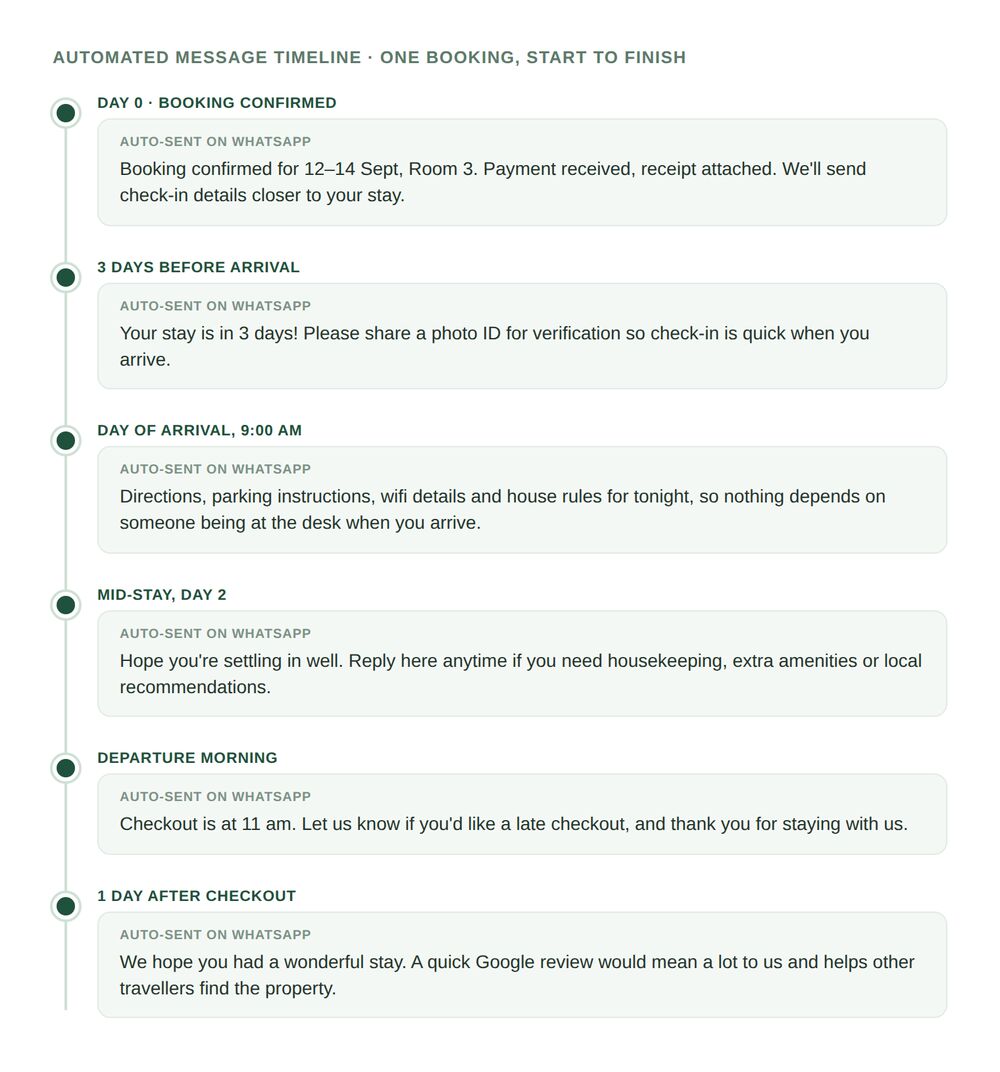
Every message in that sequence is something you write and approve in advance, not a generic template stamped with your property’s name. The pre-arrival reminder asks for exactly the information you actually need. The check-in message gives exactly the directions and wifi details relevant to your property. The review request uses your own wording, sent at the timing you choose.
The word automated is doing a specific, narrow job here. It does not mean generic and it does not mean out of your control. It means the sending itself no longer depends on a person remembering to do it on a specific day. Everything about what gets sent, when and in what words, stays exactly as much under your control as it would be if you were typing each message yourself, which is precisely why properties that try automated guest messaging for hotels rarely go back to doing it by hand once they have used it through a full season.
Nothing here is reactive the way the AI WhatsApp concierge is. A guest asking an unexpected question mid-stay is a different feature entirely, covered on the AI WhatsApp concierge page. Automated guest messaging is the scheduled half of guest communication: the messages that go out on a timeline regardless of whether the guest asks for anything at all.
The two features are designed to sit side by side rather than compete. A property can run automated guest messaging on its own, without the concierge and still get every scheduled reminder sent correctly. A property running both gets the full picture: the predictable messages arriving on schedule and any unpredictable question a guest actually asks answered in between. Neither one is a prerequisite for the other.
What gets automated, stage by stage
Four things make the difference between a messaging sequence that feels automatic in a good way and one that feels careless. All four are built into how automated guest messaging for hotels handles every send.
Triggered by the booking, not the clock
Every message is tied to a booking’s own dates, three days before that specific guest’s arrival, not a fixed calendar date, so the timing is always correct regardless of when the booking was made.
Written and approved by you
Every message template is yours to write, edit and approve before it ever goes out. Nothing sends in your property’s name that you have not seen and signed off on first.
Skips itself when it should
A guest who already shared their ID does not get asked again. A guest who already left a review does not get a second request. The sequence adapts to what has actually happened, not a rigid script.
Visible in one place
Every automated message sent, to every guest, is logged against that booking, so you can see exactly what went out and when without digging through individual WhatsApp threads.
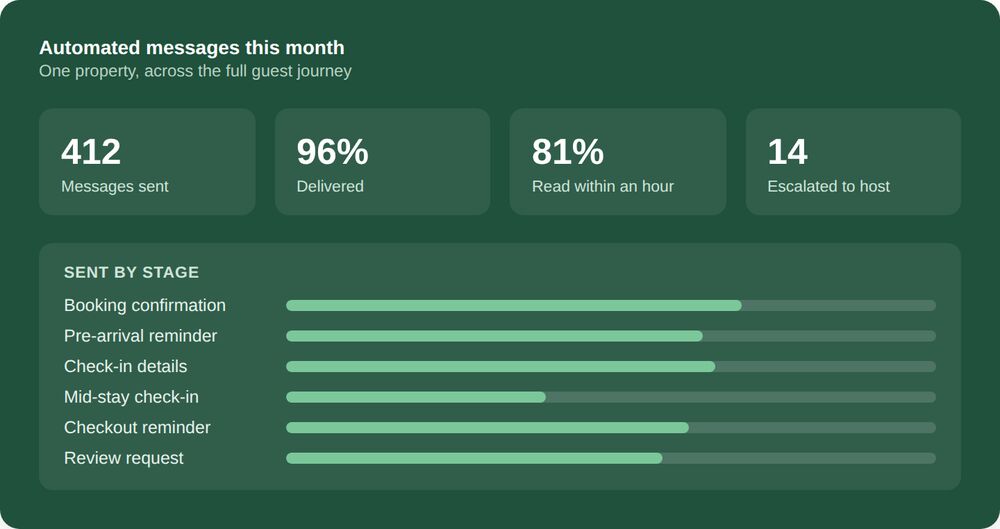
The messages that go out on their own
Booking confirmation
Sent the moment payment lands: dates, room, amount paid, a receipt. The guest has something in writing within seconds of paying, without anyone at the property lifting a finger.
Pre-arrival reminder
Sent a set number of days before arrival: a nudge that the stay is coming up, paired with a request for ID if you collect it in advance, so check-in itself is fast.
Check-in details
Sent the morning of arrival: directions, parking, wifi, house rules, so a guest arriving before anyone is at the desk still has everything they need.
Checkout reminder and review request
Sent the morning of departure and again a day or two after: the checkout time as a courtesy, then a genuine ask for a review while the stay is still fresh in the guest’s mind.
None of these five categories require a guest to ask for anything. They simply arrive, on schedule, for every booking on the calendar, whether that calendar has three reservations this month or thirty.
Most properties do not start with all five turned on. A common path is enabling the booking confirmation and checkout reminder first, since those are the easiest to trust immediately, then adding the pre-arrival ID reminder once the wording feels right and finally turning on the review request once the earlier stages have proven themselves. Nothing requires switching on the entire sequence at once and there is no penalty for taking a few weeks to build up to the full five-stage version of automated guest messaging for hotels.
SEE IT IN ACTION
A long weekend at a resort in Wayanad
Anand’s resort takes a mix of two-night weekend stays and longer five-night bookings through the season. Before automated guest messaging, pre-arrival reminders happened when someone remembered, which in practice meant roughly half the time.
A family books a five-night stay six weeks out. The morning their stay is three days away, a WhatsApp message goes out automatically: a reminder of the dates, a request to share ID for the primary guest and a note about what to pack given the season. Two of the three names come back within the hour; the third arrives the next morning, still two full days before check-in, with no one at the resort having to chase it.
On the morning of arrival, a second automatic message goes out: the gate code, parking instructions and what time the restaurant opens for lunch, timed to land in the guest’s inbox before they are even on the road. Halfway through the five-night stay, a short check-in message arrives: is everything going well, is there anything the resort can help with. The family does not need anything and does not reply, which is itself a useful, quiet signal that the stay is going smoothly.
On checkout morning, the standard reminder goes out with the time and a thank you. Two days after they leave, a review request follows, worded the way Anand actually talks to his guests rather than a generic template. The family, still thinking fondly of the stay, leaves a detailed five-star review that mentions the resort by name, the kind of review that took Anand precisely zero minutes of his own time to ask for.
A short weekend booking at a hotel in Udaipur
Priyanka’s hotel takes mostly two-night weekend bookings, a different rhythm from Anand’s longer resort stays and a good test of whether the same sequence adapts sensibly to a shorter timeline. Before switching it on, her front desk sent pre-arrival reminders manually for corporate guests only, since those were considered the priority and leisure weekend bookings mostly went without one.
A couple books two nights, arriving Friday. Because the stay is short, the pre-arrival reminder goes out just one day before rather than three, timed to still be useful without arriving so early it gets forgotten. There is no mid-stay check-in message at all, since a two-night stay does not have a meaningful midpoint before checkout is already the next concern. The sequence recognised the shorter booking window and adjusted automatically, exactly what a thoughtful host would have done by hand, without Priyanka having to configure two entirely different sequences for long and short stays.
Checkout on Sunday brings the standard reminder and the review request follows on Monday afternoon, while the weekend is still the freshest thing in the couple’s week. Priyanka’s front desk did not send a single one of these messages themselves. What they did instead, over that same weekend, was handle a request for an extra pillow and help a guest change their dinner reservation, the kind of in-person attention that automated messaging was never meant to replace and does not try to.
The bigger shift for Priyanka’s hotel showed up a month later, once every weekend booking, not just the corporate ones, had been receiving the same reminder and the same review request. Her Google review count for the quarter came in noticeably higher than the same quarter the year before, with nothing else about the hotel’s operations having changed.
Five ways properties get less out of automated guest messaging
The sequence works well by default, but a handful of habits are what separate a setup that quietly runs itself from one that gets switched on once and then ignored, or worse, actively mistrusted after one awkward message.
Most of these come down to setting the sequence up once and never looking at it again, rather than treating it as something worth refining as you learn what your own guests respond to.
- Writing messages that sound like a form letter. A pre-arrival reminder that reads like a legal notice gets ignored more often than one that sounds like the property actually wrote it.
- Asking for a review too early or too late. The window that gets the best response is short, a day or two after checkout, while the stay is still fresh; much earlier feels presumptuous, much later gets ignored.
- Sending the same sequence regardless of stay length. A two-night weekend booking and a two-week stay do not need identical timing and a mid-stay check-in message sent on a two-night booking often lands after the guest has already left.
- Never checking the delivery log. A message that consistently fails to deliver to a particular guest, wrong number, blocked contact, is worth noticing rather than assuming it always goes through.
- Treating it as fully separate from the front desk. Staff should know the automated sequence exists so they are not duplicating a reminder a guest already received, or contradicting one.
Applies to every booking on the calendar, not just direct ones
A booking added manually because it came from an OTA gets the same automated sequence as a booking made directly through OpenStays. Confirmation, reminder, check-in details, checkout, review request, all of it runs from the dates on the calendar, not from which channel the booking arrived through.
This matters most for the review request. An OTA-sourced guest who has a great stay is just as likely to leave a glowing Google review as a direct guest, if someone actually asks them to at the right moment. Automated guest messaging for hotels makes sure that ask happens for every guest, not only the ones who booked through the channel a property happens to be paying closest attention to.
It also means the sequence does not create a two-tier guest experience where direct bookers get a polished, attentive journey and OTA guests get whatever attention is left over. Every confirmed booking on the calendar receives the same reminders, the same check-in details, the same thank you, regardless of how the guest found the property in the first place.
Automated guest messaging vs. The alternatives
| Automated guest messaging | Manual reminders by staff | No structured reminders | |
|---|---|---|---|
| Sent on time, every booking | Yes, always | Depends on workload that day | Rarely, informally |
| Consistent wording | Yes, your own approved templates | Varies by who sends it | N/A |
| Review request timing | Same optimal window, every time | Whenever someone remembers | Usually never |
| Skips guests who already responded | Yes, automatically | Depends on staff noticing | N/A |
| Visible record of what was sent | Yes, logged per booking | Scattered across individual chats | None |
| Effort required per booking | None, after initial setup | A few minutes, if remembered | None and nothing sent |
Manual reminders are not a bad instinct, a property that sends thoughtful, personal messages by hand is doing something real. The problem is consistency at scale: the tenth booking of a busy week gets the same care as the first only if nothing distracts the person sending it and something usually does. Automated guest messaging does not do anything a good host would not otherwise do by hand; it just does it for every booking, every time, without depending on anyone’s memory on a specific afternoon.
Worth being honest about the trade-off: automation cannot read a guest’s mood or notice something a human would pick up on instantly, a note in the booking that this is a honeymoon, a guest who mentioned a food allergy in passing. Those still need a person paying attention. What automation reliably handles is the part that never needed a person’s judgement in the first place, just their memory and memory is the thing most likely to fail on a busy day.
The two are not competing for the same hours either. A reminder that used to take a staff member two minutes to type and send, repeated across every booking of the week, adds up to real time. Automated guest messaging for hotels gives that time back and the honest use of it is putting it toward the guest standing at the desk right now, not toward finding a new task to fill the gap.
SETUP
How to set up automated guest messaging for hotels
The sequence runs on the same WhatsApp number and OpenStays account as your booking automation and AI concierge. Setup is mostly writing the messages once.
Setting up automated guest messaging for hotels with OpenStays takes about 25 minutes to configure the full sequence, with templates you can keep refining afterward.
1. Choose which stages to automate
Start with all five, confirmation, pre-arrival reminder, check-in details, checkout reminder and review request, or turn on only the ones you want for now.
2. Write your message templates
Each stage gets its own template in your own words. Placeholders pull in the guest’s name, dates and room automatically so you are not writing each one individually.
3. Set the timing for each stage
Choose how many days before arrival the reminder goes out and how long after checkout the review request follows. These can be adjusted at any time as you learn what works.
4. Decide what skips automatically
Configure which messages should not send if a guest has already responded, such as skipping the ID reminder once ID has already been received.
5. Review the first batch of sends
Every sent message is logged. The first week or two is for confirming the timing and wording feel right before leaving the sequence to run unattended.
The booking engine, WhatsApp AI and automated guest messaging are live. Sign up on OpenStays to join.
BEFORE YOU CHOOSE
How to evaluate any automated guest messaging setup
A few tools call themselves guest messaging automation while really only handling one stage, usually the booking confirmation and leaving the rest manual. Whatever you shortlist, including us, these are worth checking:
- Does it cover the full journey, or just the confirmation? Confirmation messages are the easy part; the pre-arrival reminder and the review request are where consistency actually matters most.
- Can you write your own message templates? A tool that only offers generic, fixed wording will sound like every other property using the same tool.
- Does it skip guests who already responded? A review request sent to someone who already left one, or an ID reminder sent after ID was received, reads as careless rather than automated.
- Is the timing tied to each booking’s own dates? A sequence based on fixed calendar days rather than days relative to arrival will send reminders at the wrong time for bookings made at different lead times.
- Can you see what was actually sent? A log of every automated message per booking should be available, not just a claim that messages went out.
OpenStays was built by property owners tired of writing the same reminder by hand for the fortieth time in a season. See the WhatsApp booking system for hotels for the booking-side automation and guest ID software for how the ID requests here connect to compliance records.
It is also worth asking any vendor, including us, what happens when something changes mid-sequence, a guest cancels, a stay gets extended, a booking moves to different dates. A messaging setup that only handles the simple, unchanging case will quietly send the wrong reminder, on the wrong day, the first time a real booking does not go exactly to plan and real bookings change more often than any static system expects.
One more test worth applying: try to picture the worst version of each message before turning it on. A review request sent to a guest who complained during their stay, a checkout reminder sent after a guest already left early, a pre-arrival ID request sent to someone who cancelled last week. Any setup worth using should have an obvious answer for each of these edge cases, not a shrug.
What happens to the messages and the information collected
Automated messages carry real information, dates, payment confirmations, sometimes an ID shared in response to a pre-arrival request. Each message is logged against the specific booking it belongs to and visible to the property that guest is staying at, not shared across unrelated properties on OpenStays.
Anything collected through the pre-arrival ID reminder follows the same handling as the rest of OpenStays’ guest ID storage, covered in the guest ID compliance guide. A guest can always reply to any automated message and reach a person, the sequence does not trap them in a one-way channel with no way to ask a follow-up question.
This is also why automated guest messaging for hotels is built as a set of one-way sends into a two-way channel rather than a closed broadcast system. A guest who replies to a checkout reminder asking to extend their stay by a night is not talking to a wall, that reply reaches your dashboard like any other WhatsApp message and can be picked up by staff or, if it is a routine question, by the AI WhatsApp concierge.
Access to the message log itself is limited to the property’s own dashboard users, the same access controls that already govern who on your team can see bookings and guest details. Nothing about turning on automated messaging widens who can see a guest’s information beyond what already had access to it.
QUESTIONS
Frequently asked questions about automated guest messaging
How is this different from the AI WhatsApp concierge?
Automated guest messaging is scheduled and triggered: fixed messages that go out at set points in every booking’s journey, regardless of whether the guest asks for anything. The AI WhatsApp concierge is reactive: it answers whatever a guest actually messages about mid-stay. Most properties run both, since they cover different halves of guest communication.
How is this different from the WhatsApp booking system?
The WhatsApp booking system for hotels handles the enquiry and booking conversation before a reservation exists. Automated guest messaging starts once a booking is confirmed and continues through to the post-stay review request. One converts an enquiry; the other manages everything that follows.
Can I write my own message templates?
Yes, every stage of the sequence uses wording you write and approve, with placeholders for the guest’s name, dates and room filled in automatically.
What if a guest already sent their ID before the automated reminder?
The reminder is configured to skip automatically once the requested information has already been received, so guests are not asked twice for the same thing.
Does the review request feel like spam?
It is a single message, sent once, in wording you control, timed to the window when guests are most likely to respond warmly. Properties that word it personally see it read as a genuine ask rather than a mass notification.
Can I turn off individual stages?
Yes. Each of the five stages, confirmation, pre-arrival reminder, check-in details, checkout reminder and review request, can be switched on or off independently.
Does it work for stays booked far in advance as well as last-minute bookings?
Yes. Timing is calculated relative to each booking’s own arrival date, so a booking made six months out and one made two days out both get correctly timed reminders.
Is this available today?
The booking engine, WhatsApp AI and automated guest messaging are live.
Does it cost extra?
Pricing details live on the OpenStays pricing page rather than here, since plans change over time. Automated messages run on the same WhatsApp communication credits as the rest of your automated messaging.
Can staff see what has already been sent to a guest?
Yes, every automated message is logged against the booking, visible to anyone on your team with dashboard access, so nobody duplicates or contradicts a message that already went out.
What happens if a guest replies to an automated message?
It opens a normal conversation. A guest can ask a follow-up question on any automated message and reach a person or the AI WhatsApp concierge, depending on what they are asking.
Does this replace the front desk’s own communication with guests?
No. It handles the predictable, repeatable messages so staff time goes toward guests who are actually in front of them or need something the sequence was never meant to cover.
Can the timing be different for different room types or rate plans?
The sequence is set per property today; splitting timing by room type or rate plan is a reasonable request worth raising with OpenStays support if your operation needs it.
What happens if a booking is cancelled or rescheduled?
The sequence follows the booking’s current dates and status. A cancelled booking stops receiving further scheduled messages and a rescheduled booking’s remaining messages recalculate against the new dates automatically.
Do guests know the messages are automated?
There is no requirement to disclose it and most properties word their templates in the same voice they would use writing by hand, so guests generally experience it as attentive communication rather than a notification system.
What changes in the first month
The first visible change is usually the ID collection rate before arrival. Guests who get asked three days out, calmly, before there is any urgency, respond at a noticeably higher rate than guests asked at the desk while other people are waiting behind them.
The second change shows up in the review count. Properties that turn on the review request stage and had not been consistently asking before often see a real jump within the first month, not because guests suddenly became more willing to leave reviews, but because every guest who had a good stay is now actually being asked, not just the ones who happened to be asked by a staff member who remembered.
Nothing about the guest experience feels automated from the guest’s side. They receive a reminder before their stay, directions on arrival, a thank you and a review request afterward, exactly what a well-run, attentive property would send by hand. What changed is that it now happens for every booking, every time, without depending on anyone’s memory on a busy day.
Owners who look back after a full season tend to describe it the same way: nothing dramatic happened in any single week, but the small things that used to occasionally slip, a forgotten ID request, a review nobody asked for, a late checkout that ran into the next guest’s turnaround, simply stopped slipping. It is a quiet kind of improvement, felt more in what stopped going wrong than in anything new that started happening.
That is the honest pitch for automated guest messaging for hotels: not a dramatic new capability, but the reliable, unglamorous removal of a specific kind of failure that every property experiences occasionally and none of them can fully prevent by trying harder to remember. Trying harder is not really the fix for a memory problem at scale; a system that does not need to remember is.
Never miss another reminder, ID request or review ask.
Automated guest messaging runs on the same number and the same OpenStays account as the rest of your setup. Nothing new to install.