
FOR HOTELS, RESORTS & GROUPS
Travel agent discounts
Travel agent discounts, tracked properly, mean every agent gets the rate you actually agreed on, every booking they send is tagged back to them automatically and you can finally see which relationships are worth keeping.
No setup fee. No commission.
ILLUSTRATIVE FEATURE OVERVIEW
Agent rates
Agent relationship
Identify who you work with
Agreed discount
Set the rate arrangement
Reservation
Apply the eligible agent pricing
Your property
Keep control of the agreement
Keep agreed rates organised
What happens without a proper way to handle agent rates
No more checking an old WhatsApp thread to remember what you quoted a particular agent last time, or wondering how many rooms a partner actually sent you this year.
Most independent properties get a meaningful share of their bookings through travel agents, a local operator who sends a family for a weekend, a corporate travel desk that books a room a few times a year, an agent who has sent guests for a decade and expects to be treated accordingly. None of that runs through a booking engine the way a direct guest booking does.
It usually runs through a phone call or a WhatsApp message instead. An agent asks for a rate, the owner quotes something based on how the relationship feels that week, the room gets blocked and the booking gets entered into the system the same way a walk-in would, with nothing marking it as an agent booking at all.
The rate itself tends to drift. An agent who got fifteen percent off in March might get twelve percent in June, not because anything changed, but because nobody wrote the first number down and the owner is quoting from memory each time. A newer agent with a smaller relationship might accidentally end up on a better rate than a decade long partner, simply because the most recent conversation is the one anyone remembers.
By the time an owner wants to actually understand the relationship, whether a particular agent is worth the discount, whether it is time to renegotiate, whether one agency has quietly become the source of a third of monthly bookings, the information does not exist anywhere except memory and a scattered set of WhatsApp chats going back years.
None of this is because owners are careless about a relationship that matters to them. It is because the tools available treat every booking the same way, with no way to mark one as coming through a specific agent, at a specific rate, as part of a specific ongoing arrangement.
The problem scales in an unhelpful direction too. A property with two or three agent relationships can just about keep it all in someone’s head. A property that has grown to a dozen agents, each with a slightly different history and a slightly different rate, needs something closer to travel agent discounts managed properly, a system built for exactly this, rather than a stronger memory.
Seasonality makes the gap worse. An agent relationship agreed during a slow month, when almost any booking felt worth a generous discount, tends to carry that same rate straight through peak season, when the same room could have been sold at a much better price to someone else. Without a record to prompt a review, that seasonal mismatch simply never gets revisited.
What informal agent rates actually cost
The most direct cost is inconsistency. Two agents sending similar volumes of business can end up on meaningfully different rates, purely because one negotiated more recently or more assertively, which is not a fair or defensible way to run a set of relationships that matter to the property.
There is a visibility cost. Without bookings tagged to the agent that sent them, it is genuinely difficult to answer a simple question, which agent sent the most business this year. That answer should inform who gets a better rate next season, who gets a phone call to check in and who is quietly not worth the standing discount anymore, but none of that is possible without the underlying data.
There is a trust cost too, one that runs in both directions. An agent who suspects their rate has drifted from what was promised has no record to check it against either and a disagreement over what was actually agreed becomes a word against word conversation that can damage a relationship that took years to build.
There is a scaling cost. A single owner personally remembering rates for four or five agents is workable, if imperfect. A manager covering for the owner, or a property that has grown to a dozen agent relationships, cannot carry that much informal knowledge reliably and the whole system tends to fail exactly when the property is busy enough that agent business matters most.
There is a commission cost as well, for properties working on a commission model rather than a straight discount. Without a clear record of which bookings came through which agent, reconciling what commission is actually owed at the end of a month becomes another manual, error prone exercise, layered on top of the rate confusion already in play.
None of this shows up as one dramatic failure. It shows up as a slow erosion of exactly the relationships that were bringing in reliable, repeat business, an agent who feels a little less prioritised than they used to, a discount nobody can quite justify anymore and a source of bookings the property cannot describe with any real confidence.
There is a word of mouth cost too, one that is easy to overlook. Travel agents talk to each other and a property known for consistent, well tracked rates is an easier property for an agent to recommend to a peer than one where every arrangement depends on catching the owner in a good mood. Properties that get travel agent discounts right tend to find new agent relationships arrive a little more easily than ones that do not.
There is an opportunity cost buried in here as well. A property that cannot see which agents are actually performing has no reliable way to decide where to invest relationship building time, a lunch, a courtesy call, a slightly better rate offered proactively. That effort ends up spread evenly across every agent regardless of how much business they actually bring, rather than concentrated where it would do the most good.
What travel agent discounts actually give you
Each travel agent or agency is added to the account as a recognised partner, with a name, a contact and a standing discount, a fixed percentage off the rack rate, or a fixed agent rate, agreed once and applied automatically from then on, rather than quoted fresh in every conversation.
Every booking made through that agent is tagged to them from the moment it is created, whether it comes in through a dedicated WhatsApp number, a booking link specific to that agent, or a manual entry made on their behalf. The tag travels with the booking permanently, into the guest record, the revenue figures and any report pulled later.
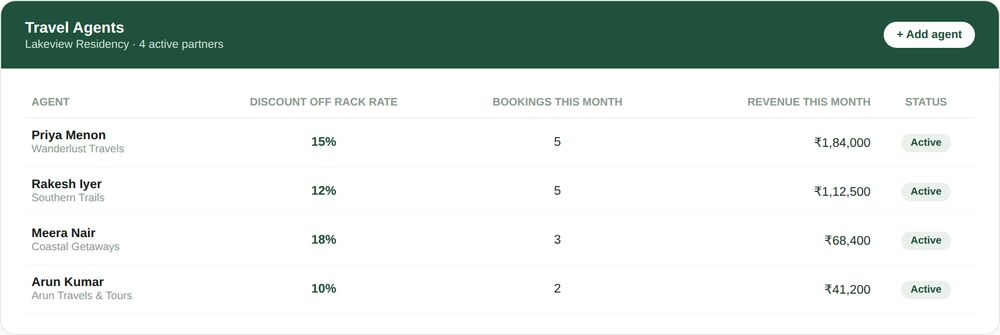
Four agent partners, each on a standing rate, with bookings and revenue tracked automatically.
That tagging is what makes the rest of it possible. An owner can open the account at any point and see, by agent, how many bookings came in this month, what revenue they represent and whether the discount on file still makes sense given the volume actually showing up.
None of this requires the owner to remember anything. The rate is set once per agent and stays exactly where it was set until someone deliberately changes it, which means a returning agent gets the same rate they got last time, without anyone needing to check an old conversation to confirm it.
What a travel agent discount setup actually covers
One rate, applied automatically
Set a standing discount or fixed rate per agent once and every booking from them applies it automatically, with nothing to renegotiate or remember on the next call.
Every booking tagged to its source
A booking made through an agent carries that agent’s name permanently, visible in the guest record, the revenue figures and any report pulled later.
Volume and revenue by agent
See exactly how many bookings and how much revenue each agent has sent, over any period, to inform who gets a better rate and who does not.
Works alongside commission tracking
For properties on a commission model rather than a straight discount, tagged bookings make working out what is owed to each agent at month end a lookup, not a reconstruction.
SEE IT IN ACTION
A resort near Munnar finally sees which agent is actually worth the discount
Lakeview Residency works with four travel agents, each on a different standing discount, agreed at different points over the past three years. For a long time, the only record of who sent what was scattered across old WhatsApp threads and the owner’s memory.
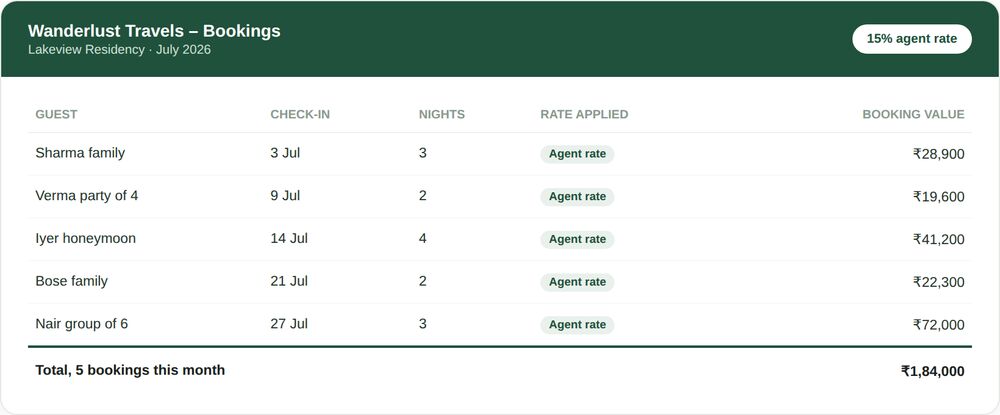
Every booking from Wanderlust Travels this month, tagged automatically and totalled without any manual work.
At the end of July, the owner opens the agent list and, for the first time, sees the numbers side by side. Priya at Wanderlust Travels sent five bookings worth ₹1,84,000 on a fifteen percent discount. Arun Kumar, on a ten percent discount that has been in place for two years, sent only two bookings worth ₹41,200 over the same month.
The gap is not subtle once it is visible. Wanderlust Travels is bringing in more than four times the revenue of Arun Travels and Tours, on a bigger discount and has been consistently one of the strongest sources of bookings for the past two quarters. That is exactly the kind of relationship worth protecting with priority and a phone call, not a fact the owner had any real way to know before.
The conversation with Arun Kumar goes differently. Rather than guessing whether the relationship is still worth the standing discount, the owner has an actual number to work from, two bookings a month and can have a straightforward conversation about whether more volume is possible or whether the rate needs revisiting.
Neither conversation required reconstructing anything from memory or old messages. Both were sitting there, already tagged and totalled, the moment the owner opened the account at the end of the month.
A few weeks later, Priya mentions she has a corporate client asking about a block booking for a conference in September. Because the owner already has a clear, current picture of exactly how valuable the Wanderlust Travels relationship has been, saying yes to a modestly better rate for the block booking is an easy, confident call, not a guess made on goodwill alone.
Mistakes properties make with informal agent rates
- Quoting a different discount to the same agent on different occasions, because the previous rate was never written down anywhere.
- Having no way to tell an agent booking apart from a walk-in once it is entered into the system, so the source of the booking is lost immediately.
- Rewarding whichever agent called most recently or most persistently, rather than the one actually sending the most business.
- Losing track of a long standing agent relationship entirely when the person who remembered the arrangement, often the owner personally, is unavailable.
- Never revisiting a standing discount once it is set, even after years, because there is no data prompting the conversation.
- Reconciling agent commission at month end from memory or a manual spreadsheet, with no tagged bookings to check the numbers against.
- Treating every agent identically regardless of volume, so a partner sending one booking a year gets the same terms as one sending several a month.
- Letting a seasonal rate agreed during a slow month carry unchanged straight through peak season, without anyone noticing it should have been revisited.
None of these come from carelessness. They come from managing a genuinely important set of relationships with tools that were never built to track them, leaving every agent rate dependent on memory rather than a record anyone can check.
The same rate, whoever books it and whichever property it is for
A rate set for a specific agent applies exactly the same way whether the booking comes in through a dedicated link, a WhatsApp message, or a manual entry made by a manager covering the front desk. It does not depend on whoever happens to be handling the booking that day remembering the correct number.
For a group running more than one property, an agent relationship can be scoped to a single property or extended across the group, so a large agency that sends business to more than one location is tracked consistently rather than as several unrelated relationships that happen to share a name.
This consistency is what actually protects the relationship over time. An agent who has been quoted the same fifteen percent for two years straight, verifiable on request, trusts the arrangement in a way that an agent relying on the owner’s memory each time never quite can.
It also means travel agent discounts do not quietly fall apart the moment the person who set them up is unavailable. A booking coming in on a Sunday, handled by whoever is covering the desk that day, applies exactly the rate that was agreed months earlier, without needing to reach the owner to confirm it first.
Who actually manages agent relationships
An owner running a single property is usually the one who agreed every existing rate personally and gets the most immediate benefit from having them written down somewhere that is not memory, especially once a manager or front desk hire needs to answer an agent’s call in the owner’s absence.
A manager handling day to day bookings needs to apply the right rate correctly and immediately, without calling the owner to confirm a number that should already be settled. A visible, standing rate per agent makes that possible without extending pricing authority any further than it needs to go and pairs naturally with a manager role that can view agent rates without necessarily being the one who sets them.
The travel agent themselves benefits too, even without ever touching the account directly. A rate that has been consistent for two years and that the property can confirm on request, is a more trustworthy partner to keep sending business to than one where every booking starts with a small negotiation.
For a property working with an accountant or a co-owner who is not involved in day to day operations, tagged agent bookings answer a question that would otherwise require asking around, how much of this month’s revenue actually came through agent relationships versus direct guests. That split matters for understanding where the business genuinely comes from, not just how much it is worth in total.
How this fits with the rest of OpenStays
Hotel rate negotiation runs a live, per-conversation negotiation with an individual guest, inside a floor the owner sets, for a one-off stay. Travel agent discounts are a different shape of relationship entirely, a standing rate agreed once with a recognised business partner and applied automatically every time they send a booking, with nothing to negotiate on any individual reservation.
Every agent-tagged booking flows into revenue and occupancy reports the same way any other booking does, so agent-sourced revenue is visible inside the same monthly numbers rather than sitting in a separate system. Rates themselves are still built on the same room and rate plan setup used everywhere else in the account and for a guest with a stay history worth tracking, the same guest CRM record applies regardless of whether they arrived through an agent or booked directly. For a group managing more than one location, agent relationships extend cleanly through multi-property management.
Travel agent discounts vs. The alternatives
Most properties compare this against whatever they currently use to manage agent relationships, usually quoting a rate from memory each time, or a shared notebook or spreadsheet that gets updated inconsistently.
| Quoting from memory | A shared notebook or spreadsheet | Travel agent discounts | |
|---|---|---|---|
| Same rate every time | No, depends on what is remembered | Only if kept up to date | Yes, set once and applied automatically |
| Bookings traceable to the agent | No, indistinguishable from a walk-in | Only if someone remembers to log it | Yes, tagged automatically every time |
| Shows revenue by agent | No | Rarely, rebuilt by hand if needed | Yes, for any period |
| Survives staff turnover | No, leaves with whoever remembered | Partially, if the notebook is kept up | Yes, the rate lives on the account |
| Setup effort | None, but costs accumulate invisibly | Low, but rarely maintained consistently | A few minutes per agent, once |
GETTING STARTED
Setting up travel agent discounts
How to set up travel agent discounts on OpenStays.
1. Add the agent as a partner
Enter the agent or agency’s name and contact details, so every booking from them can be tagged correctly from the start.
2. Set their standing rate
Choose a percentage discount off the rack rate or a fixed agent rate, agreed once and applied automatically from then on.
3. Share their booking channel
Give the agent their dedicated booking link or WhatsApp number, or note their name for manual entries made on their behalf.
4. Review bookings and revenue by agent
Check tagged bookings and revenue for any agent, over any period, from the same reports used for the rest of the property.
5. Revisit the rate periodically
Use actual volume and revenue to decide whether a standing discount still makes sense, rather than leaving it unexamined indefinitely.
What to check in any travel agent rate system
- Does every agent get one consistent rate, applied the same way regardless of who processes the booking?
- Is every agent-sourced booking tagged automatically, or does someone have to remember to record it?
- Can revenue and booking volume be seen by agent, over any period, without rebuilding it by hand?
- Does the rate survive staff turnover, or does it depend on one person’s memory?
- Does this work the same way if the property later adds a second location?
- Can an old rate still be seen after it has been changed, so a past dispute can actually be checked against what was true at the time?
A system that cannot answer these clearly is asking an owner to keep managing agent relationships from memory, exactly the problem travel agent discounts are meant to solve.
It is worth testing this against a real scenario rather than taking a features list at face value. Pick the property’s longest standing agent relationship and try to answer, right now, exactly how many bookings that agent sent last quarter and what rate is actually on file for them. If that answer requires opening several old conversations to reconstruct, that is precisely the gap a properly built system closes.
It is also worth asking who can actually change an agent rate once it is set. A standing discount that any staff member can quietly adjust is not much more reliable than no standing rate at all, which is why rate changes for agents, like rate changes anywhere else in the account, are worth tying to a specific role under staff logins with roles, rather than leaving them open to whoever happens to be logged in.
What actually happens when an agent books
A booking made through an agent’s dedicated channel applies their standing rate automatically at the moment it is created, the same way any other rate rule would, with no manual discount entry needed and no chance of it being applied incorrectly.
The agent tag travels with the booking through its full lifecycle, into the guest record, into any modification made later and into cancellation records if a stay does not go ahead, so the history stays accurate even as a booking changes after it is first made.
For properties working on a commission model rather than a straight discount, the same tagging supports that structure too, the guest is charged the full rate and the agent’s commission is calculated from the same tagged bookings, ready to check at whatever interval the arrangement calls for.
None of this changes what the agent or the guest experiences when booking. The rate is simply correct from the first message, without a phone call to confirm it and without the property needing to remember anything beyond the fact that the relationship exists, whether that relationship is three months old or a decade old.
Deactivating an agent relationship, if one ever ends, stops their rate from applying to any new booking immediately, while leaving the full history of what they sent in the past exactly where it was, still visible in reports for whatever period is needed.
A rate change works the same way in reverse. Updating an agent’s discount takes effect for bookings made from that point forward, while every booking already made keeps the rate it was actually booked at, so renegotiating a relationship never quietly rewrites what already happened.
The full history of an agent’s rate changes stays visible too, not just the current number. If a discount moved from ten percent to fifteen percent eighteen months ago, that change and roughly when it happened remain checkable, which matters the next time a renegotiation comes up and someone wants to understand how the relationship has actually evolved rather than just where it stands today.
Frequently asked questions
How is a travel agent’s rate set?
As a percentage discount off the rack rate or a fixed agent rate, entered once when the agent is added and applied automatically after that.
Can different agents have different rates?
Yes, each agent’s rate is set individually, based on whatever has actually been agreed with them.
How does a booking get tagged to a specific agent?
Through a dedicated booking link or WhatsApp number for that agent, or a manual entry made on their behalf, either way the booking carries their name from the moment it is created.
Can I see how much business a specific agent has sent?
Yes, bookings and revenue by agent are visible for any period, from the same reporting used across the rest of the account.
Does this work for a commission model instead of a discount?
Yes, tagged bookings support either a straight discount or a commission calculated on the full rate, whichever arrangement is in place with that agent.
Can I change an agent’s rate later?
Yes, a rate can be updated at any time and the new rate applies to bookings made from that point forward.
What happens to a booking already made at the old rate if I change it?
Existing bookings keep the rate they were made at, only new bookings apply the updated rate.
Can an agent see their own booking history?
The property can share exported booking and revenue detail with an agent directly, without giving them account access.
Does this work across multiple properties in a group?
Yes, an agent relationship can be scoped to a single property or extended across a group, depending on how the partnership works.
Is there a limit to how many travel agents I can add?
No, the number of agent partners is not limited by plan tier.
Can front desk staff add or change an agent’s rate?
That depends on the role assigned under staff logins with roles, rate changes can be restricted to owner or manager roles.
Does an agent booking show up differently in the reservations dashboard?
Yes, it is tagged clearly as coming from that agent, distinguishable from a direct or walk-in booking at a glance.
Can I remove an agent relationship if it ends?
Yes, an agent can be deactivated at any time, which stops their rate from applying to any new bookings without affecting the history already recorded.
How is this different from the WhatsApp rate negotiation feature?
Rate negotiation runs a live, one-off negotiation with an individual guest, while travel agent discounts apply automatically to every booking from a recognised partner, with nothing to negotiate each time.
Does the guest see the agent’s discounted rate directly?
How the rate is presented depends on the arrangement with the agent, some properties quote the discounted rate directly, others charge the full rate and settle commission with the agent separately.
Can I track how a specific agent’s business has changed over time?
Yes, revenue and bookings by agent can be compared across any two periods, the same way the property’s overall numbers can.
What changes in the first month
Setting up existing agent relationships is mostly a matter of writing down what has already been informally agreed, entering each agent’s name and their current rate, which for most properties with three to six agent relationships takes well under half an hour.
The first genuinely useful moment tends to come at the end of the first full month, when an owner can see agent-sourced bookings and revenue clearly for the first time, often confirming what was suspected about which relationships matter most and occasionally revealing a surprise.
A quieter change shows up in how agent conversations go afterward. A rate query that used to require checking an old message thread becomes a quick lookup and a conversation about adjusting a rate becomes a discussion grounded in actual volume rather than a guess at how the relationship has been going.
By the second or third month, most owners describe a similar shift, less uncertainty about what was promised to whom and a clearer sense of which agent relationships are worth actively nurturing versus which have quietly stopped sending much business at all.
For a property heading into its first peak season since setting this up, the timing tends to matter most right there. Reviewing agent rates before the busy months start, with real volume and revenue in hand rather than a guess, is a far better moment to renegotiate than realising midway through the season that a big discount is going to a relationship that barely used it.
Give every travel agent a rate that actually holds
No setup fee, no commission. Add your first agent in a few minutes.