
FOR INDEPENDENT HOTELS & RESORTS
Hotel booking software
Manage direct bookings, configured WhatsApp replies, room rates and guest ID records in one OpenStays account. Direct booking rates come from your setup. External OTA prices must be maintained on those channels because iCal only shares blocked dates.
Built by property owners for property owners · 0% commission · Core feature, live today
ILLUSTRATIVE FEATURE OVERVIEW
Hotel operations
Reservations
Keep booking details together
Availability
See rooms and dates in OpenStays
Guest information
Connect guest details to the stay
Payments
Use your configured payment options
One connected reservation workflow
What most independent hotels are actually running on
This page is the overview. If you want the booking and payment engine on its own, see the direct booking engine. If you want to go deep on one piece, the reservations dashboard, seasonal pricing, room and rate setup, the occupancy calendar, rate negotiation, guest ID or the WhatsApp AI concierge each have their own page.
What follows covers what an independent hotel or resort actually needs from its software, what most properties are patching together instead, how the OpenStays stack fits together end to end and how to evaluate any option you are considering, OpenStays included.
Ask a ten to twenty room hotel what software runs their bookings and the honest answer is rarely one system. It is an OTA extranet for the listings that bring in guests, a personal WhatsApp number for the enquiries that come in directly, a paper register or a loose spreadsheet for guest identity details and a notebook or a wall calendar at the front desk for who is actually staying in which room tonight.
None of these pieces talk to each other. A rate changed on the OTA extranet does not update the number a front desk staff member quotes over the phone. A booking taken over WhatsApp does not automatically block the room on whatever calendar the OTA is reading from, so a double booking is always one busy weekend away from happening. A guest ID collected on a phone camera roll is not filed against the reservation it belongs to, so producing a register for a police verification drive means reconstructing the week from memory and screenshots.
This is not a failure of the people running the property. It is what happens when a hotel’s software is treated as a single piece, usually just the OTA listing or a basic booking widget, rather than the full set of jobs a reservation actually touches: quoting, negotiating, confirming, collecting payment, storing identity documents and showing the result on one calendar.
The properties that struggle most are not the smallest ones. A single owner running two rooms can hold the whole picture in their head. The struggle shows up right around ten to twenty rooms, enough volume that memory stops being reliable, but not yet enough scale to justify hiring a dedicated reservations manager to hold all the pieces together manually.
It is also not a struggle unique to hotels. A homestay owner juggling two or three rooms alongside a day job runs into the same disconnected habits, just at a smaller scale, a missed WhatsApp reply while out running errands, a guest ID photo that never gets filed anywhere searchable. A resort with forty rooms across several buildings runs into it too, just with more staff involved and more room for one shift to lose track of what the previous shift already promised a guest. The size of the property changes how visible the problem is, not whether it exists.
Not just a booking widget and not a generic PMS
A booking widget, on its own, answers one question: can a guest see your availability and pay you directly instead of through an OTA. That is real and useful and it is exactly what the OpenStays direct booking engine covers on its own page. A complete stack for a hotel needs to do more than that single job.
A generic hotel PMS built for large chains usually answers a different question: how does a twenty person front desk team coordinate housekeeping, folios and multiple departments. Most independent hotels and resorts in India do not have that team or that complexity and paying for software built around it means learning screens meant for a job the property does not actually have.
What an independent hotel actually needs sits between those two: a booking engine that takes direct payments, an assistant that answers WhatsApp enquiries at 11pm without a human awake to do it, a rooms and rates setup for direct bookings and WhatsApp, a calendar that shows the truth at a glance and guest ID compliance that does not depend on someone remembering to file a photo correctly. That combination, not a wider PMS and not a narrower widget, is what this page means by hotel booking software. If you are being offered a central reservation system as well, we cover which gap your property actually has separately.
What running disconnected tools actually costs
The most visible cost is commission. A guest who books through an OTA instead of directly costs the property fifteen to twenty percent of that booking’s value, quietly deducted before the payout ever lands in the property’s account. A guest who would have booked directly if someone had answered their WhatsApp message before they gave up and opened the OTA app instead costs the same commission for a completely avoidable reason.
A second cost is the double booking that disconnected calendars eventually produce. A room sold on an OTA and, an hour later, sold again over a phone call because the front desk was looking at a whiteboard that had not been updated yet, turns into an apology, a relocation to a different property and a guest who tells other people about the experience.
A third cost is the after hours enquiry that never gets a reply. A traveller messaging at 9pm asking about tomorrow night wants an answer in minutes, not in the morning when someone finally checks their phone. Every hour that gap stays open, the guest keeps browsing and a competing property one tap away is happy to answer first.
A fourth cost is the inspection or dispute that turns into a scramble because guest identity records live across three staff members’ personal phones instead of one system. A police station asking for a register, or a dispute over who stayed in a room on a given night, should be a two minute export, not an evening spent piecing together screenshots.
None of these costs show up as a single dramatic event. They accumulate quietly across a season, a percentage of revenue leaking to commission here, an occasional double booking there, a handful of after hours enquiries that went cold overnight. Added together across a full year, the gap between a property running one connected stack and one running five disconnected habits is usually large enough to notice on the bottom line.
What hotel booking software looks like as one connected stack
On OpenStays, every module reads from the same account. A room type and its base rate, set once, is what the booking engine quotes, what the WhatsApp AI concierge tells a guest, what the occupancy calendar displays and what seasonal pricing adjusts. There is one place this information lives, not three.
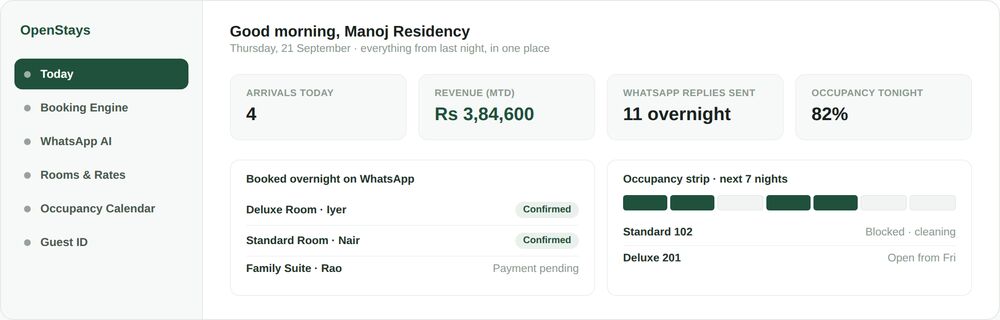
A property logging in on a Thursday morning sees what actually happened overnight in one screen: how many rooms arrived that day, revenue collected so far this month, how many WhatsApp enquiries the AI concierge answered while everyone was asleep and a strip showing occupancy for the coming week at a glance, without opening five separate tools to piece the picture together.
Each module still does its own specific job well. The booking engine handles availability and payment. The WhatsApp AI concierge handles the conversation, the quote and the gentle negotiation. Room and rate setup defines what is for sale and at what price. The occupancy calendar shows what is booked, blocked or open on any given night. Guest ID compliance handles document collection and register export. What makes it one stack rather than five separate products is that all of it reads and writes to the same underlying reservation, guest and room records.
That single record per booking is also what makes reporting trustworthy. Revenue shown on the dashboard is not a spreadsheet someone updates at the end of the week, it is the same number the booking engine and WhatsApp concierge were working from the moment the payment came in.
EVERY MODULE, ONE LOGIN
The pieces that make up the OpenStays stack
Direct booking engine
Your hosted listing page, a widget embedded on your own website, or a link shared anywhere, all reading the same live availability. See the direct booking engine in detail.
WhatsApp AI concierge
Answers enquiries, quotes the right rate, negotiates within a window you approve and sends a payment link, in the same chat a guest already started. See the AI WhatsApp concierge in detail.
Room and rate plan setup
Room types, base rates and rate plans are defined for your OpenStays booking engine and WhatsApp replies. External OTA rates need separate management. See room and rate plan setup in detail.
Occupancy calendar
Every room against every night, booked, blocked or open, on one screen instead of a search across three places. See the occupancy calendar in detail.
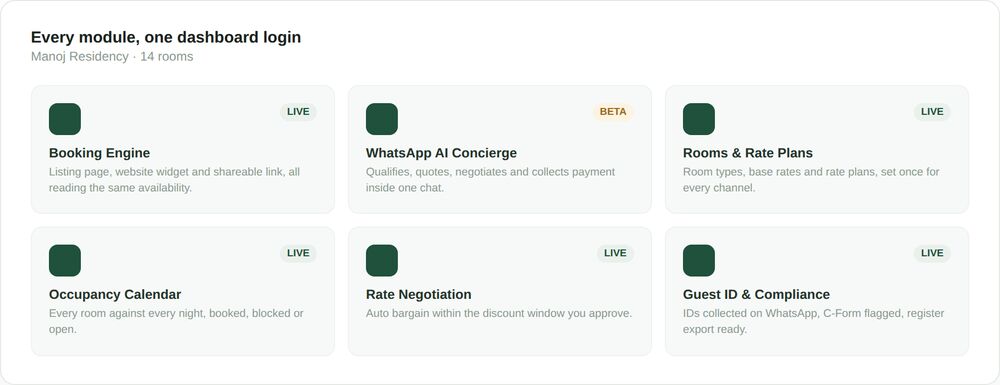
Reservations dashboard
Arrivals, revenue and pending requests, the moment you log in, with anything needing a human decision surfaced instead of buried in a chat thread. See the reservations dashboard in detail.
Guest ID and compliance
IDs collected on WhatsApp before arrival, foreign guests flagged for C-Form automatically and a register export ready whenever asked. See hotel guest ID software in detail.
Two more pieces round out the stack. Seasonal pricing applies weekend, festival and low season rules automatically on top of the base rates set in room and rate setup and rate negotiation lets the WhatsApp AI concierge bargain gently within a discount window you approve, instead of a human answering every haggling message personally.
SEE IT IN ACTION
A twelve room hotel in Coorg goes live on one stack
Ravi runs a twelve room hotel that has always listed on two OTAs and taken direct calls on a personal number. Enquiries after 9pm mostly went unanswered until morning and he estimates he lost at least a booking a week to guests who gave up waiting and rebooked somewhere that replied faster.
He sets up his rooms and rate plans first, four room types with a standard and a non-refundable rate plan each, then turns on the WhatsApp AI concierge. Within the first week, a guest messaging at 11pm asking about a weekend gets an accurate quote immediately, negotiates a small discount within the window Ravi approved and pays a UPI advance before midnight, a booking that would previously have gone stale overnight.
A month in, Ravi checks his dashboard on a Monday morning and sees the same numbers his front desk saw over the weekend, since there was never a second, separately maintained record to reconcile. His OTA commission spend for the month is noticeably lower, not because he dropped the OTAs, but because more guests who found him there came back to book directly the second time, straight through the WhatsApp thread they already had.
A homestay in Alleppey replaces three habits with one
Priya runs a three room homestay by herself and was managing guest IDs on her phone gallery, rates from memory and a shared calendar with her sister who helps out on busy weekends. A double booking during a festival weekend, two guests arriving for the same room, was the moment she decided something had to change.
She onboards in an afternoon, setting up her three rooms, a base rate for each and turning on WhatsApp booking with guest ID collection included. Her sister gets her own login rather than a shared one, so both of them see the same occupancy calendar in real time and a room blocked by one of them for a family friend shows up instantly for the other.
The next festival weekend, a booking conflict is caught the moment it would have happened, since both of them are looking at the same live calendar rather than two versions that used to drift apart. Guest IDs collected on WhatsApp before arrival also mean check in during the busy weekend takes a fraction of the time it used to, since nobody is queuing at a desk waiting for a photocopier.
A twenty five room resort in Wayanad centralizes a growing team
Anand’s resort had grown from eight rooms to twenty five over three years and the informal systems that worked at eight rooms, a shared notebook, a front desk phone, verbal handoffs between shifts, were visibly breaking down at twenty five, with rate quotes drifting between staff and no reliable record of who confirmed what.
Moving the whole reservation flow onto one stack meant every staff member logging in saw the same rooms, the same rates and the same calendar, with no separate version to keep in sync. Rate negotiation on WhatsApp now happens within a window Anand set once, rather than depending on which staff member happened to answer a haggling guest.
Guest ID collection can be part of your configured pre-arrival workflow. Keep the records linked to each stay and have staff review incomplete records and any required foreign guest reporting. OpenStays does not automatically file Form C or Form III.
Mistakes properties make when piecing this together themselves
Most of the friction independent hotels run into is not a failure of effort, it is the predictable result of stitching several unconnected tools together and hoping they stay in sync.
- Treating the OTA extranet as the master calendar, so a direct booking taken by phone or WhatsApp is not reflected there until someone remembers to update it manually.
- Running WhatsApp enquiries from a personal phone number, so replies stop the moment whoever owns that phone is asleep, driving, or simply not looking at it.
- Keeping guest IDs on a staff phone’s camera roll, which leaves with that staff member and is unsearchable by the time an inspection or a dispute needs an answer.
- Negotiating rates verbally and inconsistently between staff, so the same room gets quoted two different discounted prices to two similar guests on the same night.
- Adding a booking widget without connecting it to the same room and rate data everything else uses, creating a fourth place prices can quietly drift out of date.
- Assuming a generic hotel PMS built for large chains will simply scale down, then paying for and fighting through complexity the property never actually needed.
Each of these is fixable on its own, but fixing them one at a time as separate purchases usually recreates the same disconnection problem with newer tools instead of solving it.
One account, every booking channel
A room type, its base rate and its rate plans, defined once in room and rate setup, are what the booking engine quotes, what the WhatsApp AI concierge tells a guest and what any staff member sees when logging a phone or walk in booking manually. There is no separate price list per channel to keep aligned by hand.
OTA listings connected through channel management still need their availability confirmed on that OTAs own extranet, since OTAs do not read live from OpenStays automatically. What the OpenStays stack provides is a single, reliable reference for what those listings should say, rather than each channel drifting from its own separately maintained numbers.
The same single record also makes it straightforward to answer a question owners ask constantly but rarely have a clean answer to: which channel is actually working. Because every booking, however it arrived, lands in the same dashboard with its source recorded, a property can see plainly how much revenue came from direct WhatsApp conversations versus a connected OTA, instead of guessing from memory or comparing two systems that were never built to be compared.
Hotel booking software vs. The alternatives
| OpenStays hotel booking software | OTA listings only | Generic hotel PMS | Spreadsheets and phone | |
|---|---|---|---|---|
| Direct bookings without commission | Yes, built in | No, commission on every booking | Depends on separate integration | Yes, but nothing automated |
| Answers WhatsApp enquiries after hours | Yes, AI concierge | No | Rarely included | No |
| Direct reservations and external iCal blocks | Yes, with periodic iCal refresh | Only that OTAs own bookings | Usually, at higher cost and complexity | No, manually reconciled |
| Guest ID collection and register export | Yes, built in | No | Sometimes, as an add on | Manual, easy to lose |
| Built for ten to thirty room properties | Yes | Not its job | Usually built for larger teams | Works, but does not scale |
| Setup effort | Under a day | Minimal, but limited | Often weeks, with training | Ongoing, never really finished |
OTA listings are not a mistake to abandon, they bring real discovery traffic a new or small property cannot always generate on its own. The problem is treating an OTA extranet as if it were the whole stack, when it only ever covers the bookings that arrive through that one channel.
A generic hotel PMS built for large chains can do everything OpenStays does and more, at a cost and a learning curve built for a front desk team an independent hotel usually does not have. Spreadsheets and phone calls cost nothing to start, but the ongoing manual effort to keep them accurate is exactly the cost this software is built to remove.
The honest way to read this table is not that one option is universally correct, it is that the right hotel booking software for a ten to thirty room independent property is one built for that size, not scaled down from something built for a much larger one.
SETUP
Getting your hotel onto one connected stack
Most independent hotels are live on the full OpenStays stack within a day, starting from whatever combination of OTA listings, spreadsheets and personal WhatsApp numbers they were using before.
Most independent hotels are live on the full OpenStays stack within a day.
1. Onboard your property
Add your rooms, photos, rates and house rules through the guided wizard. Your hosted listing page and a shareable WhatsApp link go live immediately.
2. Set up rooms and rate plans
Define each room type, its base rate and any rate plans, non-refundable, long stay, corporate, so your direct booking engine and WhatsApp replies use the same configured numbers.
3. Turn on the WhatsApp AI concierge
Approve a discount window for negotiation and let the assistant start answering enquiries, quoting rates and collecting guest ID on WhatsApp.
4. Choose auto or manual booking confirmation
Turn on instant confirmation with an online payment gateway, or keep it manual and confirm each reservation yourself after verifying a UPI payment.
5. Check the dashboard and occupancy calendar daily
A short daily glance catches anything that needs a human decision before it becomes a guest facing problem.
BEFORE YOU CHOOSE
What to check in any hotel booking software
- Does a rate change made in one place apply everywhere, or does it need to be repeated across the booking engine, WhatsApp and every connected OTA?
- Can the software actually answer a guest enquiry that arrives at midnight, or does every after hours message wait for a human to wake up?
- Is guest ID collection built into the booking flow, or is it a separate step someone has to remember to do manually?
- Does the calendar show every channel’s bookings in one place, or only the bookings that came through that specific tool?
- Is the software sized for a ten to thirty room independent property, or is it a scaled down version of something built for a much larger chain?
- Can you see current, transparent pricing without a sales call and does the vendor take a commission on top of your bookings?
This applies whether or not you end up choosing OpenStays. The properties that struggle least are the ones whose software makes these distinctions clear from the start, which is worth checking against any WhatsApp booking system or reservations dashboard you are already evaluating.
Who can see and change your OpenStays setup
Every module sits behind your own OpenStays login and access can typically be limited to specific staff members rather than shared as one password everyone uses and nobody remembers to change.
Changes to your configured rates and blocked rooms update the OpenStays workflow. External iCal calendars refresh periodically and do not receive rate changes. Update unsupported channels and their prices separately.
For a property with more than one owner or manager, the same account can be shared across everyone who needs to make changes, with each edit reflected instantly rather than depending on one person to relay updates to everyone else by message.
Removing a staff member’s access removes their ability to change anything in the stack immediately, without needing to track down and undo whatever changes they might otherwise still be able to make from an old login shared informally before they left.
QUESTIONS
Frequently asked questions
What is hotel booking software, exactly?
Hotel booking software is the set of tools a property uses to take bookings, answer guest enquiries, manage rooms and rates, track occupancy and store guest identity documents. OpenStays runs all of these as one connected stack rather than separate, unconnected tools.
How is this different from a direct booking engine?
A direct booking engine is one piece of the stack, the part that lets a guest check availability and pay you directly. The full stack also covers WhatsApp enquiries, room and rate setup, the occupancy calendar and guest ID compliance, all built on top of the same booking engine.
Do I need to replace my OTA listings to use this?
No. Most properties keep their OTA listings for discovery traffic and use OpenStays for direct bookings, WhatsApp enquiries and day to day operations, connecting availability through channel management where needed.
Is this built for hotels only, or does it work for homestays and resorts too?
The same stack works for homestays, hotels and resorts. Room and rate setup, the occupancy calendar and guest ID compliance work identically regardless of property size and the WhatsApp AI concierge scales from a two room homestay to a resort with several dozen rooms.
What does the WhatsApp AI concierge actually do?
It answers guest enquiries on WhatsApp, quotes the correct rate from your room and rate setup, negotiates gently within a discount window you approve, collects guest ID and sends a payment link once a guest is ready to confirm.
How does OpenStays make money if there is no commission?
OpenStays charges a flat subscription rather than a percentage of bookings. Current pricing is on the pricing page and the software never takes a cut of what a guest pays you.
Can I try the software before committing my whole property to it?
Most properties onboard their full room inventory from the start since setup takes under a day, but you can keep existing OTA listings running in parallel the entire time, so nothing about switching is all or nothing.
Does the occupancy calendar update automatically when a booking comes in?
Yes. A booking taken through the booking engine, WhatsApp, or entered manually after a phone call all update the same occupancy calendar instantly, since every module reads from the same reservation records.
How is guest ID data kept secure?
Documents are stored against the reservation they belong to, accessible only through your dashboard login rather than a shared phone gallery and are not visible to other properties or the public.
What happens to guest data if I stop using OpenStays?
Your guest and booking records remain accessible for export. OpenStays does not hold your data hostage to keep you subscribed.
Can multiple staff members use the software at once?
Yes, staff can be given their own logins with access to the modules relevant to their role and everyone sees the same live rooms, rates and calendar rather than separate versions.
Is there a limit on how many rooms or bookings I can manage?
No practical limit. The same stack works for a three room homestay and a resort with several dozen rooms.
Does the rate negotiation feature give away discounts I have not approved?
No. The WhatsApp AI concierge only negotiates within a discount window you set yourself and never goes below the floor you have configured.
How long does it take to get a hotel fully set up?
Most properties complete onboarding, room and rate setup and turn on the WhatsApp concierge within a single day, though the exact time depends on how many room types and rate plans need to be entered.
Can I keep taking phone and walk in bookings alongside WhatsApp and the booking engine?
Yes. A staff member can log a phone or walk in booking manually and it appears on the same occupancy calendar and dashboard as any booking taken automatically.
Does this replace the need for a front desk?
No. It removes the manual, repetitive parts of quoting, negotiating and record keeping, so a front desk team spends its time on guests who are actually on site rather than reconciling numbers between tools.
Is OpenStays suitable for a property with more than one location?
Yes. Multiple properties can be managed from accounts under the same owner, with each property’s rooms, rates and bookings kept separate while staying visible from one place.
What changes in the first month
The most immediate change is that after hours enquiries stop going cold. A guest messaging at any hour gets a quote and, often, a confirmed booking before morning, instead of a message sitting unread until someone checks their phone.
By the second or third week, the front desk stops being the single point of failure for rate consistency, since every quote, whether it came from WhatsApp, the booking engine or a staff member logging a call, is built from the same room and rate setup rather than memory or a whiteboard.
Guest ID compliance quietly stops being a source of dread. IDs collected automatically before arrival mean an inspection or an audit becomes a short export instead of an evening spent reconstructing who stayed when.
None of this requires changing how the property is fundamentally run. What changes is that the pieces that used to be five separate habits, a booking widget, a personal WhatsApp number, a spreadsheet, a paper register and a whiteboard calendar, become one connected system that agrees with itself.
Who hotel booking software actually helps
Homestays and small guesthouses benefit most from the WhatsApp AI concierge, since a single owner cannot be awake and available for every enquiry and a missed message at an odd hour is a booking lost to whichever competing property replied first.
Hotels and resorts with more rooms and more rate plans to track benefit from room and rate setup and the occupancy calendar staying consistent as complexity grows and from seasonal pricing adjusting rates automatically instead of a manual weekly review.
Properties with a front desk team benefit from rate negotiation and quoting no longer depending on which staff member happens to answer, since the same rules apply automatically regardless of who is on shift.
Groups and multi property owners benefit from managing several properties without each one becoming a separate, disconnected operation, since rooms, rates and guest ID compliance work the same way across every property under one account.
One account for your direct booking workflow.
Hotel booking software from OpenStays runs the booking engine, WhatsApp AI concierge, room and rate setup, occupancy calendar, rate negotiation and guest ID compliance as one connected account. Nothing new to install.