
FOR RESORTS & RETREATS
Resort booking software
A resort rarely sells a single room to a single guest. It sells a package, a cottage or a villa, a meal plan, an activity add-on, priced per person, to a group of six or sixteen who all want an answer before the long weekend fills up elsewhere. Resort booking software is what runs that whole flow, enquiry, package quote, group negotiation, advance, guest ID for every name in the group, from one connected stack rather than a patchwork of tools built for a single hotel room.
Built by property owners for property owners · 0% commission · Core feature, live today
ILLUSTRATIVE FEATURE OVERVIEW
Resort reservations
Cottages and units
Organise the accommodation you sell
Rates and packages
Set up the options for your guests
Guest enquiries
Share configured availability and rates
Group requirements
Review complex allocations with your team
Built around your stay options
What a resort actually needs that a hotel tool does not
This page ties the whole resort stack together, package pricing, group handling, peak demand, in one place.
This page covers what breaks when a resort runs on tools built for single rooms and single guests, what a genuinely resort-shaped stack looks like and how to evaluate any resort booking software you are considering, OpenStays included.
Most booking software, including the core OpenStays stack, is built around a room, one type, one rate, one guest booking one stay. A resort rarely works that way. It has cottages, villas and suites as genuinely different categories, each with its own per person package rate and its guests frequently arrive six, twelve or twenty at a time rather than one or two.
A generic tool forces a resort to translate every package into a single room rate and then explain the rest, meals, activities, headcount, over a separate phone call or a WhatsApp thread nobody is tracking properly. Quoting a group of sixteen across four different cottage categories, with full board for some and breakfast only for others, becomes a manual calculation redone from scratch every single time.
Demand does not arrive evenly either. A resort gets a flood of enquiries in the days before a long weekend and comparative silence on a random Tuesday and a booking desk sized for the quiet days misses a meaningful share of the flood, while a desk sized for the flood sits idle most of the month.
None of this is a resort doing anything wrong. It is what happens when software built for a single room, single guest hotel stay gets asked to handle package pricing, group negotiation and a demand curve that spikes hard around holidays and long weekends.
The mismatch tends to be invisible until a resort actually compares notes with one running purpose built tools. A quote that takes ten minutes to calculate by hand feels normal right up until a guest mentions a competing resort answered in under a minute with a complete, itemised number.
The swings are not gentle either. A resort might run at half capacity through most weekdays and then face a long weekend where every category is asked about within the same forty eight hours. That kind of demand curve rewards a stack that can answer instantly and consistently and punishes one that depends on however many staff happen to be free that day.
What running a resort on the wrong shaped tool costs
The most direct cost is a slow quote. A group asking about sixteen people across mixed cottage categories, with a meal plan and an activity add-on, deserves a fast, accurate number. A resort recalculating that by hand, or worse, replying with a per room rate that ignores the package entirely, loses the booking to whichever competing resort answered first with a real number.
There is a revenue cost in the flood itself. A resort that cannot answer sixty enquiries in the two days before a long weekend, because the booking desk is sized for an average Tuesday, simply loses a share of that demand outright, guests who wanted to book this resort specifically but moved on when nobody answered in time.
Group negotiation without a floor costs money in a different way. A spokesperson negotiating on behalf of sixteen people is, by definition, motivated and persistent and a staff member without a clear price floor and package structure to work from often concedes more than the resort intended just to close the booking and move on to the next enquiry.
There is a compliance cost too, easy to miss until it matters. A group of sixteen means sixteen guest ID records to collect, not one and a resort tracking this manually across a busy checkin morning is exactly where a missed C-Form flag or an incomplete register entry tends to happen.
None of this shows up as a single dramatic loss. It accumulates as a slower reply here, a slightly worse negotiated rate there and a long weekend that could have been fully booked landing at eighty percent instead, with nobody quite able to point to why.
The costs also compound each other. A slow quote loses the booking outright, a rushed negotiation gives away margin on the bookings that do close and a chaotic checkin then spends staff time that should have gone toward the next long weekend’s flood instead.
There is a staffing cost too. When package pricing and negotiation floors live in one person’s head rather than in the system, a resort becomes dependent on that person being reachable during exactly the weekends that matter most. A day off, a shift change or someone leaving the property can turn a well handled flood into a chaotic one overnight.
What resort booking software actually covers
On OpenStays, resort booking software means the full stack, booking engine, WhatsApp AI concierge, rooms and rate plans, occupancy calendar, guest ID, works the way a resort actually sells: multiple accommodation categories, package pricing per person and group bookings handled as groups rather than as several disconnected individual reservations.
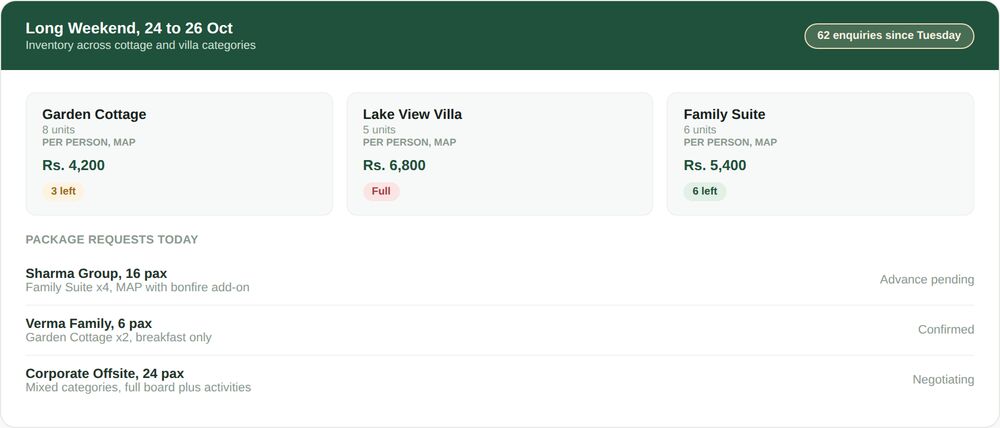
Each accommodation category, a garden cottage, a lake view villa, a family suite, keeps its own inventory and its own per person package rate, visible together in one view rather than scattered across separate spreadsheets or a whiteboard behind the front desk.
Package requests, a group of sixteen wanting four suites with full board and a bonfire evening, are tracked as a single request with its own status, not four separate bookings that happen to share a surname and a check in date.
None of this requires treating a resort as a special case bolted onto hotel software. It is the same underlying stack, booking engine, WhatsApp concierge, rates, calendar, guest ID, configured around categories and packages instead of a single room type.
A resort adding a new accommodation category, a fourth cottage type or a new set of villas coming online next season, sets it up the same way the first three were configured, with its own inventory and its own package rate from day one rather than a workaround bolted on top.
A package quote, negotiated and confirmed on WhatsApp
Package quotes built from your actual rates
A group asking about sixteen guests across mixed categories gets a real, itemised package quote automatically, cottages, meal plan, add-ons, rather than a rough number worked out by hand.
Group negotiation within a floor you set
The WhatsApp AI concierge can bring a package down toward a floor you define, closing bookings that would otherwise stall on back and forth, without ever quoting below what you have set.
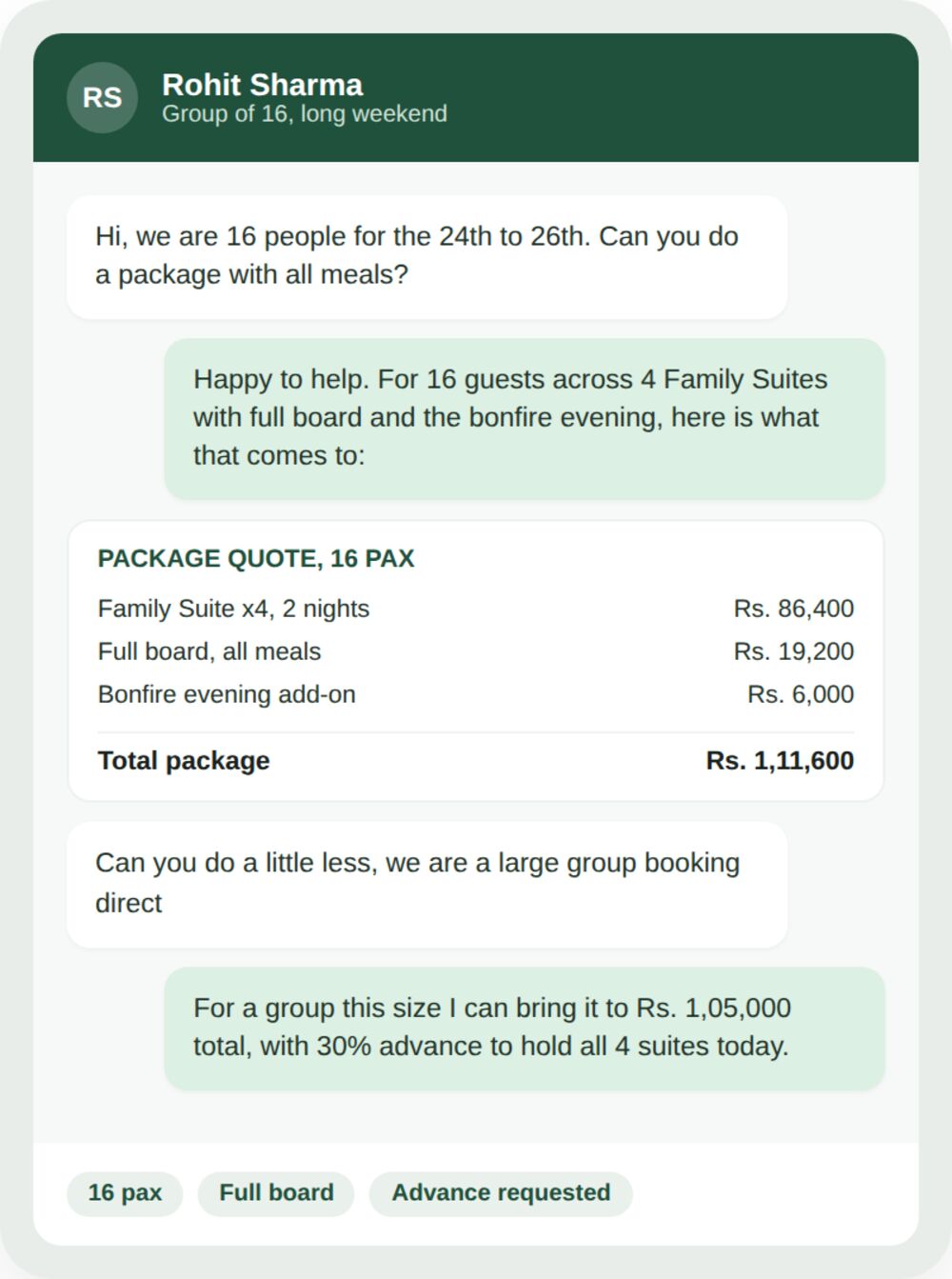
The same conversation that quotes the package can also collect the advance and, as guests are confirmed, start gathering the guest ID details the group will need on arrival, rather than leaving that for a rushed checkin morning.
The full stack, shaped for a resort
A useful resort setup covers demand, pricing and compliance as a connected flow rather than as separate tools that happen to sit near each other.
Booking engine across every category
Cottages, villas and suites each keep their own inventory and rate, all bookable from the same direct booking engine and online payment gateway, covered in full on the direct booking engine page.
WhatsApp AI concierge built for groups
Handles the long weekend flood, quotes packages per person and negotiates within your floor, the same automation layer covered on the WhatsApp booking system for resorts page.
Rates and seasonal pricing per category
Each accommodation category keeps its own rate plan, with seasonal pricing for long weekends and peak periods set once and applied automatically.
Guest ID for every name in the group
Every guest in a group gets their own ID record and C-Form flag where required, tracked against the same booking rather than collected separately at checkin.
Each of these pieces is covered in full depth on its own page, the room and rate plan setup, the seasonal pricing tools and guest ID and compliance. What changes for a resort is not the underlying tool, it is that all of it is built to handle categories and groups from the start.
SEE IT IN ACTION
A resort in Coorg handles a sixteen person group over WhatsApp
Rohit messaged a resort in Coorg asking for a package for sixteen people over a long weekend, four Family Suites, all meals and a bonfire evening if possible. The WhatsApp AI concierge quoted the full package immediately, priced per person from the resort’s actual rates, rather than making him wait for a callback the next morning.
When Rohit asked for a better number, mentioning it was a large group booking direct, the concierge brought the package down within the floor the resort had set and asked for a 30 percent advance to hold all four suites. Rohit paid the advance within the hour, before he had a chance to check two other resorts he had also messaged that morning.
By the time the group actually arrived, the resort already had confirmed guest counts, the meal plan and the bonfire add on locked in, none of it requiring a single phone call after that first WhatsApp exchange.
Rohit later mentioned to the front desk that he had messaged two other resorts that same morning with the identical request. Neither had replied with a real number before he had already paid his advance and stopped checking.
A retreat in Wayanad survives a long weekend flood without extra staff
Meera runs a twenty cottage retreat that used to dread the Tuesday before every long weekend, when enquiries would arrive faster than her two person front desk could realistically answer. Some guests waited hours for a reply and booked elsewhere before Meera’s team even saw their message.
With the WhatsApp AI concierge answering package enquiries automatically, quoting from her actual cottage inventory and rates, the flood stopped depending on how many staff happened to be free that Tuesday. Enquiries at midnight got the same instant package quote as ones at nine in the morning.
Meera’s retreat filled a long weekend completely for the first time in over a year, not because more people asked, but because far fewer of the people who asked gave up waiting for a reply.
Her two front desk staff now spend the days before a long weekend confirming bookings and preparing for arrivals rather than typing out the same package details over and over to guest after guest.
A resort in Goa keeps a corporate offsite’s guest IDs straight
A twenty four person corporate offsite booked mixed categories across a resort in Goa, full board plus a set of team activities. With that many names arriving on the same afternoon, the front desk had, in past years, genuinely lost track of which guest ID belonged to which room during the rush.
With guest ID collection tied to each confirmed name in the package rather than handled as a single bulk entry, every guest in the group had their own record ready before the bus even arrived, matched automatically to their room assignment.
The resort’s manager has since stopped dreading large group checkins specifically because of this, since the compliance side of a twenty four person arrival now takes care of itself well before anyone reaches the front desk.
A spot check by the local authority a few weeks later took minutes instead of the half day it might once have, since every record for that offsite was already complete and correctly matched to the right guest.
Mistakes resorts make on the wrong shaped tool
- Quoting a group package as a single room rate multiplied by headcount, missing meals, add-ons and the actual per person structure guests expect.
- Sizing the booking desk for an average day, so the pre long weekend flood overwhelms whoever is answering and enquiries go unanswered long enough to be lost.
- Negotiating group rates without a clear floor, so a persistent spokesperson ends up talking a tired staff member down further than intended.
- Collecting guest ID for a large group as a rushed bulk exercise at checkin instead of gathering it as each guest is confirmed.
- Treating package requests as several separate, disconnected bookings that happen to share a check in date, losing track of the group as a single unit.
- Publishing one flat seasonal rate card for the whole property, so a guest asking about a mixed group of cottages and villas gets three separate answers instead of one combined package quote.
None of these come from a resort being poorly run. They are what happens when software built for a single room, single guest hotel stay gets stretched to cover packages and groups it was never shaped for.
The fix is not more staff or more discipline during the flood. It is a stack that already understands packages, categories and groups, so nothing has to be manually translated into a single room rate in the first place.
It is also worth noticing that every one of these mistakes gets harder to fix the busier a resort gets. A small property might absorb a slow quote occasionally. A resort filling every long weekend cannot afford to lose even a modest share of that demand to a slower reply.
Built for a demand curve that spikes, not a steady queue
A resort’s enquiry volume is not flat across the month. It spikes hard in the two or three days before a long weekend or a school holiday and drops to a trickle in between and a booking desk sized for either extreme gets the other one wrong.
Because the WhatsApp AI concierge answers every enquiry the moment it arrives, the flood no longer depends on how many staff happen to be on shift that Tuesday night. Sixty enquiries in two days get the same instant, accurate package quote as six enquiries spread across a quiet week.
This matters specifically because resort guests messaging multiple properties at once tend to book whichever one answers first with a real number. A resort that responds instantly during the flood keeps a meaningfully larger share of that demand than one relying on staff who are, understandably, already stretched thin.
The same demand curve also means a quiet week does not require the same staffing a flood does. Costs stay proportionate to what is actually happening rather than sized permanently for the busiest few days of the month.
How this fits with the rest of OpenStays
This sits alongside the same hotel booking software overview covering the full OpenStays stack for a room by room property and the same WhatsApp booking system for resorts and resort rate negotiation tools already covering enquiries and group negotiation in depth. This page brings package pricing, group handling and peak demand together as the resort-specific version of that same stack, alongside the same guest ID compliance and occupancy calendar used across every property type on OpenStays.
A resort group running more than one property can bring all of it under a single account too, covered on the multi-property management page, seeing every resort’s packages and occupancy from one login rather than several.
Resort booking software vs. The alternatives
| Resort booking software | Generic hotel PMS | Manual WhatsApp and spreadsheets | |
|---|---|---|---|
| Quotes a package per person automatically | Yes | Rarely, built around single rooms | No, calculated by hand each time |
| Handles a group as one connected booking | Yes | Often split into separate room bookings | Depends on staff tracking it manually |
| Answers the pre long weekend flood instantly | Yes, every enquiry answered immediately | No, limited by staff availability | No, limited by staff availability |
| Negotiates within a set floor automatically | Yes | Not built in | Depends entirely on the staff member |
| Collects guest ID per name in a group | Yes, as each guest is confirmed | Usually manual at checkin | Manual and easy to fall behind on during a rush |
| Setup effort | Uses your existing rates and categories | Often requires a separate configuration pass | None, but every quote is manual |
A generic hotel PMS is not wrong for a resort, exactly, it simply was not built with packages or groups in mind, so a resort ends up doing by hand whatever the software does not do for it, translating packages into room rates, tracking groups manually, negotiating without a floor to lean on.
What changes with genuine resort booking software is not that any single feature is new. It is that packages, groups and peak demand are treated as the normal shape of the business rather than an exception a room by room tool has to be talked into handling.
SETUP
Setting up your resort on OpenStays
Setup follows the same steps as any OpenStays property, just configured around your actual accommodation categories and package structure.
Configure your resort’s categories, package rates and floor before your next demand spike.
1. Set up your accommodation categories
Cottages, villas and suites each get their own inventory and their own per person rate, kept separate from every other category.
2. Define your package rates and meal plans
Full board, half board or breakfast only, priced per person, so a group quote reflects what you actually sell.
3. Set a floor for group negotiation
The WhatsApp AI concierge can bring a package down toward this floor during negotiation, never below it.
4. Connect your WhatsApp number
Package enquiries start getting answered automatically from your actual rates and categories, day or night.
5. Confirm guest ID collection is switched on
Every guest in a confirmed group gets their own ID record as they are added, ready well before arrival.
BEFORE YOU CHOOSE
What to check in any resort booking software
- Does it quote a package per person from your actual categories, or does it force every booking into a single room rate?
- Can it handle a group of ten or more as one connected booking rather than several disconnected reservations?
- Does it answer enquiries instantly during a pre long weekend flood, or does response speed depend on staff availability?
- Can group negotiation stay within a floor you set, without a staff member having to hold the line under pressure?
- Does guest ID get collected per name in a group as guests are confirmed, or only as a rushed bulk exercise at checkin?
- Is it the same underlying stack as your booking engine and rates, or a separate tool you would need to keep in sync?
Worth checking against any option you are evaluating, OpenStays included, alongside the WhatsApp booking system for resorts and resort rate negotiation tools it would need to work with.
What stays consistent across every package
A package quote is always built from the rates and categories you have actually set, never invented or estimated on the spot, so what a guest is quoted on WhatsApp matches what your front desk expects on arrival.
Group negotiation never goes below the floor you define, regardless of how persistent a spokesperson is or how late in the conversation the ask comes, since the floor is a hard limit rather than a suggestion to staff.
Guest ID records stay tied to the specific booking and category a guest is part of, so a twenty person group arriving together does not create any more confusion than a single guest checking in on their own.
The same consistency applies to seasonal pricing. A rate set for a long weekend or a peak period applies automatically across every relevant category the moment it is scheduled, rather than needing to be re-entered by hand on each cottage or villa’s listing separately.
QUESTIONS
Frequently asked questions
What is resort booking software?
Resort booking software is a booking system built around how resorts actually sell, package rates per person across multiple accommodation categories, group bookings and demand that spikes around long weekends, rather than a single room rate for a single guest.
How is this different from the hotel booking software overview?
The hotel overview describes the same underlying stack for a room by room property. This page covers the same stack shaped specifically for packages, categories and groups, the way a resort actually operates.
How is this different from the WhatsApp booking system for resorts page?
That page covers how the long weekend enquiry flood gets answered and quoted. This page covers the full stack around it, booking engine, rates, guest ID, that the WhatsApp layer draws on.
Can it quote a package for a mix of accommodation categories?
Yes, a group request across multiple categories, cottages and suites together for example, gets one combined package quote reflecting all of it.
Does group negotiation ever go below my floor?
No, the floor you set is a hard limit. The WhatsApp AI concierge can negotiate down toward it but never below it.
How does guest ID work for a large group?
Each guest in a confirmed group gets their own ID record and C-Form flag where required, collected as they are added rather than as a single bulk entry at checkin.
Can it handle the flood of enquiries before a long weekend?
Yes, every enquiry gets an instant, accurate package quote regardless of volume, since it is not limited by how many staff are available to reply.
Does each accommodation category keep its own rate?
Yes, cottages, villas and suites each keep their own per person package rate and their own inventory.
Can I set different meal plans for different packages?
Yes, full board, half board or breakfast only can each be priced and quoted separately as part of a package.
Is this suitable for a small ten cottage property, not just larger resorts?
Yes, the same structure works for a small retreat as it does for a larger resort, there is no minimum size requirement.
Does it work for a resort group running more than one property?
Yes, a group running several resorts can bring them under one account, covered on the multi-property management page.
Can guests still book a single room without a package?
Yes, a guest booking one room on their own is handled exactly like any other OpenStays booking, packages are additive rather than mandatory.
Is pricing different for a resort compared to a hotel plan?
Pricing is based on properties and rooms rather than property type. Current details are on the pricing page.
Does the advance payment come through the same booking engine?
Yes, advances for a package are collected through the same online payment gateway used for any other booking.
What happens if a group’s headcount changes after the initial quote?
The package can be updated to reflect the new headcount, with the quote and advance adjusted accordingly.
Is there a separate app for managing packages?
No, packages are managed from the same OpenStays dashboard as every other booking, rates and reservations.
What changes in the first month
The first visible change is usually the speed of a package quote. A group asking about sixteen people across mixed categories gets a real, itemised number back within moments instead of a promise to call back later.
By the first long weekend after setup, the flood of pre weekend enquiries stops depending on how many staff happen to be free that evening, since every enquiry gets answered the moment it arrives, at any hour.
Group negotiation starts feeling less like a pressure test on whichever staff member picked up the conversation, since the floor holds the line automatically rather than depending on someone staying firm under a persistent guest.
Guest ID collection for large groups stops being a rushed checkin morning exercise, since names are gathered as each guest is confirmed rather than all at once when the group actually arrives.
By the end of the first month, most resort owners report the clearest change is not any single feature but that a large group booking finally feels like one manageable request instead of a scramble across several disconnected steps.
A second, quieter shift tends to show up around the next long weekend. Staff who once braced for the pre weekend flood find themselves reviewing confirmed packages instead, since most of the enquiry volume was already handled automatically before anyone needed to step in.
Who this actually helps
Resorts and retreats with multiple accommodation categories, cottages, villas, suites, benefit directly from package pricing that reflects what they actually sell rather than a single room rate stretched to cover something it was not built for.
Properties that see a genuine demand spike around long weekends and holidays benefit most, since the flood no longer depends on staff availability the way a manually answered booking desk does.
Resorts that regularly host groups, family gatherings, corporate offsites, wedding parties, benefit from treating a group as one connected booking rather than several disconnected reservations that happen to share a check in date.
Any resort currently negotiating group rates without a clear floor, or collecting guest ID for large groups as a rushed checkin exercise, is a clear case for moving to a stack built around exactly those problems.
It matters less for a property that genuinely only ever books single rooms to single guests with no meal plans or add-ons involved, since that shape of business is already well served by the standard hotel stack without needing the resort specific framing at all.
It also matters for a resort weighing a first purpose built system against staying with what already works. The honest test is not whether the current approach is broken, most resorts do get quotes out eventually, it is whether it holds up during the two or three weekends a year when the bulk of the season’s revenue actually arrives.
Every package, quoted, negotiated and confirmed, without the manual scramble.
Resort booking software on OpenStays runs on the same booking engine, WhatsApp concierge and guest ID stack as every other property type, configured around your categories and packages from day one.