
OpenStays message credits: Each outgoing WhatsApp message, including AI replies, uses 1 credit. Incoming messages are free and purchased credits never expire. An active subscription is required to use them. The provider pricing news below does not mean outgoing OpenStays messages are free. See OpenStays pricing.
It is 11pm and a guest is asking your WhatsApp assistant whether hot water will be ready before a 6am checkout. The reply goes out in seconds, the booking stays confirmed and nobody at the property had to wake up to type it. That quiet, instant reply is WhatsApp Business API pricing at work in the background and sometime this year, most hosts using it will notice a small new line on the bill they had not seen before.
Short answer: WhatsApp is getting a little more expensive to run automatically and only for certain kinds of messages and only if you are using it in a certain way. If you are a homestay or hotel owner replying to guests on your personal phone using the free WhatsApp Business app, the direct cost to you is still mostly zero, today and after every change in this article. If you are using the WhatsApp Business API (also called the WhatsApp Business Platform) through some booking or CRM tool, a few things are changing this year that will show up on your bill, some already have.
This post lays out WhatsApp Business API pricing 2026 the way an owner actually needs it, as of 8 September 2026: what has already changed, what changes on October 1, what the new AI pricing from August actually costs in rupees and whether it is really too expensive for a price-sensitive market like India, whether you personally need the paid API at all or the free app is enough and what a real monthly bill looks like for a homestay, a hotel and a resort. No rate without an example sitting next to it.
If you have landed here because you read something on the news or a WhatsApp forward saying “WhatsApp is going to start charging” and you are worried, take a breath first. WhatsApp itself, the app on your phone, is not becoming a paid app. Nobody is going to ask you or your guests to pay to send a message. What is changing sits one layer below that, in how Meta bills businesses for the automated, professional version of WhatsApp that sends messages on their behalf. If your property is not using that automated version at all, practically nothing here costs you anything directly, though it is still worth knowing, because most booking tools, CRM systems and WhatsApp chatbots properties sign up for this year run on exactly this system, whether that is obvious from the sales pitch or not.
A lot of what is written online about WhatsApp Business API pricing is written for marketing teams deciding which chatbot vendor to buy. This is written for the person running a homestay in Coorg or a 12 room hotel near a highway, who uses WhatsApp because that is where guests already are and who just wants a straight answer on what this costs and why.
On this page
- Why does WhatsApp keep changing its pricing, anyway
- WhatsApp, Business App and Business Platform
- WhatsApp app vs WhatsApp Business API, side by side
- Quick reference: the full India rate card, 2026
- How WhatsApp costs compare to the other ways of reaching a guest
- How WhatsApp Business API pricing actually works
- Two layers of cost, not one
- Does the rest of the world pay the same rates as India
- The full timeline: how we got here and where this is going
- What changing on October 1, 2026 actually means for a real conversation
- Meta AI on WhatsApp: what it actually costs and is it really too expensive for India
- Old advice still floating around that is no longer true
- How to check your own live rates in five minutes
- Do you personally need to pay for any of this, or is the free app enough
- A step by step way to actually decide, for your own property
- What a real monthly WhatsApp bill could look like for a small property
- A bigger example: a 14 room hotel near a highway junction
- A resort example: marketing heavy, seasonal
- Already using a WhatsApp chatbot or booking tool? What to check before October
- How to keep your WhatsApp costs sensible
- How OpenStays handles this, so you do not have to track any of it yourself
- Straight questions, straight answers
- Will WhatsApp messaging get more expensive for my business in 2026?
- Can I just keep using the free WhatsApp Business app and avoid all of this?
- What is Meta AI on WhatsApp and do I have to use it?
- Isn’t Meta AI too costly for a price sensitive market like India?
- What exactly changes on October 1, 2026?
- How is WhatsApp Business API pricing actually structured right now?
- Does OpenStays charge separately for WhatsApp messaging and AI?
- Do I need a technical team to set up the WhatsApp Business API for my hotel?
- Is WhatsApp Business API pricing the same in every country?
- What is the difference between a marketing message and a utility message, in plain terms?
- Will my WhatsApp costs keep changing after October 2026?
- A quick word on GST, since nobody enjoys reading this part
- The one thing to actually do with this article
Why does WhatsApp keep changing its pricing, anyway
Fair question and worth two minutes before we go further, because it explains why this article needed six timeline entries instead of one.
WhatsApp is free for you and me to chat on, but businesses messaging customers at scale is where Meta actually makes money from the app, reportedly well over a billion dollars a year in India alone, which is WhatsApp’s single largest market by user count. For years the business model was simple, conversation based pricing, pay per 24 hour window. Two things pushed Meta to keep revisiting that. First, AI. As more businesses moved from simple template replies to full AI powered conversations, a flat per message or per conversation fee stopped reflecting how much computing work was actually happening behind a reply, hence the move to token based AI pricing in August 2026. Second, plain commercial pressure, Meta periodically rebalances rates market by market, the way any large platform revisits its pricing as costs, competition and currency movements shift, which is why India specifically has seen three separate rate adjustments in little over a year while some smaller markets saw none.
None of this is unique to WhatsApp. Every messaging and advertising platform does this. The difference is that WhatsApp became so central to how Indian businesses, especially small ones, actually operate, that a pricing change here is felt much more directly than the equivalent change on, say, a LinkedIn ad account would be.
WhatsApp, Business App and Business Platform
This is where most confusion starts, so let us clear it up properly before touching a single rupee figure.
Plain WhatsApp is the app you already have on your personal phone. Free, one number, one device (with a few linked devices allowed), meant for personal chats. Technically a business can use this too, lots of small vendors do, but it has no business features at all: no catalogue, no automated greeting, no labels for organising chats.
WhatsApp Business app is also free and also just an app on a phone. This is what most small hotels and homestays actually use today. It looks almost identical to regular WhatsApp but adds a business profile (address, hours, category), a product catalogue, quick replies for common questions, a greeting message and an away message and basic labels to tag chats as “new enquiry” or “booked” and so on. You can run this from up to four linked devices. It supports broadcast lists of up to 256 contacts at a time. There is no bot, no automation beyond the simple greeting and away message and no way to plug it into a booking calendar or a CRM.
WhatsApp Business Platform, usually still called the WhatsApp Business API out of habit, is a different animal entirely. It is not an app you install, it is a set of technical building blocks that a piece of software (a booking system, a chatbot, a CRM) uses to send and receive WhatsApp messages on your behalf, automatically, at any hour, across as many staff and conversations as you need, with no 256 contact limit. This is what lets a hotel’s booking assistant quote a room rate to a guest at 11pm without anyone at the front desk touching a phone. It is also the only way to get the green verification tick on your business profile, the only way to run genuine chatbot flows and the only way to connect WhatsApp to a booking calendar so a confirmed chat actually blocks a room.
Here is the part that matters for this whole article: the free WhatsApp Business app has no per-message cost, ever. The paid pricing this entire post is about applies only to the API, the automated version. If your hotel is small enough that one person can handle WhatsApp enquiries by hand, on the free app, none of the rate changes below cost you a single rupee. They only start applying the moment you (or a booking system acting for you) move to the automated, API based version.
WhatsApp app vs WhatsApp Business API, side by side
| WhatsApp Business app (free) | WhatsApp Business API (paid) | |
|---|---|---|
| Cost | Free, always | Per message charges from Meta, usually plus a platform fee from whichever provider sets it up for you |
| Who runs it | One person, or up to 4 linked devices | Software, on your behalf, unlimited conversations at once |
| Automation | Simple greeting and away message only | Full automated replies, quote generation, bargaining logic, booking flows, AI agents |
| Broadcast limit | 256 contacts per broadcast list | No fixed limit, governed by your message quality and opt in rules |
| Green verified tick | Not available | Available, subject to Meta’s verification |
| Works while you sleep | No, someone has to type the reply | Yes, this is the whole point |
| Connects to a booking calendar or CRM | No | Yes |
| Best suited for | A solo owner or very small property with low enquiry volume | Any property that gets enquiries around the clock, runs multiple staff, or wants guests answered instantly at 2am |
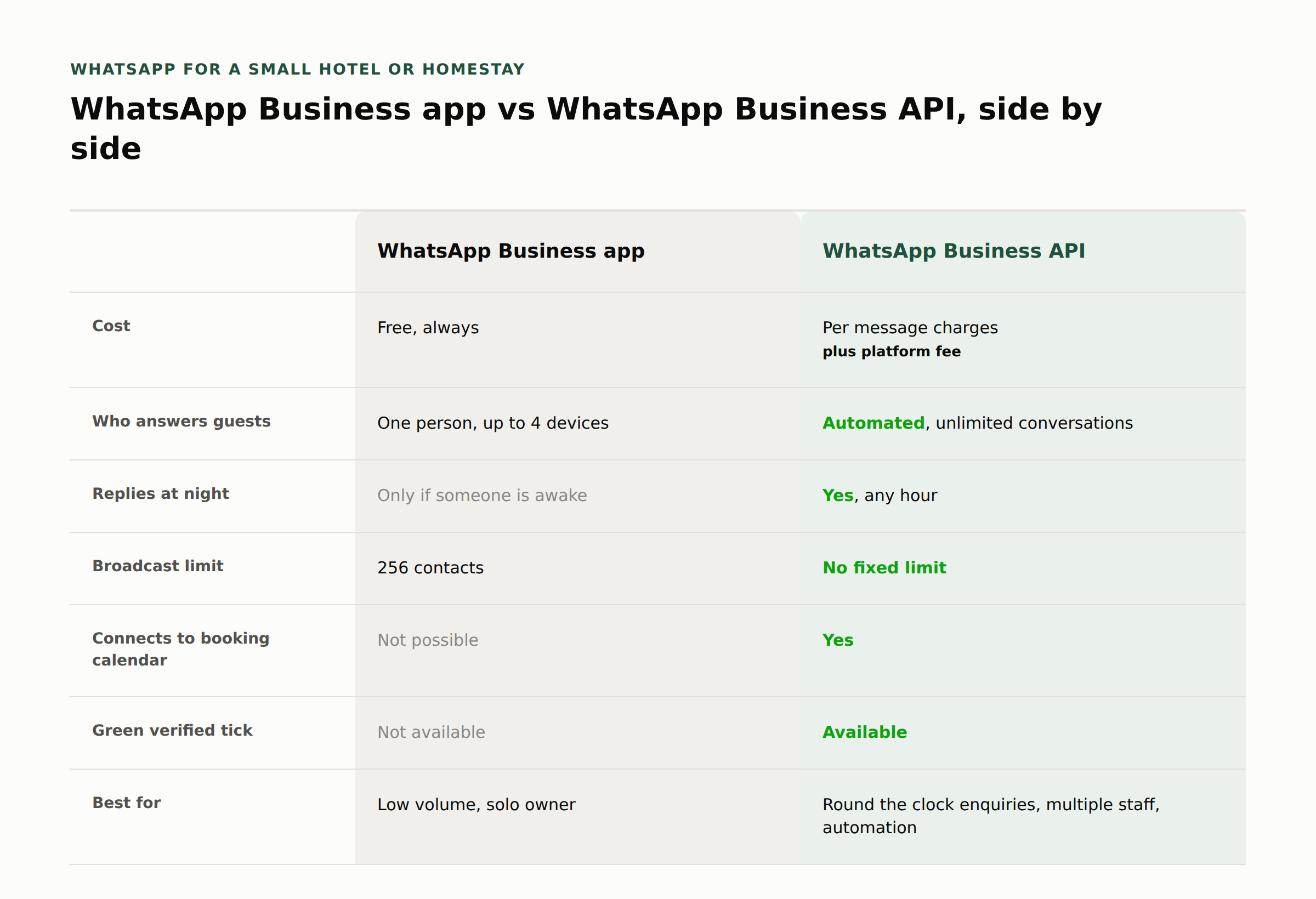
If you run a two room homestay and get four or five WhatsApp enquiries a day, honestly, the free app is enough. You do not need to read the rest of this article to make a decision, you need to read it so that if you ever do grow into the API, or a booking tool you sign up for uses it behind the scenes without saying so, you understand what you are being charged for.
Worth saying plainly too, since it trips people up: when someone casually says “WhatsApp Business API,” in almost every real conversation they mean the same thing as “WhatsApp Business Platform.” Meta itself renamed the product a while back, but the older name stuck the way “STD booth” stuck long after the actual telecom technology moved on. This article uses both names interchangeably for exactly that reason, because that is how people actually search for this and talk about it, not because they are technically two different products.
If you run anything bigger, or you are tired of enquiries dying because nobody was free to answer the phone at checkout time, the API is where the real value is and also where these pricing changes actually land.
Quick reference: the full India rate card, 2026
For anyone who just wants the numbers without the explanation first, here they are in one place. Everything below is Meta’s own published India rate as of this writing, before any BSP platform fee or GST is added and every figure here should be treated as “current as of today,” not permanent.
| Message category | Approximate India rate | Free option available | Changing this year |
|---|---|---|---|
| Marketing | ~₹0.86 per message | 72 hour free window via Click to WhatsApp ads only | Increased January 2026 |
| Utility (new conversation) | ~₹0.115 per message | No | Stable since April 2026 change |
| Utility (same window reply) | Free until October 2026 | Yes, until October 2026 | Becomes chargeable October 2026 |
| Authentication (domestic) | ~₹0.115 per message | No | Stable |
| Authentication (international) | Slightly higher, increased ~8.6% in April 2026 | No | Increased April 2026 |
| Service (plain reply) | Free through September 30; from October 1, published service rate after the allowance | 1,000 free service messages per phone number each month from October 1 | Charges start at the 1,001st delivered service message; monthly reset, no rollover |
| Meta AI Business Agent reply | Roughly ₹3.50 to ₹4.50 per typical reply (token based, $2 per million tokens) | No | New pricing model from August 2026 |
| WhatsApp Business app (free app, not API) | ₹0, always | Always free | No change, not affected by any of the above |
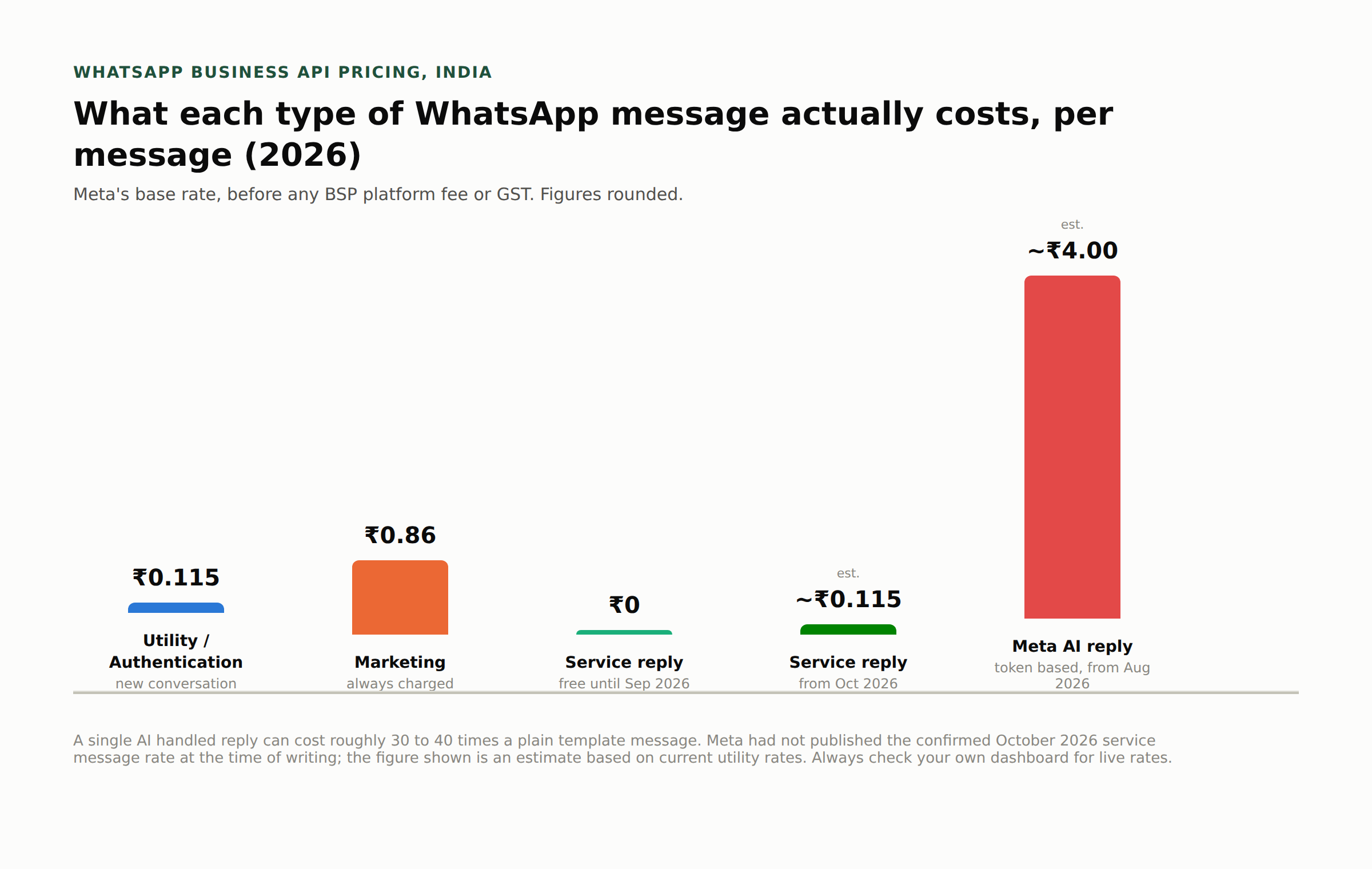
Meta’s October rate cards are now published. The rupee figures in this article’s worked examples are rounded budgeting assumptions; check the official rate card for your account currency and recipients’ markets, plus your provider’s fees.
How WhatsApp costs compare to the other ways of reaching a guest
It helps to put these numbers next to what a hotel or homestay was already spending to reach guests before WhatsApp automation, because on its own, “₹0.115 per message” or “₹4 for an AI reply” sounds like a number floating in space. Next to the alternatives, it looks quite different.
A phone call to follow up on an enquiry costs a staff member’s time, several minutes per call, multiplied across every enquiry of the day and still only reaches one guest at a time, during working hours, in whatever language the staff member happens to speak. An SMS gateway, still used by some properties for confirmations, typically costs somewhere in a similar range to a WhatsApp utility message, sometimes more, with none of WhatsApp’s ability to carry photos, a rate card, or a two way conversation. And an OTA booking, the channel most properties are trying to reduce dependence on in the first place, routinely costs 15 to 25 percent of the entire room revenue in commission, which on a modest ₹3,500 a night booking is ₹525 to ₹875 gone in one transaction, for a guest whose contact details you often never even get to keep.
Set against that, even the higher end AI reply cost of roughly ₹4, or a full month of a resort’s marketing broadcasts running into a couple of thousand rupees, is a rounding error. A single OTA commission on one weekend booking usually costs more than an entire month of WhatsApp messaging for a small property, AI included. This is not an argument to ignore the pricing changes in this article, they are real and worth planning for, it is a reminder of scale: WhatsApp remains, even after every increase covered here, one of the cheapest ways available to actually talk to a guest.
How WhatsApp Business API pricing actually works
Forget the old system for a moment, here is how it works today, in 2026.
Every message a business sends through the API falls into one of four categories and each category is priced differently.
Marketing messages are anything promotional: a festive season offer, a “book now for Diwali” broadcast, a follow up nudge after someone clicked your ad. These are always charged, no matter what. In India, Meta’s current published rate is around ₹0.86 per marketing message (some provider dashboards may show a slightly different number once GST and rounding is added, always check your own account for the live figure).
Utility messages are practical, non promotional notifications: a booking confirmation, a payment reminder, a check in instruction. These are charged at around ₹0.115 per message in India when sent to open a new conversation, but are currently free if sent as a reply within 24 hours of the guest messaging you first (this free bit is exactly what changes in October, more on that shortly).
Authentication messages are OTPs and verification codes. Priced similarly to utility, around ₹0.115 per message domestically, with a slightly higher rate for international numbers.
Service messages are ordinary non-template replies to a guest within an open 24-hour customer service window. They remain free through September 30, 2026. From October 1, each business phone number receives 1,000 free service messages a month; further delivered service messages are charged. The allowance resets monthly without rollover.
There is also a genuinely free way to message a customer: if someone reaches you through a Click to WhatsApp ad or taps a WhatsApp button on your Facebook or Instagram page, the first 72 hours of that conversation are completely free regardless of category. Useful to know if you ever run ads.
Two layers of cost, not one
Here is something a lot of pricing guides skip and it explains why two people can search the exact same thing and see two very different numbers. When you use the WhatsApp Business API, you are almost never dealing with Meta directly. You go through a Business Solution Provider, often shortened to BSP, which is the company that actually gives you the dashboard, the chatbot builder, the booking integration, whatever tool you signed up for. Meta’s per message rates above are the wholesale cost. Your BSP usually adds its own monthly platform fee on top, sometimes a small markup on the per message rate too. Platform fees vary a lot, commonly somewhere in the ₹1,000 to ₹3,000 a month range for a small business plan, though this genuinely depends on the provider and what features you need, so treat that as a rough starting point and always check the current price on whichever platform you are evaluating.
So your real WhatsApp Business API pricing is: Meta’s per message rate, plus your BSP’s monthly fee, plus GST on both. This is the number that actually lands on your bank statement and it is worth asking any provider you are considering to write it out in full rather than just quoting “₹0.86 a message” and leaving the rest implied.
Does the rest of the world pay the same rates as India
No and the differences can be large. Meta sets rates market by market, based on local factors it does not fully explain and the gaps between countries can be striking. In the same round of April 2026 changes that nudged India’s international authentication rate up by about 8.6 percent, Pakistan saw authentication and utility rates jump by roughly 85 percent, one of the steepest increases anywhere that round, while Turkey saw its rates drop by more than 80 percent, the largest cut in that same update. Saudi Arabia’s marketing rates went up around 10 percent in the same window.
The lesson here is not the specific numbers, which will have moved again by the time you read this, it is that WhatsApp Business API pricing is not one global price list, it is dozens of separate country specific rate cards that Meta adjusts independently and often, which is exactly why “what does WhatsApp cost” never has one permanent answer. If you run a property that gets a meaningful share of enquiries from international guests, especially on WhatsApp numbers registered abroad, it is worth checking your own dashboard’s country breakdown occasionally rather than assuming the India rate applies to every conversation.
The full timeline: how we got here and where this is going
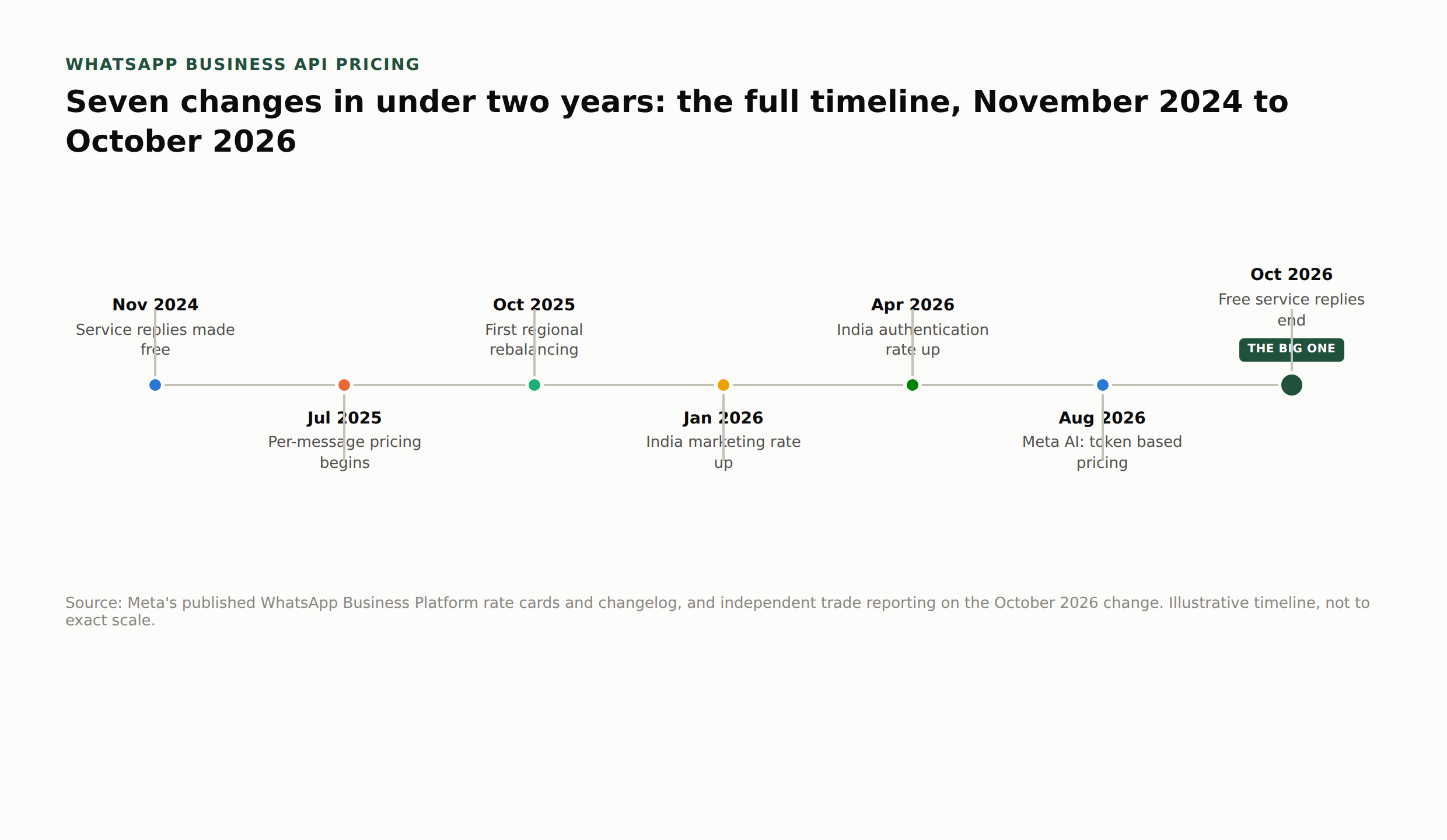
WhatsApp Business API pricing has changed more times in the last two years than in the several years before that combined. If you read an old blog post or a friend’s advice from even a year ago, there is a real chance it is describing a system that no longer exists. Here is the honest, full timeline.
Before November 2024: WhatsApp charged businesses per 24 hour conversation, not per message. Once you opened a conversation window with a customer, whether by sending them one message or fifty, you paid one flat conversation fee. This rewarded chatty back and forth, since extra messages inside the same window were free.
November 2024: Meta made a big change: it made service conversations, meaning ordinary customer replies within the 24 hour window, free for everyone. This was a genuinely generous move at the time and it is exactly why so many hotels and homestays adopted WhatsApp automation heavily over the last year and a half, replying to guest queries cost nothing extra.
July 1, 2025: The conversation based system was scrapped entirely in favour of per message pricing. Instead of paying once for a 24 hour window, businesses now pay for each individual template message (marketing, utility, authentication) they send. This is the pricing model everything in this article is built on. Service replies remained free at this point, only template messages became per message billed.
October 1, 2025: A smaller, quieter rebalancing. Meta adjusted rates in several countries, some up, some down, as part of what looks like a now regular practice of revisiting rates a few times a year rather than once. India was not majorly affected in this particular round.
January 1, 2026: India specifically saw an increase in marketing message rates. If your hotel runs seasonal WhatsApp broadcasts, this is the change that quietly made each one slightly costlier.
April 1, 2026: Another India specific change, this time to authentication messages sent to international numbers, up roughly 8.6 percent. Small in absolute terms but part of the same pattern, Meta revisiting India rates multiple times a year now rather than once.
August 1, 2026: This is where things get genuinely new rather than just a rate tweak. Meta introduced token based pricing for its own Meta Business AI Agent, moving away from a flat per message charge for AI replies to a charge based on how much the AI actually had to “think” to answer. We go into this in detail in its own section below, because it is probably the single most misunderstood change on this list and directly answers the “isn’t AI too costly for India” question a lot of owners are asking right now.
October 1, 2026 (this is the big one): Meta introduces per-message charges for service replies after each business phone number’s first 1,000 service messages in a month. The allowance resets monthly and unused messages do not roll over. Utility templates delivered within the customer service window also become chargeable. Meta has now published its October 1, 2026 rate cards; service rates match utility and authentication rates for the recipient’s market.
Put plainly: the 24-hour customer service window remains in place; it is the pricing inside it that changes. From October 1, service replies remain free within the monthly allowance of 1,000 per business phone number, with charges starting at message 1,001. Utility templates do not use this service-message allowance. Provider fees and any separate AI charges still depend on your plan.
What changing on October 1, 2026 actually means for a real conversation
Let us make this concrete with an example, because rate categories on their own do not mean much until you see them in an actual guest conversation.
Say a guest messages your hotel’s WhatsApp: “do you have a room for 2 nights this weekend and is breakfast included.” Here is roughly what happens on each side of that conversation, before and after October 2026.
Before October 2026: the guest’s message is free to receive, obviously. Your reply, whether typed by a receptionist or sent instantly by an automated assistant, “yes we have rooms, breakfast included, would you like me to block it,” costs nothing, it is a free service reply. If the system then sends a formal booking confirmation once payment is made, that too is free if it happens within the same 24 hour window as the guest’s message. The entire conversation, potentially five or six messages back and forth, costs the hotel zero rupees in Meta charges.
From October 1, 2026: the guest’s message is still free to receive. If your phone number has enough of its monthly allowance left, four ordinary service replies use four of its 1,000 free service messages. A utility-template booking confirmation is charged separately, even inside the same 24-hour window. Once that phone number has used its allowance, further delivered service replies are charged at Meta’s published service rate for the guest’s market. Count service replies and utility templates separately when estimating the monthly bill.
Two honest things worth saying here. First, this is not some unprecedented WhatsApp money grab, service messages were paid before November 2024 too, this is described by several trade sources as “a return to charging” rather than a brand new fee. Second, at current utility level rates, this remains genuinely cheap compared to almost any other way of reaching a customer instantly, a phone call, an SMS gateway, or a human staff member’s time. The change is real, but it is not the kind of change that should make anyone panic, it is the kind that should make you budget properly instead of assuming this particular channel stays free forever.
Meta AI on WhatsApp: what it actually costs and is it really too expensive for India
This is probably the question we get asked most often right now, so let us take it seriously and go through the actual numbers rather than a vague “AI is expensive” line.
Meta has its own AI tool built into the WhatsApp Business Platform, currently called the Meta Business Agent. It is meant to handle real conversations end to end: answering product questions, recommending options, booking appointments, qualifying a lead and handing the chat over to a human only when it genuinely needs to. For a hotel, this looks like a guest asking a slightly open ended question, “what is there to do near your property,” and getting a genuinely useful, specific answer instead of a scripted template.
From August 1, 2026, Meta stopped charging for this on a flat per message basis and moved to token based pricing, at $2 per one million tokens, which comes to roughly ₹185 to ₹190 depending on the exchange rate on any given day.
Now, what is a token, in plain language. Think of a token as roughly three quarters of a word. AI systems do not “read” a message the way we do, they break it into small chunks called tokens and every chunk the AI has to process, both what the guest typed and what the AI replies with, counts towards the bill. A short, simple question and answer uses fewer tokens. A longer, more thoughtful conversation, or one where the AI is pulling in extra context (like your rate card, room availability, or a policy document) to give a good answer, uses more.
Here is the number that actually matters for your monthly budget: a fairly typical AI handled message can use up to around 25,000 tokens once you count both the question and a well formed answer with context. At $2 per million tokens, that works out to somewhere around 4 to 5 cents per AI reply, or roughly ₹3.50 to ₹4.50 at current exchange rates.
Now compare that to a plain utility message at around ₹0.115. An AI handled reply can cost 30 to 40 times more than a plain template message. That is the honest number behind the “isn’t Meta AI too costly for India” worry and yes, if you let an AI agent handle every single guest question, including the simple ones a fixed quick reply could answer just as well, your WhatsApp bill will climb noticeably faster than it would on template messages alone.
But there are two things that soften this considerably and they matter.
First, Meta’s own AI is still meaningfully cheaper than the alternative most Indian businesses were quietly using before this change: plugging a third party AI model like ChatGPT or Claude into their WhatsApp chatbot through a BSP. Industry estimates comparing the two put ten thousand complex AI interactions through a third party model at somewhere around $968, versus roughly $400 to $500 for the same volume through Meta’s own Business Agent, with simpler service style interactions costing as little as $268 per ten thousand through Meta AI. Several trade commentators have pointed out, fairly, that this pricing structure quietly makes it more attractive to use Meta’s own AI than to bring your own from OpenAI or Anthropic, since with a third party model you are paying that provider directly on top of Meta’s delivery charges, essentially paying twice.
Second and this is the practical bit for a small hotel or homestay: nobody is forcing you to let AI answer everything. A well built WhatsApp assistant should be answering routine, predictable questions, “what time is checkin,” “do you have parking,” “what is the wifi password,” using cheap, fixed template or utility style replies and reserving the costlier AI reasoning only for genuinely open ended questions where a scripted answer would sound robotic or simply be wrong. Used that way, AI cost stays a small fraction of your total WhatsApp spend, not the majority of it.
Think of it a bit like the difference between a fixed menu and asking the cook to prepare something special. A guest asking “what time is breakfast” needs the fixed menu answer, quick, cheap, correct every time. A guest asking “we are vegetarian, travelling with an elderly parent who needs a ground floor room and arriving very late, can you help us plan the stay” genuinely needs the cook to think and that thinking costs more, in a kitchen and on a WhatsApp bill alike. The mistake is asking the cook to prepare something special for every single order, including the ones the fixed menu already covers perfectly well. Good WhatsApp automation, AI included, is mostly about knowing which question is which and routing accordingly, rather than switching AI on or off entirely.
One more practical point worth flagging clearly, because it changes the “is this too expensive” answer depending on your situation: token pricing means longer, more detailed answers cost more than short ones, since every word in and every word out counts toward the token total. An AI agent that has been told to write warm, detailed, three paragraph replies to simple questions will cost noticeably more per month than one told to be helpful but concise. If you are using or evaluating an AI powered WhatsApp assistant, it is worth asking specifically how the assistant is instructed to keep replies tight, since that single setting can meaningfully affect your monthly AI spend, more than almost anything else in this article.
So, is Meta AI too expensive for a country like India specifically? Fair question, given India’s price sensitive market and the fact that ₹3 to ₹4 per AI reply sounds trivial to an enterprise but adds up for a business running on thin margins. The honest answer: per message, yes, it is genuinely far pricier than a plain template reply and a hotel that lets AI handle every single guest message without any cost discipline will feel it on the bill. But used selectively, only where a scripted reply genuinely would not do and compared honestly against what it used to cost to run the same conversation through a third party AI model, it is not the villain it is sometimes made out to be. The mistake is treating AI replies and template replies as the same cost, they are not and any hotel using an AI powered WhatsApp assistant should ask their provider directly how AI usage is metered and billed, rather than assuming it is included for free forever.
Old advice still floating around that is no longer true
Because this has changed so many times, a lot of outdated information is still sitting on the first page of search results, some of it written before July 2025, some before this year’s changes. A few myths worth clearing up directly.
“Messages inside the 24 hour window are always free.” This is too broad. From October 1, 2026, service replies are free within the 1,000-message monthly allowance per business phone number, then charged. Utility templates are charged even within the window. The separate rules for eligible 72-hour free entry point windows still apply.
“You have to buy the WhatsApp Business API directly from Meta.” Not really, in practice almost nobody does this alone. You go through a Business Solution Provider, which is what gives you the dashboard, template builder and any booking or CRM integration. Meta sets the underlying per message rate, the BSP handles everything you actually interact with day to day.
“A chatbot on WhatsApp is always going to be expensive.” Depends entirely on what the chatbot is doing. A bot answering fixed questions with template replies costs the same small utility rate as anything else. It is specifically AI powered, open ended conversation that costs meaningfully more and even then, only per AI handled message, not across the board.
“WhatsApp Business API pricing is basically the same everywhere.” Not even close, as the country comparison above shows. Rates move independently market by market and an article written with US or European pricing in mind will be wrong for an Indian property, sometimes wrong by a large margin.
“Once I set this up, the price I signed up at is the price I will always pay.” Almost certainly not, based on the timeline above. Budget for occasional small changes the way you would for a electricity tariff revision, not as a one time decision made once and forgotten.
How to check your own live rates in five minutes
Do not take this article’s numbers, or anyone else’s, as gospel for your own account, because by the time you read this some figures may have moved again. Here is how to see your own actual current rates directly.
If you use a Business Solution Provider (most small properties do), log into your provider’s dashboard and look for a section usually called something like “billing,” “usage” or “conversation pricing.” A reasonable provider shows you a breakdown by category, marketing, utility, authentication and service, with the exact rate you are being charged for your country. If you cannot find this anywhere in the dashboard, that is worth asking your provider about directly, it should not be hidden.
If you have direct access to Meta’s own WhatsApp Manager (some larger or more technical setups do), the official rate card sits under the business settings for your WhatsApp Business Account and Meta’s own developer documentation for WhatsApp Business Platform pricing carries the live, current per country rate sheet, which is the single most reliable source, more reliable than any third party blog including this one.
Either way, it is worth doing this check every few months rather than once, given how often these numbers move. A five minute habit, done once a quarter, is genuinely enough, this is not something that needs daily watching, it is something that quietly drifts if nobody looks at it for a year, the way a mobile plan slowly stops matching what you actually use if you never revisit it.
If you manage more than one property, or a small group of homestays under the same family, it is worth doing this check for each WhatsApp number separately rather than assuming they are all on identical terms, since volume tiers, country specific rates for any international guest traffic and even which BSP plan each property was originally signed up under can quietly differ property to property, especially if they were set up at different times over the last two years covered by this article’s timeline.
Do you personally need to pay for any of this, or is the free app enough
Let us answer this properly, because it is the single most practical question in this whole article.
You do not need the paid API at all if: you are one or two people handling WhatsApp enquiries personally, your volume is genuinely low, say under 30 to 50 messages a day, you are fine with guests sometimes waiting a few hours for a reply during a busy shift and you do not need the green verified tick or a chatbot. The free WhatsApp Business app does everything you need, with genuinely zero per message cost, today and after every change described in this article.
You almost certainly need the API if: you are missing enquiries because nobody is free to answer WhatsApp during checkin and checkout rushes, guests message late at night and get no reply until morning, your quoted rates vary depending on which staff member answers, you want a booking confirmed and a room blocked the moment a guest pays without anyone manually updating a calendar, or you simply get too many enquiries a day for one person or a small team to answer promptly by hand.
Here is the honest trade off in one line: the free app costs nothing in rupees but costs you missed enquiries, inconsistent quotes and staff time. The paid API costs a genuine, if usually small, amount in rupees, but buys back exactly those three things. For most properties past a certain size, the lost bookings from a missed enquiry at 11pm cost far more than the WhatsApp charges ever will. This is really a staffing and lost revenue decision dressed up as a technology pricing question and it is worth thinking of it that way rather than purely as “is WhatsApp expensive now.”
A step by step way to actually decide, for your own property
If you are still unsure which side of that line you fall on, work through these questions honestly, in order and stop at the first one that clearly applies to you.
One, count how many WhatsApp enquiries you actually get in a normal week, not a festive weekend, an ordinary week. Write down the number. If it is under, say, 200 to 250 a week, roughly 30 a day, one person can genuinely keep up with that by hand and the free app is likely enough.
Two, ask yourself honestly how many of those enquiries currently go unanswered for more than an hour, especially during checkin, checkout, or after 10pm. If the honest answer is “quite a few,” that is lost revenue hiding inside a WhatsApp thread and it is usually the single biggest argument for moving to the automated API, well before any pricing conversation.
Three, check whether your quoted rate for the same room and same dates has ever varied depending on who answered the enquiry, a manager quoting one price and a trainee quoting another. If yes, that is a consistency problem the API and its fixed rate card solve directly, independent of cost.
Review how your property collects guest IDs and verifies advance payments. OpenStays flags Form C requirements based on each guest’s nationality. It does not automatically submit Form C; the property is responsible for submission.
Five, only once you have answered the four questions above, look at the actual rupee numbers in the worked examples further down this article and decide whether the cost is worth what it buys back. For most properties getting more than about 200 to 300 enquiries a month, or losing bookings to slow replies even occasionally, the answer tends to be yes, comfortably.
What a real monthly WhatsApp bill could look like for a small property
Numbers are more useful than percentages, so here is a rough, honest worked example. Take a 10 room homestay in Wayanad using an automated WhatsApp assistant for enquiries, getting roughly 300 guest conversations a month (a mix of new enquiries and returning guests), with occasional festive season broadcasts.
Rough monthly message mix, purely illustrative. Each example assumes one phone number with its full monthly service allowance. Utility templates and AI usage are listed separately; the free allowance does not waive provider or AI fees.
- 300 guest conversations averaging 4 service replies each on one phone number: 1,200 service messages minus the 1,000 free monthly allowance = 200 charged messages. At an illustrative ₹0.115 each: around ₹23.
- 300 booking confirmation messages (utility category, sent when opening a fresh conversation, not as a same window reply): around ₹35
- 4 festive season marketing broadcasts a year, say 500 contacts each, at roughly ₹0.86 per message: works out to roughly ₹1,720 across those four campaigns, or about ₹143 a month averaged out
- If the assistant uses AI for maybe 15 percent of the more open ended questions, say 45 AI handled replies a month at roughly ₹4 each: around ₹180
Rough total: around ₹381 a month (₹23 service + ₹35 utility + ₹143 averaged marketing + ₹180 assumed AI cost), before additional platform fees and taxes.
Compare that to what a single missed festive weekend booking is worth to a 10 room property, easily several thousand rupees for one weekend alone and the message costs above look like exactly what they are: a small, predictable, manageable line item, not a reason to abandon WhatsApp as a booking channel.
Your own bill depends on message categories, recipient markets, AI use and provider fees. For each phone number, subtract the 1,000 free monthly service messages from eligible service volume, with a minimum of zero charged messages. Calculate utility templates, marketing, authentication and AI costs separately.
A bigger example: a 14 room hotel near a highway junction
Now scale that up. A 14 room hotel near a highway, getting a heavier, steadier flow of enquiries, say 700 guest conversations a month between walk in style highway travellers checking availability last minute, returning corporate accounts and a few travel desks that send group booking requests in writing over WhatsApp.
Rough monthly numbers, again illustrative, not a promise:
- 700 conversations averaging 5 service replies each on one phone number: 3,500 service messages minus the 1,000 free monthly allowance = 2,500 charged messages. At an illustrative ₹0.115 each: around ₹288.
- 700 booking confirmations at utility rates: around ₹80
- No AI usage at all: this hotel uses saved non-template service replies within the customer service window, with utility templates for booking confirmations. Template messages are billed separately and do not qualify for the service allowance.
- No marketing broadcasts, this property relies entirely on inbound enquiry, not outbound campaigns
Rough total: around ₹368 a month (₹288 service + ₹80 utility), before platform fees and taxes.
A resort example: marketing heavy, seasonal
Now the opposite case. A 20 room resort in a leisure destination that leans hard into WhatsApp marketing ahead of long weekends and the winter season, running monthly broadcasts to a growing list of past guests, alongside routine enquiry handling.
Rough monthly numbers:
- 400 guest conversations averaging 4 service replies each on one phone number: 1,600 service messages minus the 1,000 free monthly allowance = 600 charged messages. At an illustrative ₹0.115 each: around ₹69.
- 400 booking confirmations at utility rates: around ₹46
- Monthly marketing broadcast to 2,000 past guests and enquirers, at ₹0.86 per message: around ₹1,720 a month
- Light AI usage for detailed itinerary and activity questions, say 60 AI handled replies a month at roughly ₹4 each: around ₹240
Rough total: around ₹2,075 a month (₹69 service + ₹46 utility + ₹1,720 marketing + ₹240 assumed AI cost), before additional platform fees and taxes. Marketing volume remains the main cost in this example.
Three very different properties, three very different bills and in each case the biggest lever was a deliberate choice, how much AI to use, how many templates versus replies, how big and how targeted the marketing list is, not some fixed, unavoidable cost of “being on WhatsApp.”
| Property example | Charged service messages | Estimated monthly total |
|---|---|---|
| Homestay | 200 | ₹381 |
| Hotel | 2,500 | ₹368 |
| Resort | 600 | ₹2,075 |
Already using a WhatsApp chatbot or booking tool? What to check before October
If your property already runs on some WhatsApp automation tool or a BSP subscription, you do not need to switch anything because of this article, but it is worth having one honest conversation with your provider before October 2026 arrives. Four questions worth asking directly.
Ask how the 1,000 free monthly service messages per phone number are reflected in your bill and whether your current plan already accounts for the October change to service and same window utility messages, or whether that is going to be an additional line item added later without much notice. A provider who has already thought this through should have a ready answer, not a vague one.
Ask whether your monthly platform fee is flat, or whether it scales with your message volume and if it scales, at what point. A flat fee that seemed generous at low volume can turn out to be a poor deal once your enquiry numbers grow and it is better to know that threshold now than discover it on an invoice.
Ask specifically how AI usage, if you use it, is metered and billed and whether you can see a monthly breakdown of AI handled conversations versus template ones. If a provider bundles AI in without separating the cost anywhere visible, that is worth pressing on, since AI is the single largest new variable in WhatsApp Business API pricing this year.
And ask what happens if you want to leave. Your WhatsApp Business Account and phone number should, in a properly set up arrangement, remain usable if you ever move providers. If a provider cannot explain clearly how migration would work, treat that as useful information about the relationship in general, not just about pricing.
None of this means your current setup is bad. It means WhatsApp Business API pricing has moved enough times in the last two years that a five minute conversation with whoever runs your account is worth having, the same way you might occasionally sanity check a mobile plan or a broadband bill instead of assuming it never changed.
How to keep your WhatsApp costs sensible
A few practical, non technical habits that genuinely help, regardless of which provider or booking tool you use.
Answer inside the 24 hour window whenever you can, rather than letting a conversation go stale and needing a fresh, costlier template message to restart it. This was already good guest service advice and it happens to be good cost advice too.
Keep routine questions on fixed quick replies or simple templates rather than routing them through AI. “What time is checkin” does not need an AI agent to think about it, a saved quick reply answers it for free in effort and cheaply in message cost and reserves AI for the questions that actually benefit from it.
Be deliberate about marketing broadcasts. A well targeted broadcast to 200 genuinely interested past guests before Onam or Diwali earns its cost back many times over in bookings. A broadcast blasted to every contact you have ever collected, most of whom never asked for it, mostly just adds to your bill and annoys people.
Ask whoever provides your WhatsApp tool, plainly, how they bill for AI usage and whether you can see a breakdown of template versus service versus AI replies each month. If a provider cannot answer that clearly, that itself tells you something.
Revisit this every few months. As this whole article demonstrates, WhatsApp Business API pricing has changed six or seven times in under two years. Treat any figure you read today, including the ones in this article, as “current as of when this was checked,” not as a permanent fact.
How OpenStays handles this, so you do not have to track any of it yourself
We built OpenStays for homestays, hotels and resorts specifically and this entire pricing maze is exactly the kind of thing we think an owner should not have to become an expert in just to answer a guest on WhatsApp.
Each outgoing WhatsApp message, including AI replies, uses 1 credit. Incoming messages are free and purchased credits never expire. An active subscription is required to use them. OpenStays message usage is shown in credits. View current OpenStays plans.
This is deliberately a great deal specifically for the kind of property this whole article is written for, homestays, hotels and resorts, rather than a generic pricing plan borrowed from a marketing SaaS tool built for e-commerce brands. Those tools are usually priced around high volume broadcast campaigns, which is not how most Indian hospitality properties actually use WhatsApp, mostly it is enquiry replies, quotes, confirmations and the occasional festive push, not thousands of daily marketing blasts. A flat, simple credit system fits that usage pattern far better than a category by category rate card ever will.
For a homestay, hotel or resort specifically, this genuinely saves on all three things owners care about most. On money, a flat, predictable credit cost is usually a noticeably better deal than paying Meta’s per message rates plus a separate BSP platform fee plus GST on both, especially once October’s changes and AI usage are added into the mix and there is no separate contract or top up hassle to manage. On effort, nobody at your property needs to set up a WhatsApp Business Account, get templates approved, negotiate with a BSP, or read pricing changelogs like this one, we absorb that layer entirely. On time, because the whole point of the WhatsApp assistant is answering guests instantly at any hour, including the AI handled conversations that would otherwise carry the token based charges explained above, without your front desk having to weigh “should I let the bot answer this or is it going to cost extra,” which is exactly the kind of second guessing that slows a property down and eventually gets automation switched off out of caution.
Straight questions, straight answers
Will WhatsApp messaging get more expensive for my business in 2026?
The October 1, 2026 change applies to the WhatsApp Business Platform. Each business phone number gets 1,000 free service messages per month, with charges starting at the 1,001st delivered service message. Utility templates sent within the customer service window also become chargeable. The effect on your bill depends on message volume, categories and provider fees.
Can I just keep using the free WhatsApp Business app and avoid all of this?
Yes, entirely, if your enquiry volume is low enough for one or two people to answer by hand and you do not need automation, the green verified tick, or a booking calendar connection. The free app has no per message charges and none of the changes in this article apply to it. The moment you need instant replies at any hour, multiple staff handling chats at once, or automated booking confirmation, you move into the paid API and these rates start to apply.
What is Meta AI on WhatsApp and do I have to use it?
Meta’s Business Agent is an optional AI tool that can hold more natural, open ended conversations with guests, recommending things, answering questions a fixed template could not anticipate and handing off to a human only when needed. It is not compulsory, a WhatsApp Business API setup works perfectly well using only fixed templates and quick replies, with no AI involved and no AI charges. Whether to use it is a choice, not a requirement.
Isn’t Meta AI too costly for a price sensitive market like India?
Per message, AI handled replies are genuinely far more expensive than plain template messages, roughly 30 to 40 times more at current rates, since AI billing is based on how much the system had to process (tokens) rather than a flat per message fee. That said, Meta’s own AI pricing is meaningfully cheaper than running a third party AI model like ChatGPT or Claude through the same WhatsApp connection, where you would pay that provider directly on top of Meta’s own charges. The sensible approach for a small business is using AI selectively, for genuinely open ended questions, while keeping routine questions on cheap fixed templates, rather than letting AI answer everything.
What exactly changes on October 1, 2026?
From October 1, 2026, each business phone number receives 1,000 free service messages every month. Meta charges from the 1,001st delivered service message at its published market-specific service rate. Unused free messages do not roll over; the allowance resets monthly per phone number. Utility templates inside the 24-hour customer service window also become chargeable. Service messages still require an open customer service window. Meta has now published the October rate cards.
How is WhatsApp Business API pricing actually structured right now?
Meta bills by message category and recipient market. As of September 8, 2026, service replies and utility templates within the customer service window remain free. From October 1, utility templates within that window become chargeable, while service replies receive a monthly free allowance of 1,000 per business phone number before charges apply. Authentication messages do not receive the utility-template window exemption. Provider platform and AI fees may be additional.
Does OpenStays charge separately for WhatsApp messaging and AI?
Each outgoing WhatsApp message, including AI replies, uses 1 credit. Incoming messages are free and purchased credits never expire. An active subscription is required to use them. These OpenStays credit terms are separate from the Meta pricing categories discussed in this article.
Do I need a technical team to set up the WhatsApp Business API for my hotel?
No, not with a proper provider. A genuine WhatsApp booking system for hotels, OpenStays included, handles the API setup, template approval and technical configuration during onboarding. Your job is choosing room rates and policies, not managing API credentials.
Is WhatsApp Business API pricing the same in every country?
No. Meta sets rates market by market and revisits them independently, sometimes multiple times a year. India, Pakistan, Turkey and Saudi Arabia all saw different, unrelated rate changes in the same April 2026 update, some rates going up sharply, one going down by more than 80 percent. Always check the rate card for your own country rather than relying on a figure quoted for another market.
What is the difference between a marketing message and a utility message, in plain terms?
A marketing message is anything promotional, an offer, a discount, a “book now” nudge and it always costs money to send. A utility message is a practical notification tied to something the guest already asked for or booked, a confirmation, a reminder, a receipt and it is priced lower than marketing, though it stops being free as a same window reply from October 2026 onward.
Will my WhatsApp costs keep changing after October 2026?
Almost certainly yes, based on the pattern of the last two years. Treat WhatsApp Business API pricing as something to check every few months, the way you might check a mobile recharge plan, rather than a fixed cost you set once and never look at again.
A quick word on GST, since nobody enjoys reading this part
One last practical note before we close. Every rupee figure in this article is Meta’s base rate, before GST. Whether GST is added on top of the message rate, the platform fee, or both and at what point it shows up on your invoice, depends on how your BSP or provider structures billing, which varies enough between providers that it is not something this article can state as one universal number. When you are comparing what two different WhatsApp providers will actually cost you, ask each one plainly whether the number they quoted is before or after GST, this alone can explain what looks like a confusing gap between two quotes that are actually closer than they first appear.
The one thing to actually do with this article
If you run a small property and read nothing else here, do this one thing: check which version of WhatsApp you are actually using today, the free app or a paid API through some booking or CRM tool and if it is the paid version, ask your provider directly how they are pricing AI replies and what happens to your bill from October 2026 onward. Most owners genuinely do not know which one they are on and given how often these rates have moved in the last two years, that is not a small thing to be unsure about.
If you are still on the free app and enquiries are starting to outgrow what one person can answer by hand, this is also a good moment to actually run the numbers, not guess. Take a real week, count your enquiries, note how many arrived after 9pm or during a checkin rush and be honest about how many of those probably went to a competitor because nobody replied in time. Put that lost booking value next to the worked examples earlier in this article. For most properties past a certain size, that comparison settles the question quickly and it settles it in rupees, not opinions.
WhatsApp remains, by a wide margin, the cheapest instant channel available to reach a guest directly, cheaper than a phone call, cheaper than SMS and far cheaper than the commission an OTA takes for the same booking. These changes make it slightly less free than it has been for the last year and a half. They do not make it expensive and they certainly do not make it a reason to go back to a landline that rings busy at checkout time.
What has your own experience with WhatsApp business messaging been, free app or API, AI or plain templates? Tell us in the comments below and if a provider has quoted you a monthly WhatsApp cost, we would genuinely like to hear the number, it helps keep articles like this one honest.
Charts in this post are original graphics built from the sources cited in our research, not stock imagery.


Leave a Reply