
FOR HOTELS, HOMESTAYS & RESORTS
Automated rate negotiation
An AI that negotiates room rates the way your best staff member would, holding a floor price, working inside a window you set and closing the booking the moment the guest is ready to pay, whether the ask comes from a hotel front desk, a homestay host’s phone, or a resort package enquiry.
Built by property owners for property owners · 0% commission · Direct payments to your bank
ILLUSTRATIVE FEATURE OVERVIEW
Rate controls
Your base rate
Start with your configured room prices
Your discount rules
Set the offers you are willing to make
Guest enquiry
Respond within the limits you choose
Your control
Review the conversation and adjust your rules
Your rules set the limits
THE 11PM CONCESSION
The negotiation your staff either wins or gives away
“Best price bataiye” is not rudeness. It is the market talking. Automated rate negotiation plays that game every single time, without getting tired or giving away margin just to end the conversation.
Every property owner knows the pattern. A guest asks for a better rate. A tired staff member, or the owner themselves at 11pm, gives in faster than they should, not because the rate could not hold, but because saying yes ends the conversation. Multiplied across a season, those small, tired concessions add up to real margin lost for no reason other than fatigue.
WHY IT WINS
Three reasons software out-negotiates a tired owner
It never gets tired
The fiftieth negotiation of the week gets the same discipline as the first.
It always remembers the floor
A human under pressure can forget where the line was supposed to be. The system cannot.
It works at 2am
The hour when an owner is most likely to say yes just to get back to sleep is the hour the system handles best.
THE MECHANICS
You set the window, it plays the game
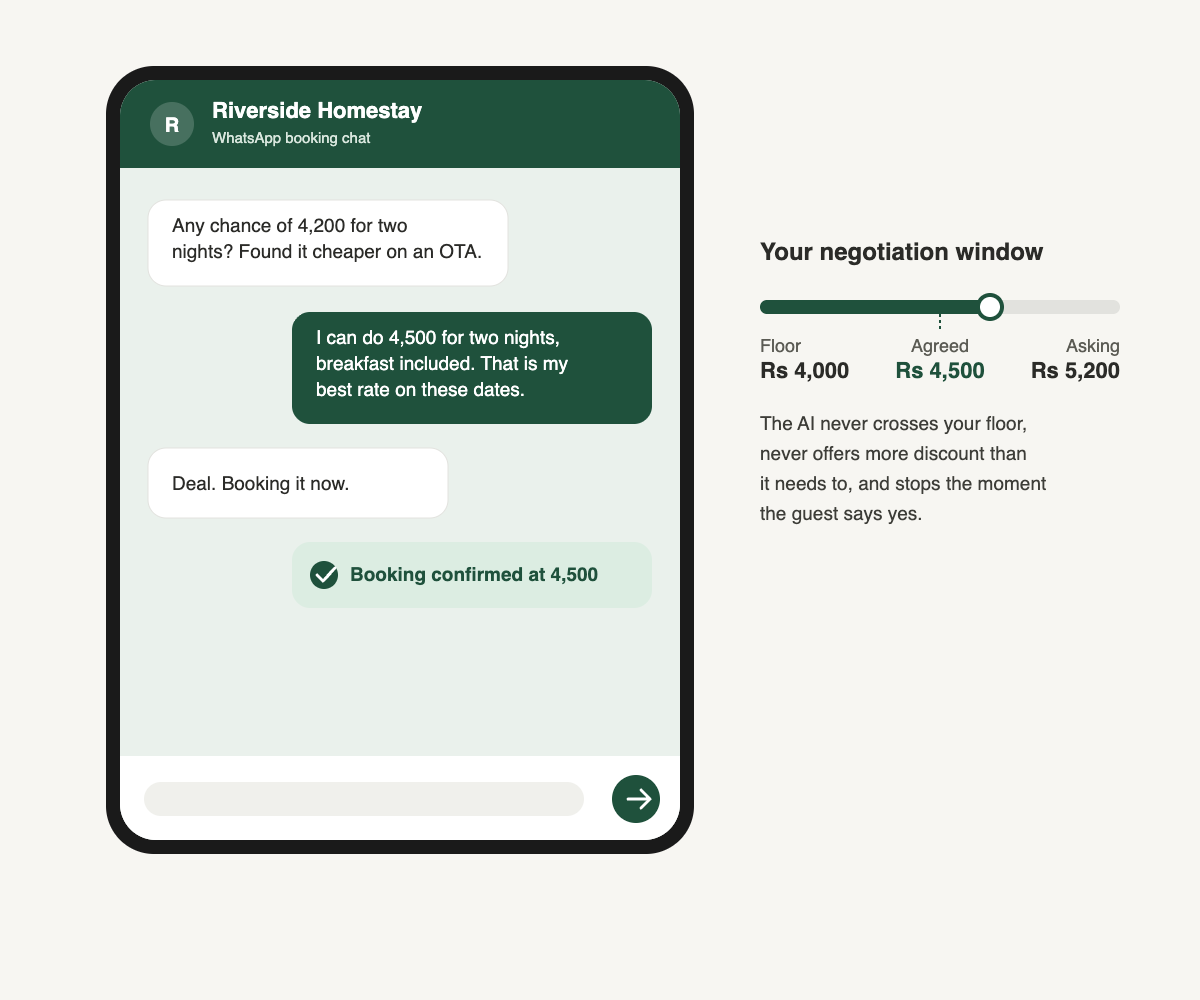
You decide the floor price you will never go below, a target price you are happy with and the published rate you start from, whether that is priced per room, per unit, or per package. The system negotiates inside that window, offering small steps down only when it needs to and stopping the moment it reaches your floor.
GUARDRAILS
What the AI will never do in a rate negotiation
- It will never quote below the floor price you set, no matter how the conversation goes.
- It will never negotiate on dates you have marked as non-negotiable, such as a festival weekend or a fully booked period.
- It will always log the full conversation, so you can review exactly what was offered and accepted.
BEYOND THE ROOM RATE
Concede value, not margin
The strongest move in a rate negotiation is not always a lower number. It is a better package. Every property has things that cost little to give but carry real perceived value: a free breakfast, an early check-in, a late checkout on a quiet day, a welcome drink, a bonfire evening for a resort group. Real perceived value, modest real cost.
So before the assistant touches the rate, it offers what you have told it to offer, whether that is a homestay’s home-cooked breakfast, a hotel’s early check-in, or a resort’s bonfire and nature walk for an arriving group. Whoever is negotiating responds well to this, because they get to report back having won something visible. “I got us the bonfire included” or “breakfast is on the house” travels better than “I got 200 rupees off per head”.
This is standard practice among skilled negotiators: expanding the pie before dividing it, as researchers at Harvard’s Program on Negotiation describe it. What software adds is that it never forgets to try this first, whether it is the fortieth chat of a Tuesday night or the first enquiry of the season.
SEASONAL SENSE
The window moves with the season
The right rate-negotiation window is a seasonal decision and the good news is you only make it a few times a year. Off-season and midweek, run it wide: a discounted midweek guest beats an empty room or cottage and the assistant can concede cheerfully to fill quiet nights. Long weekends, festival dates and peak season, pull it narrow: demand is coming regardless, so concessions should be small and always exchanged for a full advance.
Then let the record teach you. If the monthly review shows most chats closing at your floor, your quoted rate is scaring people off, or your floor is set too soft. If everyone pays the quoted rate without a murmur, congratulations, you are underpriced and that is the cheapest market research you will ever get. Researchers at Harvard’s Program on Negotiation would call this calibrated anchoring; a property owner would call it finally knowing what the room, unit, or package is worth.
HONEST LIMITS
What automation will not fix
It is worth being straight about the boundaries, because a tool oversold is a tool distrusted.
Rate negotiation software cannot make an overpriced room, unit, or package sell. If your rate sits well above what the location, the photos and the reviews justify, the assistant will negotiate down to your floor and guests will still walk. What it does give you is evidence: a month of transcripts showing exactly where conversations die tells you more about your pricing than any competitor survey.
It also will not replace hospitality. The assistant closes the booking; you still run the front desk with warmth, cook the breakfast, or brief the boat crew before a resort’s group arrives. Automation protects your energy so more of it reaches the parts guests actually remember. It does not host for you.
And it will not rescue a property with no demand. Negotiation is a conversion tool, not a discovery tool. If enquiries are not arriving at all, the work is upstream: your listing pages, your Google Maps profile, your Instagram, your past-guest list. Fix the flow first, then let automated rate negotiation make sure none of it leaks on the way to a confirmed booking.
COMPARE
Automated rate negotiation vs fixed pricing vs manual haggling
| Automated negotiation | Fixed pricing | Manual haggling | |
|---|---|---|---|
| Books price-sensitive guests who would otherwise walk away | Yes | No | Sometimes |
| Protects a floor price | Always | Not applicable | Depends on who is on shift |
| Available at 2am | Yes | Yes | No |
| Consistent every time | Yes | Yes | No |
| Staff time required | None | None | High |
SEE IT IN ACTION
Three floors, three ceilings, three properties
A hotel front desk, Saturday evening
A guest messages a hotel’s WhatsApp on a peak Saturday: “Room for 2 tonight, 1 night. Best price bataiye 🙏” The assistant replies with the room’s standard weekend rate for two guests, breakfast included and notes that rooms are moving fast: shall it hold one? The guest pushes: “Too much yaar, final price?” The assistant offers a small, pre-configured concession for guests who pay the full advance immediately: genuinely the best it can do for a Saturday: and asks if it should send the payment link. The guest agrees, pays and the booking is confirmed on the spot. The actual rate came straight from the property’s rate card; the concession came from a window the owner set in advance and would have been politely declined if the guest had pushed any further. No one on the front desk typed a word.
An 11pm homestay call, without the surrender
Every homestay owner knows this shape: breakfast for eight at six, a school run, a plumber, a checkout, two check-ins, dinner: and then at 10:47pm the phone lights up. “Room available next weekend? What’s the best you can do?” Tired, at the end of a fourteen-hour day, it is easy to give away ₹400 for the sake of sleep without meaning to. Multiplied across a season, that is a slow leak: a few hundred rupees surrendered here, a weekend rate quoted as a weekday rate there, a “final price” that changes depending on how the day went. With automated rate negotiation, the same conversation runs inside the floor and target the owner set on a calmer day: awake or asleep, the negotiation holds the line it was given and the owner finds the booking confirmed in the morning instead of a rate she does not remember agreeing to.
A family of sixteen, the Friday before a long weekend
A couple booking one cottage negotiates once, briefly and books. A family group of sixteen is a different sport: three days of back-and-forth across a WhatsApp group the property can’t see, with a designated bargainer nominated because he is relentless and a headcount that changes every time someone’s cousin decides to join. The ticket is large, so the group expects a “group rate.” The package includes meals and activities, so there is more to argue over. And the whole thing usually lands on a Friday evening before a long weekend, alongside forty other enquiries. Handled manually, one large group can consume an entire team’s evening and still end with cottages held for people who never pay. Automated negotiation applies the same floor and per-person logic to every one of those forty conversations at once and only locks a cottage once an advance actually clears.
MEASURE WHAT MATTERS
The three numbers rate negotiation moves
Floor price (the number you will never go below), target price (what you are actually hoping to close at) and published rate (the number the guest sees first, before any negotiation starts). Getting these three numbers right for each room, unit or package type matters more than any negotiating tactic.
GET STARTED
Set up automated rate negotiation
Setting up automated rate negotiation with OpenStays takes under an hour.
1. Set your floor price
Set your floor price for every room, unit or package type.
2. Set your target and published rate
Set your target price and your published starting rate.
3. Turn on negotiation
Turn on negotiation for your WhatsApp or booking channel.
4. Review weekly
Review the negotiation log weekly and adjust your numbers as the season changes.
BEFORE YOU CHOOSE
How to evaluate any automated rate negotiation tool
- Does it enforce a hard floor price, or can a determined guest talk it down further?
- Does it log every conversation for you to review later?
- Can it work across different room types, unit types or package tiers at once?
- Does it hand off to a person if a guest gets frustrated or asks a question it cannot answer?
- Does it favour filling the room or protecting your margin when the two conflict and can you control which one it prioritises?
Frequently asked questions
How does it decide when to stop negotiating?
It stops the moment it reaches your floor price, or the moment the guest accepts an offer above it, whichever comes first.
Can it drop below my floor price?
No. The floor price is a hard limit the system cannot cross, whatever the conversation looks like.
Does it work the same for a single room and a resort package?
The logic is the same, but a resort can set floor, target and published rates per package rather than per room.
Can I override or take over a negotiation midway?
Yes, anyone on your team can step into the conversation at any point.
Does it remember a guest’s previously negotiated rate for their next stay?
Yes, repeat guest history is available so you can decide whether to offer the same rate again or not.
How does it handle a repeat or loyal guest differently from a new enquiry?
You can set a separate floor or target for returning guests if you want to reward loyalty, though this is optional.
Will guests notice they are negotiating with AI?
Some will ask directly and the system does not pretend otherwise if asked. Most guests care more about getting a fair price than about who or what they are talking to.
Does it work during festive or peak season pricing too?
Yes, you can raise your floor, target and published rates for specific dates the same way you would for any seasonal pricing change.
What happens if two guests are negotiating for the same last room?
The room is held for whichever guest completes payment first. The system does not let both negotiations end in a confirmed booking for one room.
Will discounting hurt my brand?
No, because nothing is discounted in public. The negotiation happens privately in a one-to-one chat, so nobody else sees the rate another guest settled at and your published rate on your website and OTAs stays exactly where you set it.
Is this different for a hotel, a homestay and a resort?
The mechanics are the same everywhere: a floor, a target and a ceiling that the assistant works between. What changes is the unit being negotiated, a room category for a hotel, a whole homestay for a weekend, or a multi-night package for a resort and how tightly you set the window for each.
What about corporate offsites and event planners?
Corporate bookings and planner enquiries go through the same chat and the same floor and ceiling rules, so a large block booking never quietly undercuts the rate an individual guest is offered the same week.
I run a small property with only a few rooms. Is this overkill?
No. A single missed or mishandled negotiation matters more, not less, on a small property, since it is a larger share of that month’s bookings. Setup takes the same amount of time regardless of size.
Can I keep my own tone in the negotiation messages?
Yes. The opening line, the counter-offer phrasing and the closing confirmation can all be written in your own words. The assistant follows your script and your numbers; it does not replace your voice.
Is the room or unit held while the negotiation is happening?
A short hold keeps it available for the length of the conversation, so it is not lost to another enquiry mid-chat, but nothing is blocked on the calendar until the guest actually pays the advance.
Can guests negotiate over a phone call instead of WhatsApp?
Negotiation happens wherever the enquiry comes in, primarily WhatsApp. If a guest calls instead, your team can quote using the same floor and ceiling, so the numbers stay consistent across every channel.
WHAT TO EXPECT
What changes in your first season with automated rate negotiation
The first few weeks are mostly about getting your floor and target prices right for each room, unit or package type. Once those numbers are set, the negotiations themselves need no attention from you unless you want to review the log. Most owners check in weekly at first, then move to a monthly review once the numbers settle for the season.
Let the haggling happen. Just not to you.
Every negotiation you are not personally having is margin you did not have to fight for.