
FOR HOMESTAYS & GUESTHOUSES
Homestay booking system
Manage direct bookings, answer WhatsApp enquiries and collect payments for your homestay in one account. Record external reservations and connect compatible iCal feeds to keep blocked dates visible alongside direct stays.
Built by property owners for property owners · 0% commission · Direct payments to your bank
ILLUSTRATIVE FEATURE OVERVIEW
Homestay reservations
Your rooms
Configure room types and rates
Direct bookings
Share your booking link or embed it
Guest conversations
Answer configured enquiries on WhatsApp
Your availability
Keep direct reservations in one place
More time for your guests
THE OWNER-RUN REALITY
A homestay doesn’t have a front desk. It has you.
Hotel software assumes a front desk and a shift roster. A homestay booking system has to assume the opposite, one person doing reservations, breakfast and housekeeping, often in the same hour. This is built around that reality, not adapted from it.
A hotel has a reception desk, a night auditor and someone whose whole job is answering the phone. A homestay has an owner who is also the reservations desk, the cook and the housekeeping staff, often for two, four or six rooms at most. That difference is exactly why software built for hotels feels wrong the moment you try to use it for a homestay.
Enquiries don’t wait for a good time
A family finalizes a weekend trip after dinner and messages you at 10:47pm. You’re already asleep, or mid-conversation with the guests checking out tomorrow morning. By the time you reply, they’ve often booked the homestay two doors down that answered first.
Your rate card lives in your head
Weekend rate, festival rate, the discount you give a returning guest, the extra-bed charge. All of it sits in memory, not in a system. It’s fine until you’re distracted and then a guest gets quoted the wrong price, or a repeat guest doesn’t get the rate they were promised last time.
Every OTA is a separate app to check
Airbnb, Booking.com, MakeMyTrip, direct calls and now WhatsApp, five different places a booking can land, each with its own calendar. Miss syncing one and you’ve sold the same room twice, which for a four-room homestay is a much bigger share of your business than it would be for a fifty-room hotel.
Reviews are your only marketing budget
A homestay rarely has an ad budget, word of mouth and star ratings do the work instead. A double-booking, a slow reply, or a wrong quote doesn’t just cost one booking; for a four-room property it can dent a meaningful share of your total review count at once.
WHAT JUGGLING FIVE CHANNELS COSTS
The guest you nearly double-booked is also the one paying commission
Run the numbers on a typical independent homestay and the picture is uncomfortable: 15–20% of every OTA booking goes to commission before you’ve paid for breakfast, laundry, or the extra help you bring in on a busy weekend. On a hotel with eighty rooms, that’s a painful line item. On a four-room homestay, it can be the difference between a good month and a break-even one.
Put a number on it: a four-room homestay charging ₹3,000 a night that fills through an OTA at 18% commission keeps roughly ₹2,460 per room-night. The same booking taken directly keeps the full ₹3,000. Across even ten direct bookings a month, that gap is real money that a homestay this size notices immediately, not a rounding error the way it might be for a much larger property.
The less visible cost is time and reputation. Every minute spent copying a booking from one calendar to another is a minute not spent on the stay itself, the handwritten welcome note, the local recommendations, the things that actually earn a homestay five-star reviews instead of generic three-star ones. And a double-booked guest doesn’t just cost you a refund; it’s an awkward call to make on the day and often an honest but painful review right after.
There’s also a relationship cost that’s easy to miss. A guest who loved their stay and would happily rebook directly next year usually can’t, their phone number and email belong to the OTA, not you. Every return visit routes back through the same commission, for a guest who was already yours.
A QUICK DEFINITION
‘Homestay,’ ‘guesthouse,’ or ‘vacation rental’, does it matter which one you are?
Not for how the system works, but it’s worth being clear on the terms since they get used loosely. In India, a homestay is usually a small, owner-occupied or owner-run property, often the host’s own home or a property right next to it, offering a handful of rooms, typically with breakfast included and some direct interaction with the host. A guesthouse tends to be similar in scale but without the host necessarily living on-site. A vacation rental or holiday home is usually unhosted, guests get the keys and the host isn’t part of the stay.
The booking problems this page covers apply almost identically across all three: one small team, multiple channels, a rate card that’s easy to lose track of and guests who increasingly expect a fast reply on WhatsApp regardless of which label is on the listing. Whether your own property is formally called a homestay, a guesthouse, a B&B or a holiday home, the same booking system fits, the terminology matters more for local registration rules than for how the software should work.
Where it does matter is compliance: some state homestay-registration schemes specifically use the word ‘homestay’ and come with requirements that don’t apply to a plain vacation rental, so it’s worth knowing which category your property falls into with your local tourism department, separate from what you call it on your own listing.
WHO THIS IS BUILT FOR
Not every homestay loses bookings the same way
A homestay booking system has to flex across some very different properties and the pain points shift depending on which one you’re running:
- Heritage homes and havelis, guests book weeks or months ahead and expect a real conversation before they commit, not a generic listing page. The WhatsApp back-and-forth about the property’s history often matters as much as the room photos.
- Farm stays and plantation stays, patchy mobile network is normal and a booking system needs to work reliably on a basic connection rather than assume constant high-speed data.
- Hill-station and tea-estate homestays (Munnar, Coorg, Kasauli, Chikmagalur), weekend demand spikes hard around long weekends and festival dates and rates need to flex accordingly without the owner rewriting a spreadsheet every time.
- Backwater and lakeside homestays (Alleppey, Kumarakom, Udaipur), often booked as part of a multi-stop itinerary, so guests expect a fast confirmation before they lock in the rest of their trip.
- Wellness and wildlife-adjacent stays (Rishikesh, Coorg, Bandhavgarh-area homestays), guests frequently ask detailed questions before booking (activities, food, timings), which is exactly the kind of back-and-forth WhatsApp handles better than a static listing page.
- City homestays and guesthouses, shorter booking windows, more last-minute enquiries and guests comparing you directly against a hotel room a few streets away on price and speed of response.
- Multi-room owner-run properties (4–10 rooms), closer to a small hotel in inventory, but still run by one or two people, so the calendar-sync and double-booking risk is highest here.
The common thread across all seven: one person (or a very small team) is doing reservations alongside everything else and whatever system they use has to fit inside that reality rather than assume a dedicated front desk exists.
WHAT IT ACTUALLY IS
What a homestay booking system actually does
A homestay booking system is software that gives an independent host one real-time calendar, one place to quote and confirm guests and one flow to collect payment, instead of a separate tool for each OTA, a spreadsheet for rates and a phone for everything else. For a homestay specifically, that comes with one requirement hotel software doesn’t have to meet: it has to work for a single person’s day, not a shift roster, because the same person who confirms a booking at 11pm is also the one who’ll clean the room and serve breakfast.
OpenStays combines a direct booking calendar with configured WhatsApp replies, room rates and payment options. Compatible iCal feeds share blocked dates periodically, so external updates are not instant and need checking during the refresh delay. Choose a connected gateway for payment confirmation or verify direct UPI transfers yourself. Eligible UPI payments can have zero MDR. Provider fees and eligibility depend on your collection setup.
None of this requires becoming a tech-savvy operator overnight, onboarding is built to take under an hour and the parts that used to eat your evenings run themselves from there.
WHAT YOU GET
Built for a one-person front desk
Eight pieces that work together, not eight separate tools to keep in sync yourself.
Direct stays and external blocks
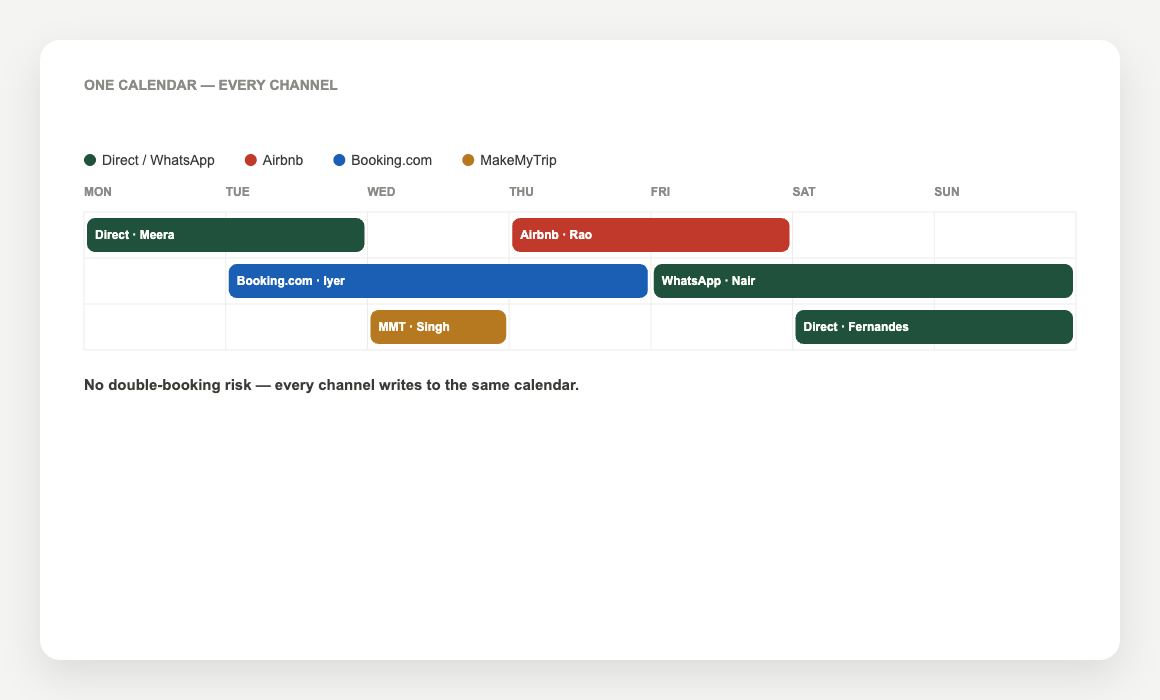
Direct bookings, WhatsApp, Airbnb, Booking.com and MakeMyTrip all write to the same calendar through iCal sync, so a room sold on one channel disappears from every other channel immediately. See how iCal Calendar Sync works.
WhatsApp that knows your rate card
Guests get an instant, accurate quote for the right room and dates, day or night. It bargains only within the floor you set and collects the advance before the room is blocked. More on the WhatsApp Booking System for Homestays.
UPI-first payments, straight to your account
Guests pay the way they already pay for everything else, UPI, card, or your own QR code and the money lands in your account directly. OpenStays is never in the funds path, so there’s no settlement delay to wait out.
Rates that don’t depend on memory
Season rates, festival pricing and the discount for a returning guest live in the system, not in your head, the same quote reaches a guest whether they message at 3pm or 3am. More on Homestay Rate Negotiation.
A public booking page that’s actually yours
Every homestay gets its own listing page with real photos and live availability. Something to share on Instagram, Google Maps or a WhatsApp status, instead of sending guests to somebody else’s app to check availability.
Guest details, without a paper register
IDs collected over WhatsApp after confirmation, filed against the booking and ready if local authorities ask for records, the same compliance backbone OpenStays built for hotels, sized for a homestay. More on Guest ID software.
Built to work on an average phone connection
The dashboard and WhatsApp conversations are designed to stay usable on a modest mobile connection, not just fast broadband, useful when your homestay is exactly the kind of scenic, out-of-the-way place where signal is patchy.
One dashboard for more than one property
Hosts running two or three homestays manage every calendar, rate card and WhatsApp conversation from a single login, instead of switching between separate accounts for each property.
WHY GENERIC SOFTWARE FALLS SHORT
Why most vacation-rental software doesn’t quite fit an Indian homestay
Plenty of booking software exists for short-term rentals and most of it was built for a different market: a host managing a listing on Airbnb, payments settling in dollars or euros and guests who message through the platform’s own app rather than WhatsApp. None of that maps cleanly onto how an Indian homestay actually operates.
- Payments assume a card gateway. Most Indian guests want to pay by UPI and a system where UPI is bolted on as an afterthought, rather than the default, adds friction at exactly the moment a booking should be closing.
- Guest communication assumes an app the guest has to download. Indian travelers overwhelmingly expect to talk to a host on WhatsApp, not through a platform’s in-app chat that neither side checks as often.
- Compliance is treated as a footnote. Guest ID collection and local reporting requirements are routine in India in a way most global tools never had to design for.
- Bandwidth is assumed to be reliable. A dashboard built for fast, constant connectivity struggles for a homestay in a hill town or a farm stay with patchy signal, exactly where a lot of India’s most-loved homestays sit.
- Pricing and support are dollar-denominated. Subscription costs, payment processing and even customer support hours are often built around a US or European day, not an Indian one.
- Bargaining isn’t accounted for at all. Indian guests routinely ask for a better rate over chat and a system with no concept of a negotiation floor either can’t handle the conversation or leaves it entirely to the host to answer by hand.
None of this makes generic software bad, it’s simply solving a different problem for a different market. A homestay booking system built in and for India starts from UPI, WhatsApp, bargaining and local compliance as defaults, not as add-ons bolted onto a product designed somewhere else.
THE MATH
How much can a homestay booking system actually save you?
Numbers make this concrete faster than percentages do. Take a four-room homestay charging an average ₹3,000 a night, running at roughly 60% occupancy across a month, about 72 booked room-nights.
| All bookings via OTA (18% commission) | Half direct, half OTA | |
|---|---|---|
| Gross room revenue | ₹2,16,000 | ₹2,16,000 |
| Commission paid | ₹38,880 | ₹19,440 |
| Revenue kept | ₹1,77,120 | ₹1,96,560 |
| Difference | Baseline | +₹19,440 that month |
That’s one month, one small property and a conservative 50/50 split, plenty of homestays that switch on WhatsApp and a direct booking page end up tilting further toward direct bookings once repeat guests and word-of-mouth referrals have a fast way to book without going through an OTA first. Across a season, that gap compounds into a meaningful amount for a property this size.
None of this counts the harder-to-price side: the booking that didn’t get missed at 11pm, the double-booking that didn’t happen, or the hour a week no longer spent reconciling three calendars by hand.
Seasonality changes the exact numbers but not the direction: a homestay in a peak-season location might see occupancy climb well past 60% for a few months and dip in the off-season, while a year-round hill-station or backwater property sees steadier demand, either way, every percentage point of bookings that moves from OTA to direct keeps a proportionally larger share of that month’s revenue, without changing what the guest pays.
BEFORE AND AFTER
A homestay owner’s Saturday, with and without a booking system
It’s easier to see what a homestay booking system actually changes by walking through the same Saturday twice.
Without one: 7:00am, breakfast prep starts. 7:20am, a missed call from a number you don’t recognize, probably a guest, but you’re mid-omelette and can’t check. 9:00am, you finally call back; the guest already booked elsewhere. 11:00am, an Airbnb booking comes in for next weekend; you update your personal calendar but forget to block the same dates on your MakeMyTrip listing. 3:00pm, a returning guest messages asking for “the same rate as last time,” and you can’t quite remember what that was. 6:00pm, you discover the MakeMyTrip listing was booked for the same dates as the Airbnb one from this morning, now there’s an awkward phone call to make and a refund to process.
With a configured booking system, routine WhatsApp enquiries can receive rates and payment links while you host your guests. Confirmed OpenStays reservations update direct availability. An external iCal block appears after the next refresh, so check pending OTA updates before accepting another stay. Your team can take over complex requests.
Nothing about the property changed between the two Saturdays, only whether the booking side of running it needed constant, interruptible attention.
SEE IT IN ACTION
A weekend booking comes in while you’re making breakfast
Meera runs a four-room homestay outside Munnar, tea-estate views, breakfast she cooks herself and no one else on staff most weeks. On a Tuesday morning, mid-omelette for the two guests checking out, her phone buzzes.
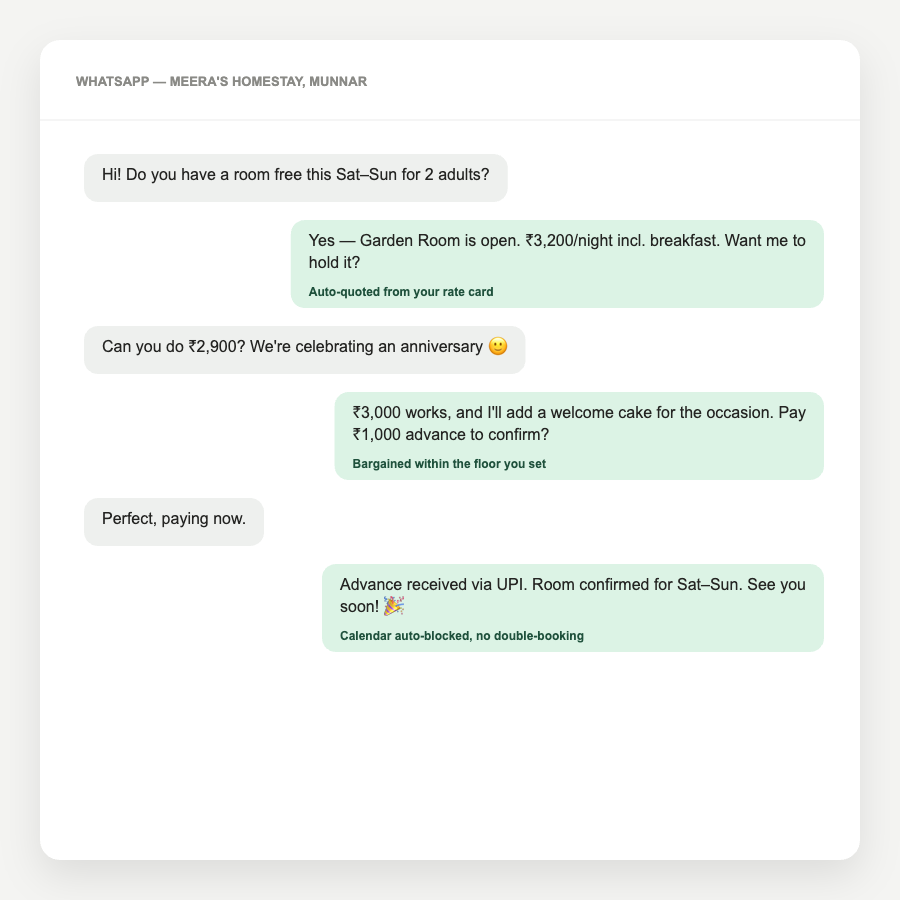
- A guest messages on WhatsApp asking for a room this Saturday and Sunday, for two adults.
- The system checks the live calendar, finds the Garden Room free and quotes ₹3,200 a night with breakfast, the actual weekend rate Meera set, not a guess.
- The guest asks for ₹2,900. The assistant offers ₹3,000 with a welcome cake thrown in, staying inside the discount floor Meera configured.
- The guest agrees and pays a ₹1,000 advance over UPI on the spot, the Garden Room disappears from Airbnb, Booking.com and every other channel the moment it’s blocked.
- Meera sees a confirmed booking with the advance already in her account when she checks her phone after breakfast service. She never touched the conversation.
Nobody hired a reservations agent. The homestay just stopped losing bookings to a phone that couldn’t be answered mid-omelette.
COMPARE
Homestay booking system vs. OTA listings vs. Spreadsheet & phone
What actually differs structurally between the three ways most homestays run today, not what any of them cost, since that depends on your property and season.
| OpenStays Homestay Booking System | OTA Listings Only | Spreadsheet + Phone | |
|---|---|---|---|
| Who answers at 11pm | The system, instantly | Whoever’s on the OTA app | You, if you’re awake |
| Commission on the booking | 0% on direct/WhatsApp bookings | 15–20% typical | 0%, but limited reach |
| Risk of double-booking | Reduced with current records; refresh delays remain | Low, within that one OTA | High, across channels |
| Guest relationship | Yours | The OTAs | Yours, but hard to reuse |
| Rate accuracy | Configured rates for direct bookings and WhatsApp | Set per platform | Depends who’s asked |
| Setup effort | Under an hour, guided | An OTA account | None and that’s the problem |
Keep the OTAs for the reach they bring, plenty of first-time guests still start there. A homestay booking system exists to catch the guest who already wants to book you directly, so that booking doesn’t have to pay a platform for an introduction that already happened.
HOW IT WORKS
Get your homestay booking system live
Setting up a homestay booking system with OpenStays takes about 30 minutes with the guided wizard, most of it is entering rooms, rates and photos you already have on hand.
Setting up a homestay booking system with OpenStays takes about 30 minutes with the guided wizard, for a typical 1–6 room property.
1. Onboard your homestay
Add your rooms, rates, house rules and photos through the guided wizard. This is also where your public booking page gets created, using the photos and details you provide.
2. Connect the channels you already use
Connect iCal feeds from channels that support them to share blocked dates with your direct calendar. Availability refreshes periodically. Rates, guest details and complete booking records do not sync through iCal.
3. Turn on WhatsApp booking
Set your rate card and how much room the assistant has to negotiate. OpenStays handles the WhatsApp Business API setup. You don’t touch the technical side and your existing WhatsApp number can usually be reused.
4. Add your payment details
UPI ID or bank account for direct settlement. Guests pay however they prefer, UPI, card or a QR code at check-in and the money reaches you the same way either way.
5. Share your booking link
Google Maps, Instagram bio, WhatsApp status, a QR code at check-in, anywhere a guest might look for you next time. Most hosts add it to their OTA listing descriptions too, for guests who look you up directly next visit.
BEFORE YOU CHOOSE
How to evaluate any homestay booking system
Most booking software is built for hotels first and adapted for homestays later and it shows. Whatever you shortlist, including this one, it’s worth asking these questions before you commit a season’s bookings to it:
- Does it assume a front desk you don’t have? A tool built for shift handovers and multi-department reports will fight you at every step on a 2–6 room property.
- Does WhatsApp actually quote from your rate card, or just forward messages to you? Forwarding isn’t automation, it’s one more inbox.
- Is payment UPI-native, or a card gateway bolted on afterward? For Indian guests, UPI should be the default, not an afterthought.
- Who owns the guest’s phone number and booking history. You, or the platform?
- Does it sync with the OTA calendars you already have listings on, or does switching mean pulling them down first?
- How long does real setup take, with your actual rooms and rates, not the demo account?
- What happens on a bad-network day? If the system only works on a strong, constant connection, it will fail you exactly when a hill-station or farm-stay property needs it most.
A vendor that answers these plainly, without redirecting to a sales call, is usually a good sign either way.
DON’T SKIP THIS
Guest ID and local compliance for homestays
It’s a common assumption that guest-identification rules only apply to hotels. In practice, many Indian states expect homestays and guesthouses to record guest identification too and in some tourist-heavy states, Himachal Pradesh, Uttarakhand, Goa and Kerala among them, homestay registration schemes come with their own reporting expectations. Requirements vary by state and by whether the property is formally registered, so it’s worth checking the specific rule for your district rather than assuming either way.
What a homestay booking system can do is make the routine part painless: collecting a guest’s ID over WhatsApp after a booking is confirmed, filing it against that reservation automatically and keeping a digital register that’s ready to show if it’s ever asked for, instead of a physical register book that’s easy to fall behind on during a busy weekend.
This isn’t a substitute for knowing your state’s specific homestay registration requirements, it’s the record-keeping layer underneath whatever those requirements turn out to be.
A practical starting point: check with your state or district tourism department (or local municipal office) whether homestays need to register separately from general trade licensing and whether that registration comes with its own guest-reporting rules. Many hosts find that once this is sorted once, keeping a digital, searchable guest record, rather than reconstructing one from memory when it’s asked for, is the part that actually saves time going forward.
LEARN FROM OTHERS
Common mistakes homestay owners make before switching
A few patterns show up again and again with homestay owners who’ve been running things manually for a while:
- Waiting for ‘enough bookings to justify it.’ The chaos of juggling channels by hand usually gets worse, not better, as bookings grow, the busiest month is the worst time to be manually cross-checking three calendars.
- Switching everything at once, mid-season. Most hosts do better connecting one channel at a time, WhatsApp first, since it fixes the most painful problem (missed enquiries) immediately, then layering in OTA calendar sync once that’s comfortable.
- Assuming automation means losing the personal touch. The whole point for a homestay is the opposite: automating the repetitive quoting and confirming frees up time for the parts guests actually remember, a personal welcome, local tips, the extra thoughtfulness a homestay is supposed to offer.
- Not telling existing OTA guests about the direct option. A line in your OTA listing description, a QR code at checkout, or a mention at check-in turns a one-time OTA guest into a repeat direct booking next time, but only if they know the option exists.
- Underpricing to compete with OTA listings shown at a discount. Once a booking is commission-free, there’s often no need to match an OTAs discounted rate, the room can be priced at what it’s actually worth and still come out ahead for both host and guest.
None of these are hard to avoid once they’re named. They mostly come from treating a booking system as a big, risky migration instead of a gradual, low-stakes switch.
QUESTIONS HOMESTAY OWNERS ASK
Frequently asked questions
What is a homestay booking system?
A homestay booking system is software that gives an independent host a single real-time calendar, a way to quote and confirm guests automatically (usually over WhatsApp) and a way to collect payment directly, replacing the separate OTA apps, spreadsheets and phone calls most homestays run on today.
How is this different from hotel management software?
Hotel software is built around shifts, departments and a front desk that’s staffed around the clock. A homestay booking system has to work for one person doing reservations, housekeeping and hosting in the same day, so the parts that matter most are automated guest replies and simplicity, not multi-department reporting.
How is this different from generic vacation-rental software?
Most vacation-rental tools were built for a global market: card payments, in-app guest chat and no built-in guest-ID compliance step. A homestay booking system made for India instead starts from UPI, WhatsApp and local compliance by default, rather than adding them on later.
Does this work for a homestay with just 1–3 rooms?
Yes, most OpenStays homestays run 1 to 6 rooms. The setup and pricing are built around a small property, not scaled down from a hotel package.
Does it work for a farm stay or a property with weak network coverage?
Yes. Guest conversations happen over WhatsApp, which is built to work on low-bandwidth mobile connections and the calendar and dashboard are designed to stay usable on an average phone rather than requiring constant high-speed data.
Do I need the WhatsApp Business API?
For automated replies, yes, the official API is what lets the system quote and confirm on your behalf reliably. OpenStays sets this up as part of onboarding; you don’t need any technical knowledge to use it.
Can I keep listing on Airbnb, Booking.com and MakeMyTrip at the same time?
Yes. iCal sync keeps those calendars in step with your direct and WhatsApp bookings, most hosts keep every OTA running and simply add a commission-free channel alongside them.
How do guest payments reach me?
Directly to your bank account or UPI ID. OpenStays is never in the funds path, so there’s no settlement delay and no cut taken from the advance or balance payment.
Is there a commission on bookings?
No commission on direct or WhatsApp bookings, that’s the core difference from an OTA. Your existing OTA listings still carry whatever commission those platforms charge, since that’s set by the OTA, not OpenStays.
Do I need to maintain a guest register or collect ID proof?
In many states, yes, homestays are expected to record guest identification much like hotels are and some tourist-heavy states run their own homestay registration schemes on top of that. IDs can be collected over WhatsApp after a booking is confirmed and filed against the reservation automatically, so there’s no separate register to maintain by hand.
Can I run more than one homestay property from the same account?
Yes, hosts running more than one property can manage each one’s calendar, rates and WhatsApp conversations from the same dashboard rather than juggling separate logins.
Does it handle Instagram DMs as well as WhatsApp?
WhatsApp is where the automated quoting, bargaining and confirming happens today. Instagram DM enquiries are common for homestays and can be redirected to your WhatsApp link so they flow into the same system rather than a separate, unmanaged inbox.
Do I still need to worry about GST or tax invoicing?
That depends on your registration status and turnover, which is worth checking with a tax advisor. Where an invoice is needed, the booking and payment records in the system make it straightforward to generate one, rather than reconstructing details from a chat thread afterward.
Does it help with pricing, including festivals and long weekends?
Yes, on both counts. Rate cards support season and festival pricing that you set and rate negotiation tools can suggest what to charge for a specific weekend based on demand, useful for pricing decisions generally, not just for quoting an incoming enquiry.
I already use another booking tool or a spreadsheet, is switching disruptive?
Most hosts switch one piece at a time, WhatsApp booking first, since it fixes missed enquiries immediately, then iCal sync for existing OTA calendars once that feels comfortable. Nothing requires pulling down existing listings on day one.
How long does setup take?
Around 30 minutes with the guided wizard for a typical 1–6 room homestay, most of it spent entering rooms, rates and photos you likely already have ready.
What if I’m not comfortable with technology?
The guided onboarding is built for exactly this, most of it is filling in details you already know (rooms, rates, photos) and WhatsApp is the same app most hosts already use daily. Support is available if you get stuck at any step.
Is my guests’ data private and secure?
Guest details and ID proof are stored against the specific booking record, not scattered across chat threads or a shared spreadsheet and used only for confirming the stay and meeting the compliance requirements described above. Guest phone numbers and booking history stay tied to your account, not pooled across other properties on the platform.
What happens if a guest wants to cancel, or there’s a dispute?
Cancellations and refunds follow whatever policy you set for your property. The system keeps each booking’s payment status on record, so processing a refund or adjusting a booking doesn’t mean re-reading an old WhatsApp thread to remember what was agreed.
Is this the same as a hotel channel manager or a property management system (PMS)?
Not quite. A channel manager typically only keeps OTA calendars in sync and a hotel PMS is usually built for a shift-based front-desk team at a larger scale. A homestay booking system combines direct booking, calendar sync, WhatsApp automation and guest ID in one system sized for an owner-operated property, it’s fine to run alongside a channel manager you already pay for, though most hosts find the built-in iCal sync covers what the separate one was doing anyway.
Does it help guests find my property, or only manage bookings once they do?
Mainly the second. This is a booking and operations tool, not a discovery engine, your public booking page and direct link are built to be shareable and searchable, but the actual discovery still comes from your own Instagram, Google Business Profile, word of mouth and any OTA listings you keep running. It earns its keep by turning a guest who already found you into a direct booking instead of a commission-bearing one.
What happens to bookings during monsoon or a quiet off-season?
Nothing about the system changes with the season, the same calendar sync, WhatsApp automation and booking page keep working whether you get five enquiries a week or fifty. Many hosts specifically use a quiet stretch between seasons to get set up, since there’s no risk of disrupting a full calendar while learning something new.
WHAT TO EXPECT
Your first month with a homestay booking system
The first thing that changes is the panic. A booking enquiry at 11pm stops being something you have to catch. It gets answered whether you’re asleep, cooking, or driving a guest to the nearest viewpoint. Rate quotes stop varying depending on how tired you are; the rate card answers instead of memory.
By the second or third week, the pattern becomes visible in the calendar itself: fewer near-misses where two channels almost sold the same room and a small but steady trickle of bookings that didn’t come through an OTA at all, guests who found you on Google Maps or Instagram and booked directly because there was finally a fast, obvious way to do it.
By the first full season, the shift is less about any single booking and more about where your time goes. Enquiries that used to interrupt breakfast service or housekeeping get handled without you; what’s left for you to do by hand are the decisions that actually need a person, whether to hold a room for a guest who’s still deciding, or how to price the one weekend a year everyone wants at once.
By the second season, the compounding becomes visible in a different way: returning guests who book directly out of habit, referrals from past guests who never had to think about which OTA to use and a rate card that’s been quietly tuned by a season’s worth of real demand instead of a single guess made on day one. None of this requires you to work more. It mostly means the work you were already doing between guests stops being interrupted by the work of managing the calendar.
Run your homestay like a system, not a scramble.
Every booking that comes straight to you instead of through an OTA is one less commission paid on a room you’d have filled anyway. Set up your homestay booking system and stop losing bookings to a phone you couldn’t answer in time.